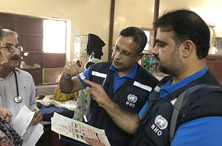


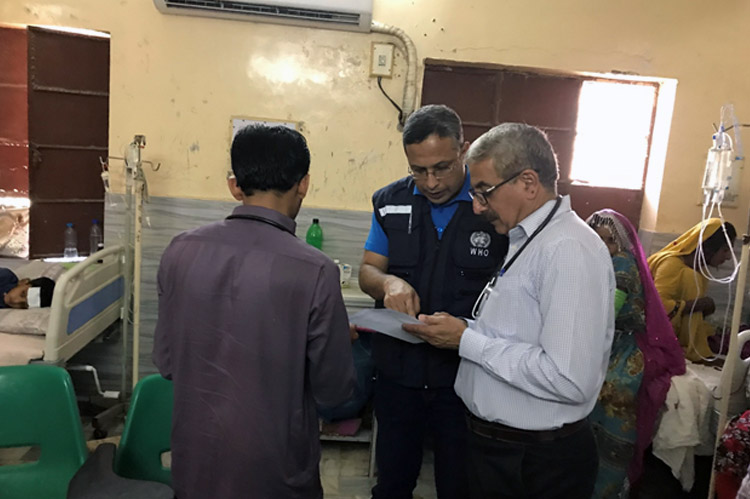
 WHO staff inspecting a health center in Pakistan, where an outbreak of extensively drug-resistant typhoid fever started in 2016 (Photo: Mamunur Malik/WHO).
Typhoid fever is a life-threatening infection of the intestinal tract and bloodstream, caused by the highly virulent bacteria Salmonella Typhi. It only lives in humans and is usually spread between humans through food or water which is contaminated with faeces. The incubation period ranges from 7-14 days on average, but can range from 3 days to two months. Symptoms include prolonged high fever, fatigue, headache, nausea, abdominal pain, constipation or diarrhea, and in some cases a rash. Severe cases may lead to serious complications or even death.
Typhoid fever is an important public health problem in many low and middle income countries, causing between 11 and 21 million cases and between 128,000 to 161,000 deaths each year. The majority of cases occur in South Asia, South-East Asia, and sub-Saharan Africa. The actual burden of typhoid fever in the Eastern Mediterranean Region of WHO remains unknown. In recent time, Pakistan experienced an extensive drug resistant typhoid fever outbreak
To prevent and control Typhoid fever, key interventions include hygiene promotion, improvement of water safety, use of safe water for all purpose, better sanitation infrastructure and ensuring adequate and timely access to patient care. The disease can be treated with antibiotics, although increasing antimicrobial resistance (AMR) is making treatment more complicated. Typhoid vaccination can contribute to reduction of antibiotics use, which will delay AMR. The typhoid vaccination play an important role to control endemic typhoid fever and outbreaks as well. Among the available typhoid vaccines, typhoid conjugate vaccine (TCV) is preferred at all ages for its improved immunological properties, suitability for use in younger children and expected longer duration of protection. However, availability of good quality surveillance data on typhoid fever is a pre-requisite for introduction of typhoid conjugate vaccine either as preventive or control strategy for typhoid fever.