Emergency Preparedness and
Humanitarian Action


Any public health situation endangering the life or health of a significant number of people and demanding immediate action. An emergency situation may result from a natural or man-made disaster or be a complete (conflict) emergency.


2008-2009 World Disaster Reduction Campaign - Hospitals Safe from Disasters - Reduce Risks - Protect Health Facilities - Save Lives

Highlights

The current situation in Yemen

The ‘sixth war’ between the Yemeni army and Shia Houthi rebels broke out on 12 August after a year-old truce collapsed.


Field visit to a IDP camp at Amran governorate: WR Dr. Ghulam Popal, H.E. Minister of Health  Dr. Abdulkareem Rasa'a and UN Resident Coordinator Pratibha Mehta.

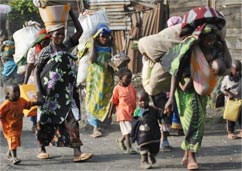
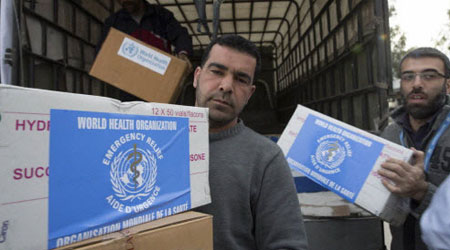
Since the fighting began nearly 120 000 people from various districts in Yemen’s northern province of Sa’ada have fled their homes to safer areas on the border with Saudi Arabia, as renewed clashes between the army and Houthi rebels escalated. The conflict has rapidly expanded to Daher, Razih, Saqayan, Shada, Maraan, Ghamar and Haydan districts in Sa’ada and the Harf Sufian district in the Amran governorate. According to recent reports, internally displaced persons (IDPs) are scattered in different locations, including Al Malahet and Al Hassama, Amran and Al-Jouf governorates. There are no accurate figures on the numbers of IDPs in Sa’ada city. There are some reports suggesting that there are approximately 30 000 IDPs in Baqim (bordering Saudi Arabia). A camp for IDPs will be established in Baqim. The WHO Country Office in Yemen has been working with the MOH since the beginning of the situation. The first medical supplies arrived in the country on  17 August. Mobile medical teams were dispatched to the field to provide medical assistance to the IDPs. Regional Office support was also mobilized to support WHO’s operation.

Situation report 10 (18 October 2009)
Situation report 9 (6 October 2009)
Situation report 8 (29 September 2009)
Situation report 7 (23 September 2009)
Situation report 6 (14 September 2009) (Arabic - French)
Situation report 5 (7 September 2009) (French)
Situation report 4 (2 September 2009) (Arabic - French)
Situation report 3 (27 August 2009) (Arabic)
Situation report 2 (20 August 2009)
Donors briefing (19 August 2009)
Situation report 1 (20 August 2009)
 

19 August 2009: World Humanitarian Day

The General Assembly of the United Nations adopted in its Plenary Session on 11 December 2008 for the 19 August to be adopted as World Humanitarian Day to honour all humanitarian workers and the United Nations staff and associated personnel who have lost their lives in the cause of duty.
Six years ago, on 19 August 2003, the United Nations Office in Iraq was bombed and 22 people lost their lives.
Among them were many humanitarian workers.
While there have been many other fatal incidents involving humanitarian personnel the General Assembly decided to commemorate the anniversary of this incident as World Humanitarian Day.
The designation of the Day is a way to increase public understanding of humanitarian assistance activities worldwide.
The General Assembly invites all countries, entities of the UN system and international and nongovernmental organizations to observe the day annually in an appropriate manner.

Pakistan: Displacement in North-West Frontier Province of Pakistan 17 June 2009

More than 4 million internally displaced people (source: Provincial Relief Commissionerate) have been uprooted from their homes in just over 2 months as a consequence of the ongoing military operation. These people are now residing in temporary camps (233 000) and in host communities (approximately 4 100 000) in North-West Frontier Province of Pakistan. Immediate funding is needed for national and international health providers in Pakistan to provide life-saving health care. The World Health Organization, UNICEF, UNFPA and 19 nongovernmental organizations, who together constitute the health cluster in Pakistan, are requesting US$ 37 million in the revised Pakistan Humanitarian Response Plan (PHRP) to provide medicines, comprehensive primary health care services, monitor outbreaks of communicable diseases, conduct health and hygiene promotion, testing of drinking-water supplies and to strengthen secondary and tertiary level referral and health care services. The health sector, so far has only received 11% of the amount requested

More information


Training of Trainers (TOT) on Hospital Vulnerability Assessment
Oman: 12 - 14 April 2009

The training was jointly organized by the Ministry of Health of Oman and World Health Organization to pilot the hospital safety index.  Three experts from EMRO and two from PAHO technically supported the event. The three days were dedicated to introduce the regional Hospital Safety Index check list, train a group of experts on hospital assessment using the index, pilot testing of the checklist and set the process of developing guidelines for evaluators at national context and priorities. One of the key recommendations made during the workshop was to modify the tool according to the country context and national standards. The inclusion of organizational structure and health workforce assessment part was welcomed by all participants in the workshop.  More than 28 people ranging from structural engineers, architects, electrical/mechanical engineers, hospital managers, public health experts, national emergency agency professionals and maintenance engineers participated in eth workshop. On the last day the two tertiary care hospitals were assessed using the checklist modified in the workshop.

Afghanistan struck by a 5.5 magnitude earthquake 

At around 2.00 AM in the early morning of April 17, 2009 an earthquake of a magnitude of 5.5 on the Richter scale followed by 5.1 magnitude aftershocks hit Nangarhar Province in the Eastern Afghanistan. The epicenter earthquake was in the Hindu Kush mountainous region near Sherzad and Hesarak districts with a respective estimated population of 60,000 and 28,000 people. Behzadkhil and Sayedkhil villages are the most affected areas. Early reports indicated that 21 people died, 59 were injured and 650 families lost their homes. Approximately 50 houses were totally destroyed. No information is yet available regarding damage to roads, public infrastructures such as health facilities and schools. The Government Disaster Tasks force is on site. The Afghan public Health Department dispatched medical kits, tents and blankets to the affected area. On April 19, WHO as part of a joint UN mission is under way to assess the situation and prepare tailored response. Meanwhile, WHO country office immediately provided an Inter-agency Emergency Health Kit to the Provincial Health Director office in Jalalabad.

Read the WHO full report
OCHA situation report number 3, 22 April 2009


Disaster Risk Reduction in Health Sector Workshop 24-26 February, 2009 - Juba, Southern Sudan

The Ministry of Health of South-Sudan with the technical support of WHO organized the first workshop on Disaster Risk Reduction in Health for 30 participants. Southern Sudan is highly prone to natural and man-made disasters such as conflicts, droughts, floods and epidemics. There are existing preparedness plans for specific diseases in southern Sudan. The current challenge however, is to develop a “all hazards approach” as this will be the only way to enhance capacity of the health sector to face all types of major risks. The workshop aimed at building in-depth understanding of the correlation between vulnerabilities, risks and hazards and developing a “all hazard approach” Disaster Management Program.

Programme
Concept note
 

Joint statement on the humanitarian situation in Darfur
6 March 2009

The Government of Sudan’s order suspending 16 non-governmental organisations (NGOs) will have devastating implications for the citizens of Darfur. Aid operations in North Sudan, the largest humanitarian emergency in the world costing over $2 billion annually, will be irrevocably damaged.

Read the full statement (English - Arabic)


UN calls for immediate access to areas in South Darfur  
12 February 2009


Khartoum 12 February 2009: UN Humanitarian Coordinator, Ameerah Haq calls for immediate access to over 100,000 civilians in Muhajariya, Sheria and Labado areas of South Darfur. International humanitarian agencies have attempted to reach the area four times since 7 February but are unable to obtain clearance for humanitarian flights.

Read the statement (Arabic - English)


Related publications


Issue 1, 30 August 2009


Lives
prepare, respond, rebuild

(pdf, 6 MB)


The WHO e-atlas of disaster risk: volume 1. Exposure to natural hazards