

Sélectionnez votre langue
Training health workers to fight COVID-19 in Sudan
Polio personnel are putting in the hours to strengthen response
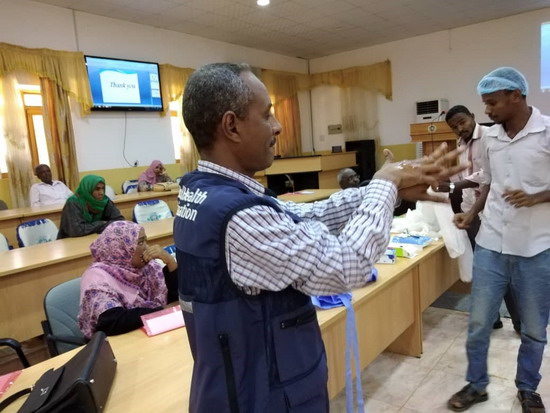 Dr Niazy trains medical staff on handwashing during a COVID-19 training session in River Nile state. Photo: WHO/Sudan
28 May 2020 – The polio eradication programme has stepped up to help the Sudanese Ministry of Health limit spread of the COVID-19 virus. The programme is working in 14 states in the country supporting COVID-19 surveillance, information dissemination and training of health workers.
Dr Niazy Abd Alhameed Abd Alwahab, a National Medical Officer for the polio programme since 2013, is one of the personnel playing a key role. He and colleagues recently led 2 WHO COVID-19 trainings in River Nile state, one for rapid response teams and one for local hospital staff, in addition to supporting training run by the State Ministry of Health.
Thanks to the training, health workers in all 7 localities in the state are ready to help individuals who are showing symptoms of COVID-19. In total, more than 3000 rapid response team members have been trained across Sudan with support from polio National Medical Officers.
By early May, River Nile state had suffered 7 cases of COVID-19, with 2 fatalities. “The state is organized to respond,” Dr Niazy explains, “All patients are being treated in dedicated isolation facilities in hospitals, and medical staff are on high alert for more cases. We helped train teams so that they are able to serve the population.”
Training rapid response teams
A 5-day training of rapid response teams, funded by WHO, was targeted at 7 teams, one from each state locality. Of the 42 individuals trained, 30 were women and 12 were men. The teams have been created for the COVID-19 response. Each team contains individuals with the collective public health experience to contribute to local efforts to fight the virus, spearheading work in contact tracing and engagement with the community.
The first day of training was attended by the Director General Health of the State Ministry of Health and the Head of the Emergency Humanitarian Assistance department.
Dr Niazy explains that over the 5 days, participants gained a comprehensive understanding of Sudan’s COVID-19 surveillance and contact tracing systems, infection prevention and control practices, case management methods, and how to collect samples and arrange shipment to the national laboratory in Khartoum. Participants were also trained on how to use PPE safely and how best to wash their hands.
“Participants were encouraged to take part in interactive exercises to test and strengthen their knowledge, as well as take part in discussions,” he says.
“By the end of the training, all participants were fully trained and able to pass on their knowledge in their localities.”
Training local health staff
The polio programme also supported a 2-day COVID-19 training for 34 women and 22 men who work in state hospitals as doctors, laboratory technicians, or other medical personnel. The programme continues to support the State Ministry of Health with further local training, including for medical registrars.
Ongoing challenges
The situation in River Nile state is very challenging. There are chronic shortages of PPE, hand sanitizer and masks, and WHO is offering urgent support to help procure these. Severe shortages of fuel and currency are making response more difficult. Social norms in some communities dissuade individuals with COVID-19 symptoms from seeking medical assistance, and work must be carried out to build trust and ensure people with COVID-19 are found and offered care.
To serve the COVID-19 response and prevent virus spread, the polio eradication programme has had to scale back some of its usual work. Dr Niazy explains, “Vaccination campaigns are paused, and many private clinics are closed, some of the public health centres are turned into isolation centres as part of the response to this emergency. This makes detecting acute flaccid paralysis (AFP) more difficult, as health personnel are trained to report children with AFP who come to the health centres.”
Efforts are being made across the Eastern Mediterranean Region to minimize the impact of COVID-19 on the overall health of populations, during a time when many health activities cannot go ahead. In Sudan, a number of children do not have full immunity against polio, and it is critical that routine immunization continues where possible until vaccination campaigns can resume.
Dr Hoda Youssef Atta, acting WHO Representative, explains, “During the COVID-19 emergency the polio eradication programme is committed to providing expertise, training and medical skills to protect Sudan. However, as soon as it is safe to do so, we must scale up programme operations once more to protect vulnerable populations from polio.”
Somalia’s polio teams help combat COVID-19
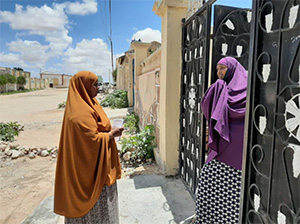 Polio programme staff are conducting disease surveillance for COVID-19 as well as educating communities on the symptoms of the virus, how to prevent transmission, and how to report suspected cases. ©WHO/Somalia4 May 2020 – “The road to the mountain village was rough. It’s only 50 kilometres, but it took more than 3 hours,” says Dr Fatima Ismail, a disease surveillance officer working in Somaliland. “We were bouncing in the car.”
In early 2020, Dr Fatima’s team headed to a remote village near Djibouti to check on a small boy. The boy’s right arm and leg showed a kind of paralysis that sometimes indicates polio. “The village polio volunteer in this mountainous area, geographically inaccessible, found an acute flaccid paralysis (AFP) case,” Dr Fatima remembers.
When children show signs of this paralysis, it’s critical to get stool samples to a laboratory to determine whether they have polio. Polio teams ride camels in the desert or donkeys in the mountains when they have to. They brave bombs to get samples out of conflict zones to laboratories. In brutally hot climates, they plug mini-freezers into car dashboards to keep samples cool.
All over the world, polio surveillance systems that have been built up over decades track infection sources, evaluate symptoms and transport samples to the laboratory — despite distance, natural disasters, and sometimes war. Now, this network of disease surveillance — reaching into the most far-flung corners of the globe — is being tapped to address the COVID-19 pandemic.
“In Somalia, the polio programme pivoted its workforce of thousands of frontline staff to support the effort as the cases of COVID-19 spread. Rapid response teams — made up of disease surveillance officers, community health care workers and volunteers — were trained to educate people about the virus and to test suspected cases. By April 2020, the teams were deployed in the field,” said Dr Mamunur Malik, WHO Representative in Somalia.
Polio eradication staff support COVID-19 response
April 2020 – Using the vast infrastructure developed to identify the poliovirus and deliver vaccination campaigns, the polio eradication programme is pitching in to protect the vulnerable from COVID-19, especially in polio-endemic countries. In Pakistan and Afghanistan, as well as worldwide, the programme is drawing on years of experience fighting outbreaks to support governments as they respond to the new virus.
Tracking the poliovirus in the Eastern Mediterranean Region
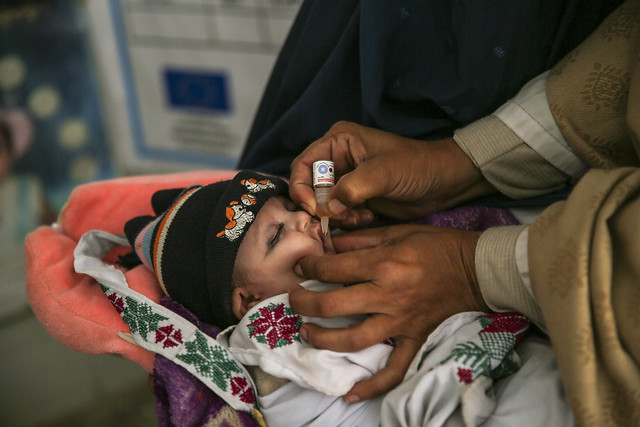 Majra Bibi gives polio drops to 10-day-old Bilal Khan at a health unit in Khyber Pakhtunkhwa province, Pakistan. The polio programme works to vaccinate every child and detect the poliovirus wherever it remains. ©WHO/Asad Zaidi
12 November 2019 -- In a rapidly expanding megacity, amongst conflict or in mountainous border areas, how does the polio programme deduce where the virus is hiding?
To eradicate the poliovirus, every child must be vaccinated. We must also detect where virus remains. The two key methods used to do this are acute flaccid paralysis (AFP) surveillance, which alerts the programme to children exhibiting the key sign and symptom of polio, and environmental surveillance, which is used to detect the poliovirus in the sewage water systems of communities. But the most skilled disease surveillance officers can go one step further.
By cross referencing AFP and environmental surveillance data with data on immunization activities, population movements and high-risk populations, surveillance officers can learn to interpret the poliovirus risk in the countries where they work. Through painstakingly piecing these clues together, they can determine where there may be a high chance of polio re-appearing.
Disease surveillance officers and data managers from across the Eastern Mediterranean Region came together across a series of workshops held in September and October 2019, to learn how to use QGIS mapping software to record the clues that help the polio programme determine where the virus could circulate. Representatives attended from many member states in the region, three levels of the World Health Organization (WHO), and from CDC STOP, the Eastern Mediterranean Public Health Network, the VPI WHO EMR team, and the UNICEF MENA Regional Office.
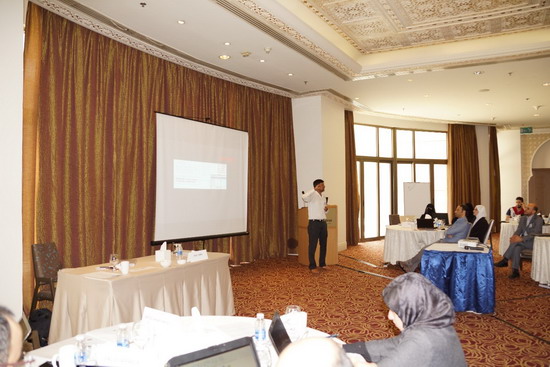 GIS and Mapping expert Ravi Santhana Gopala Krishnan presents aspects of QGIS to meeting participants. ©WHO/EMRO
QGIS is a powerful open-source Geographic Information System that supports editing, storing, analysing and displaying diverse geospatial data. The workshop taught the officers to use QGIS and mapping services in addition to other risk assessment tools to provide decision makers with a clear picture of country surveillance indicators, AFP cases, the geographical reach of routine and supplementary immunization activities, and data on accessibility and the movement of high-risk populations.
Information can be layered in QGIS to create a highly detailed virtual map with key indicators and risks for disease spread. For instance, it would allow programme officers to spot a high-risk area where there is a low level of AFP reporting, where there is high population movement, and where few vaccination campaigns have been carried out and children have low immunity to the virus.
In other words, the maps allow real time analysis of outbreak risk. This information can then be used to strategize upcoming supplementary immunization campaigns and technical surge support or make recommendations to improve programme performance.
QGIS is free, works on mobile phones, and does not require a license, making it ideal for use in resource-poor contexts where the expensive licenses required for other GIS applications are not a viable option for some users.
The workshop ultimately aimed to empower surveillance officers and data managers to create maps that will help them to spot areas of concern and develop mitigation strategies. They learnt how to overcome common challenges, for instance, how to reconcile data sets created in different programmes, and how to treat data that arrives without a dedicated GPS coordinate.
This training is just one strategy to improve our ability to prevent outbreaks and stay ahead of the virus, in some of the most challenging epidemiological contexts in the world.
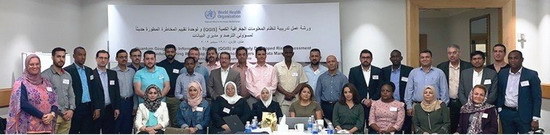 Participants at the first QGIS training, held in September 2019. ©WHO/EMRO
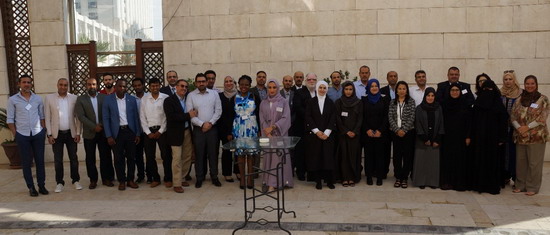 Participants at the second QGIS training, held in October 2019. ©WHO/EMRO
Related link