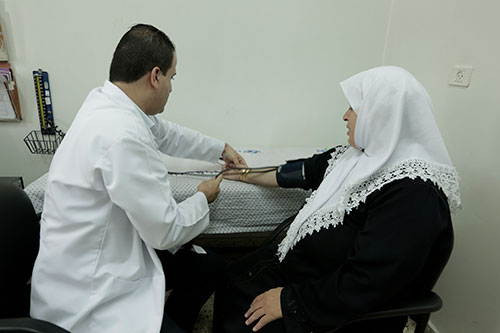
Scaling up noncommunicable disease prevention and control in occupied Palestinian territory
The burden of noncommunicable diseases in occupied Palestinian territory is increasing. Cardiovascular and cerebrovascular diseases and cancer are the main causes of death among adults. The costs of treatment care are also increasing and will rise exponentially over the coming years. A new approach is needed based on primary and secondary prevention. WHO has provided technical support to the Ministry of Health to develop a national policy and strategy to prevent and manage noncommunicable diseases.
Policy objectives: legislative, regulatory and intersectoral
There are eight legislative, regulatory and intersectoral policy objectives relating to the organization and delivery of health care services; human resource development; community participation and empowerment; the national health information system; research and development. These are to:
- strengthen the enforcement of the existing anti-smoking law and implementation of measures to reduce tobacco use
- promote and encourage a healthy diet
- promote and facilitate regular physical activity
- realign and optimize health systems for the prevention and control of noncommunicable diseases
- foster the development of the health care workforce
- empower the community to participate noncommunicable disease-related activities
- track the burden of noncommunicable diseases and health outcomes of people with noncommunicable diseases
- promote research activities to generate evidence for policy.
Surveillance
WHO has provided technical support to the Ministry of Health in conducting the first national STEP survey on noncommunicable disease risk factors, the first national Global Student Health Survey and the Global Youth Tobacco Survey (Table 1).
WHO also supported the formulation of a national strategy for a health information system. The new Palestinian National Public Health Institute will focus on noncommunicable disease data analysis, research and training.
Table 1. Results of the STEPS survey in oPt, 2010–2011
|
Results for adults aged 15-64 years |
Both sexes |
Male |
Female |
|
Step 1. Tobacco use |
|||
|
Currently smoke tobacco (%) |
20.2 |
37.6 |
2.6 |
|
Eat less than 5 servings of fruit and/or vegetables on average per day (%) |
85.9 |
85.4 |
86.5 |
|
Not engaging in vigorous activity (%) |
75.3 |
63.9 |
86.7 |
|
Step 2. Physical measurements |
|||
|
Overweight (BMI>25 kg/m2) (%) |
57.8 |
55.2 |
60.7 |
|
Obese (BMI >30 kg/m2) (%) |
26.8 |
23.3 |
30.3 |
|
Raised BP (SBP>140 and/or DBP>90 mmHg or currently on BP medication) (%) |
35.8 |
36.0 |
35.6 |
|
Raised BP (SBP>140 and/or DBP>90 mmHg who are not currently on BP medication) (%) |
24.7 |
29.2 |
20.0 |
|
Step 3. Biochemical measurements |
|||
|
Impaired fasting glycaemia |
5.8 |
5.8 |
5.8 |
|
Raised fasting blood glucose as defined below or currently on medication for raised blood glucose (%) |
8.5 |
9.5 |
7.6 |
|
Mean total blood cholesterol, including those currently on medical for raised cholesterol (mg/dl) |
177.4 |
175.0 |
179.8 |
|
Raised total cholesterol (> 5.0 mmol/L or >190 mg.dl or currently on medication) (%) |
36.5 |
35.8 |
37.3 |
Prevention
WHO has provided technical support to the Ministry of Health of oPt in: establishing a tobacco control working group; constituting intersectoral tobacco control committee; conducting the first workshop on aligning national anti-tobacco law with the Framework Convention on Tobacco Control (Article 8, 11 and 13); and strengthening the enforcement of the existing anti-smoking law and implementing measures to reduce tobacco use.
The workshop concluded in the development of a set of recommendations. These were to: revise national anti-tobacco legislation (coverage of all indoor offices, public places and work places), establish enforcement mechanisms, and engage national media sources to raise awareness of existing and future laws.
Management
Technical support was also provided to the Ministry of Health in: realigning and optimizing health systems and integrating noncommunicable disease prevention and control and assessing primary health care clinics in Ramallah and Jerusalem district, focusing on:
- organization of services
- assessment, treatment, documentation
- supplies, health education and counselling, education, monitoring and supervision
- planning to introduce the package of essential noncommunicable disease interventions in primary care) with support from
- provision of technical support and clarity to stakeholders
- two initial protocols for the integrated management of cardiovascular diseases and diabetes (heart attacks, strokes, hypertension, renal failure, amputations and blindness); and health education and counselling (tobacco, diet, physical activity and adherence to treatment).


Goal 7: Ensure environmental sustainability
Goal 8: Develop a Global Partnership for Development