

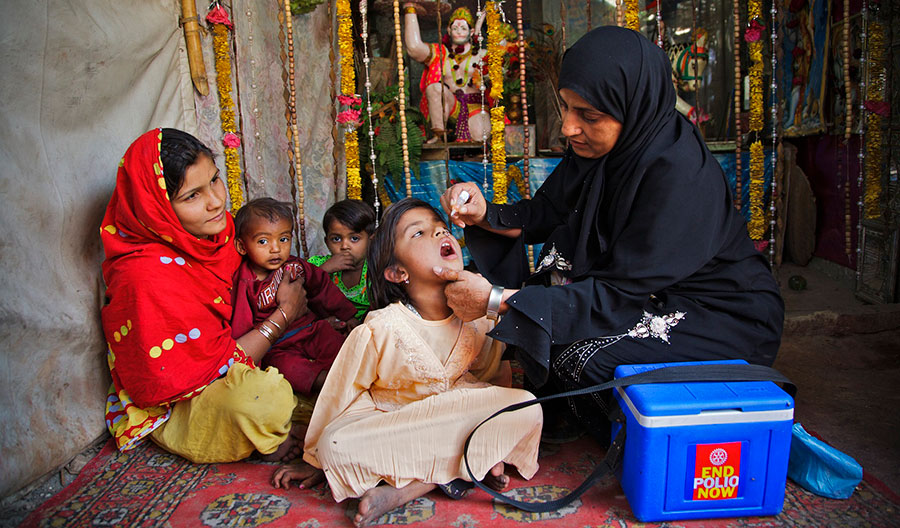
 A health worker vaccinates a child from Hindu community against polio, in-front of their holy place in her home during Polio – national immunization day in Bhakar Niger in Gulshan-e-Iqbal town, Karachi Pakistan.
Polio eradication is the permanent interruption of the transmission of poliovirus, and the elimination of the disease it causes – poliomyelitis. In order to achieve this goal, the global polio eradication programme relies on several strategies, including ensuring high immunization coverage, robust surveillance for the signs and symptoms of polio and rapid response to any detection of the virus.
The regional context
The Eastern Mediterranean Region, the last WHO region where wild poliovirus (WPV) transmission continues, is home to many of the challenges that have defined polio’s endgame. In order to halt transmission, immunity levels across the Region must be raised to the point that the disease cannot infect any child. But vaccinating that many children is complex and raises its own challenges around accessing communities, the role of gender, and the function of goods or services beyond vaccination.
Disease surveillance is another critical aspect of eradication: robust and reliable surveillance is the only way to be sure that the virus is not circulating in communities, but this can be challenging in areas the programme is not able to fully access.
There is also the work of setting policy around how the virus will be contained and how certification of eradication will work once the world sees its last case. This forward planning is a critical part in the last mile.
WHO, the GPEI partnership and the 2022–2026 strategy
The World Health Organization (WHO) takes a leading role for the implementation of health and immunization programming, including polio, through the Global Polio Eradication Initiative (GPEI). The GPEI is a public-private partnership led by national governments with six partners – the World Health Organization (WHO), Rotary International, the US Centers for Disease Control and Prevention (CDC), the United Nations Children’s Fund (UNICEF), Bill & Melinda Gates Foundation and Gavi, the Vaccine Alliance.
The GPEI strategy 2022–2026 builds on recent lessons learned from the last three decades and sets out the needed approaches, tactics and tools, particularly in the COVID context. Priorities include a focus on filling gaps in operations and community engagement in endemic countries (microplanning, social and programmatic suitability of human resources, social mapping and alliance building, and data-driven, high-level accountability), adjusting operational resilience and access negotiation strategies to the evolving context in Afghanistan, and intensifying government ownership and oversight in Pakistan. The use of novel oral polio vaccine type 2 (nOPV2) also features prominently.
Programme areas central to eradication
These are the key programme areas bringing us closer to eradication in the Eastern Mediterranean Region:
Another critical area of work is around how gender shapes the delivery and impact of health interventions. The latest research, activities and results in this area are on the GPEI Gender page.
To learn more about polio eradication and the GPEI’s work, take the Open WHO free online course Introduction to Poliomyelitis and the Global Polio Eradication Initiative.