


While 94% of global malaria cases occur in the WHO African Region, the WHO Eastern Mediterranean had an estimated 11.1 million cases and 22 000 deaths in 2024.
Eastern Mediterranean Region
In the WHO Eastern Mediterranean Region, 14 countries are free of indigenous malaria and are at the stage of prevention of re-establishment of local transmission. There are 6 high malaria burden countries in the Region: Sudan has the highest burden, followed by Somalia, Yemen, Pakistan, Afghanistan and Djibouti, respectively.
Epidemiology
In 2024, the WHO Eastern Mediterranean Region reported 4.6 million malaria cases (presumed and confirmed), of which 69.9% were confirmed, an increase from 18.8% in 2015. A total of 772 malaria deaths were reported. Children aged under 5 years accounted for 17.3% of reported cases and 18.1% of deaths. Females accounted for 46.3% of cases and 55.1% of deaths. Almost two thirds of cases were due to P. vivax. In 2024, there were 11.1 million estimated malaria cases and 22 100 estimated malaria deaths.
4.6 million
The WHO Eastern Mediterranean Region reported 4.6 million malaria cases (presumed and confirmed) in 2024.
69.9%
Of all reported cases, 69.9% were confirmed, a significant increase from 18.8% in 2015.
772 deaths
A total of 772 malaria deaths were reported in the region in 2024.
The malaria burden was mainly concentrated in the Sudan (44.6%) and Pakistan (28.4%), which together accounted for almost three quarters of the region’s malaria burden, followed by Yemen (12.3%). Saudi Arabia has continued its progress towards elimination, reporting 4 consecutive years of zero indigenous malaria cases. Egypt was certified malaria free in 2024. However, none of the remaining seven endemic countries in the region are on track to meet the GTS 2025 targets for incidence and mortality, with significant increases seen in six of them.

Interventions and biological threats
In 2024, ITN mass campaigns were implemented in Afghanistan, Pakistan, Somalia and Yemen. However, in Afghanistan, the Islamic Republic of Iran, Somalia and Yemen, there has been confirmed resistance to at least one insecticide class from one site since 2020.
Funding
Total malaria funding decreased by 27% between 2015 and 2024, from US$ 152 million to US$ 111 million; the domestic funding share declined from 36% to 21%.
Key challenges
Countries in the WHO Eastern Mediterranean Region continue to face complex challenges that undermine malaria control, surveillance continuity and elimination efforts. Ongoing conflict, large-scale population displacement and recurrent climate-related disasters disrupt health service delivery, weaken surveillance systems and increase vulnerability to malaria transmission. The 2025 ITN mass campaign in the Sudan exemplifies these difficulties: mass displacement due to conflict complicated microplanning, while continued insecurity hindered accessibility and overall campaign operations, leaving 32 localities across three states still to be reached. Stagnant or declining funding, particularly from domestic sources, further threatens programme sustainability and innovation – a concern compounded by the global reduction in malaria financing in 2025. The resurgence of local malaria transmission in the Islamic Republic of Iran since 2022 demonstrates the fragility of elimination progress, especially in countries bordering endemic areas where population movement and constraints such as economic sanctions limit access to essential interventions. At the same time, the rising burden of other vector-borne diseases, particularly dengue, has placed additional pressure on health systems and diverted already limited resources away from malaria control.
Key successes
Despite the region’s challenges, Egypt was certified as malaria free in 2024, becoming the first country in the region to do so since Morocco in 2010 and the United Arab Emirates in 2007. Oman and Qatar are preparing for certification. In the Sudan, more than 12.5 million ITNs – representing 81.2% of the total planned distribution for 2025 – were delivered across 11 states and partially in the eastern sector of South Kordofan, reaching 109 of 141 targeted localities despite a highly challenging operating environment.
In November 2024, the Sudan also became the first country in the WHO Eastern Mediterranean region to introduce the malaria vaccine. To the end of October 2025, the vaccine had been administered to more than 930 000 children in 15 localities in Gedaref and Blue Nile states, with expansion to an additional 20 localities planned for December 2025. These achievements were supported by strong political commitment, domestic resource mobilization and contributions from local communities. Regionally, countries have introduced and and scaled-up the malaria vaccine, enhanced surveillance for pfhrp2 gene deletions and advanced the integration of malaria and other vector-borne disease programmes, leading to improved efficiency in coordinated responses.
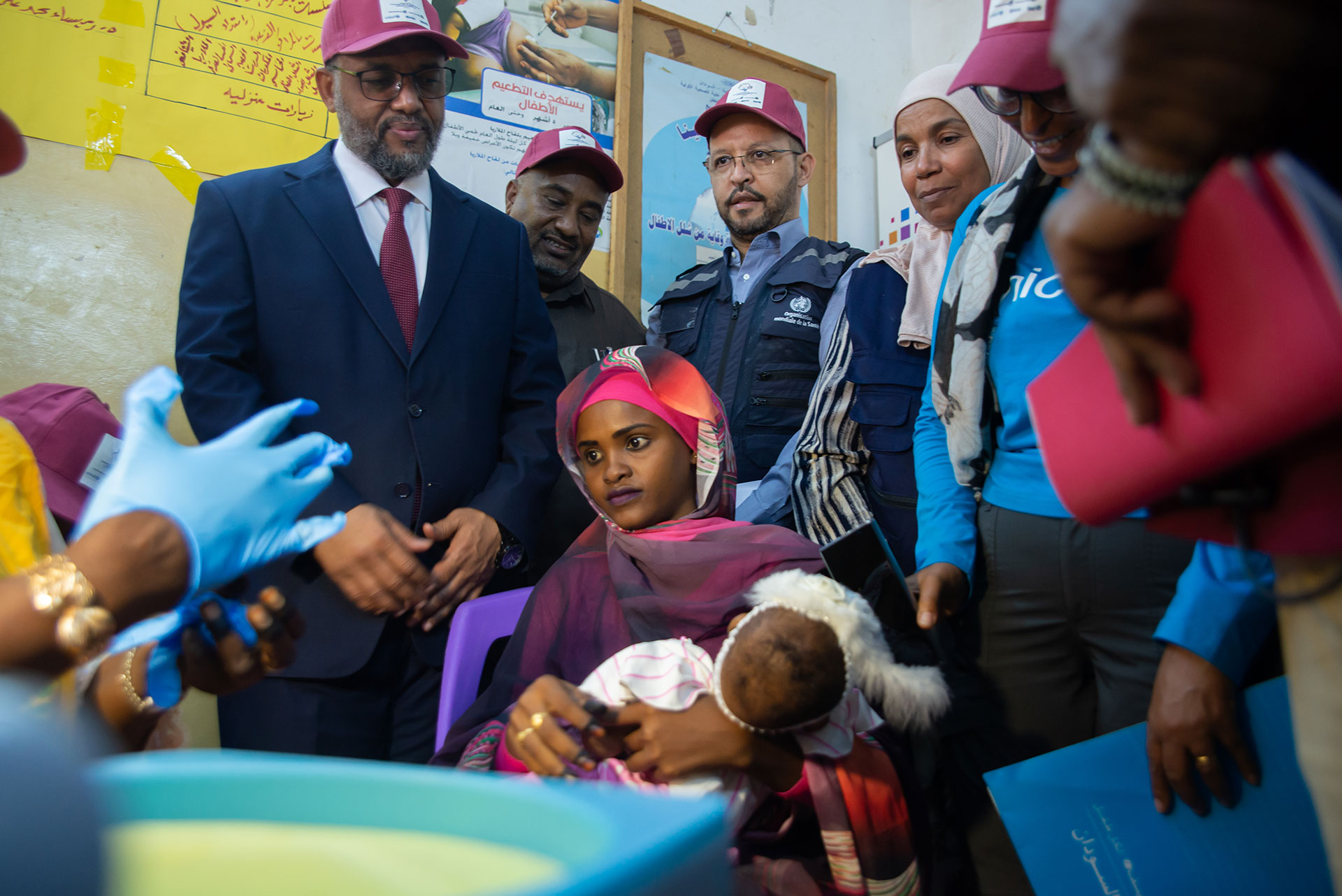 Sudan rolls out first malaria vaccines. Photo credit: WHO
Lessons learned The region’s experience emphasizes that reintroduction and reestablishment of malaria transmission remain a real risk, even after years without indigenous cases. Sustained vigilance, robust cross-border collaboration and locally tailored interventions are essential to prevent re-establishment. Stable and predictable domestic financing, coupled with high-level political commitment, forms the foundation for longterm success – when funding stagnates, progress slows. The 2025 ITN campaign in the Sudan also highlights that strong political leadership, coordinated partner support and engagement of local communities are critical for maintaining operations under crisis conditions. Furthermore, regional inequities require tailored approaches: malaria free countries need to prioritize prevention of reintroduction through sustained surveillance and cross-border cooperation, while highburden and crisis-affected countries require humanitarian and climate resilient health systems, strengthened preparedness and adaptable interventions to sustain gains and advance towards elimination.
Resources
Global Health Observatory: malaria
Malaria action plan for the Eastern Mediterranean Region 2022–2030
Egypt is certified malaria-free by WHO
Pakistan malaria news


