


Select your language

The Frontline Shift
The Frontline Shift is a podcast by WHO in the occupied Palestinian territory that examines one of the most complex emergency health responses in the world: Gaza.
Through firsthand accounts from emergency medical teams, coordinated and deployed by WHO, the short series revisits key moments from the two-year conflict between October 2023 and October 2025, as well as the ongoing health response.
Each episode explores how health workers delivered care amid access constraints, power outages, severe shortages of medical supplies, and hostilities, while working to maintain essential services. It also highlights the challenges they continue to face and the needs related to rehabilitating and rebuilding the health system.
Focused on operational realities and lessons learned, The Frontline Shift offers insights into what it takes to sustain a health system under extreme pressure.
The podcast is intended for medical and humanitarian professionals, as well as listeners seeking a deeper understanding of health response challenges on the ground in the Gaza Strip.
Hosted by:
Dr Egmond Evers, Health Emergencies Team Lead, WHO occupied Palestinian territory
Dr Luca Pigozzi, Acting In Charge Gaza, WHO occupied Palestinian territory
Production:
Bisma Akbar, Team Lead Communications, WHO occupied Palestinian territory
Qasem Tobal, Communications Officer, WHO occupied Palestinian territory
Episodes
 A health worker examines a child at a primary health care centre in Gaza
Episode 3: Delivering Primary Healthcare in Gaza
After two years of conflict, more than 42,000 people in Gaza are living with potentially life-changing injuries, including over 5,000 amputations and thousands of spinal cord injuries, burns, and complex limb injuries.
In this episode of Frontline Shift, health workers from NORWAC — an emergency medical team working in coordination with WHO in the Gaza Strip since February 2024 — alongside a WHO rehabilitation specialist, discuss the urgent needs, gaps, and challenges in expanding access to physical rehabilitation services. They share how the lack of functioning services and essential assistive devices is affecting patients’ recovery, independence, and quality of life.
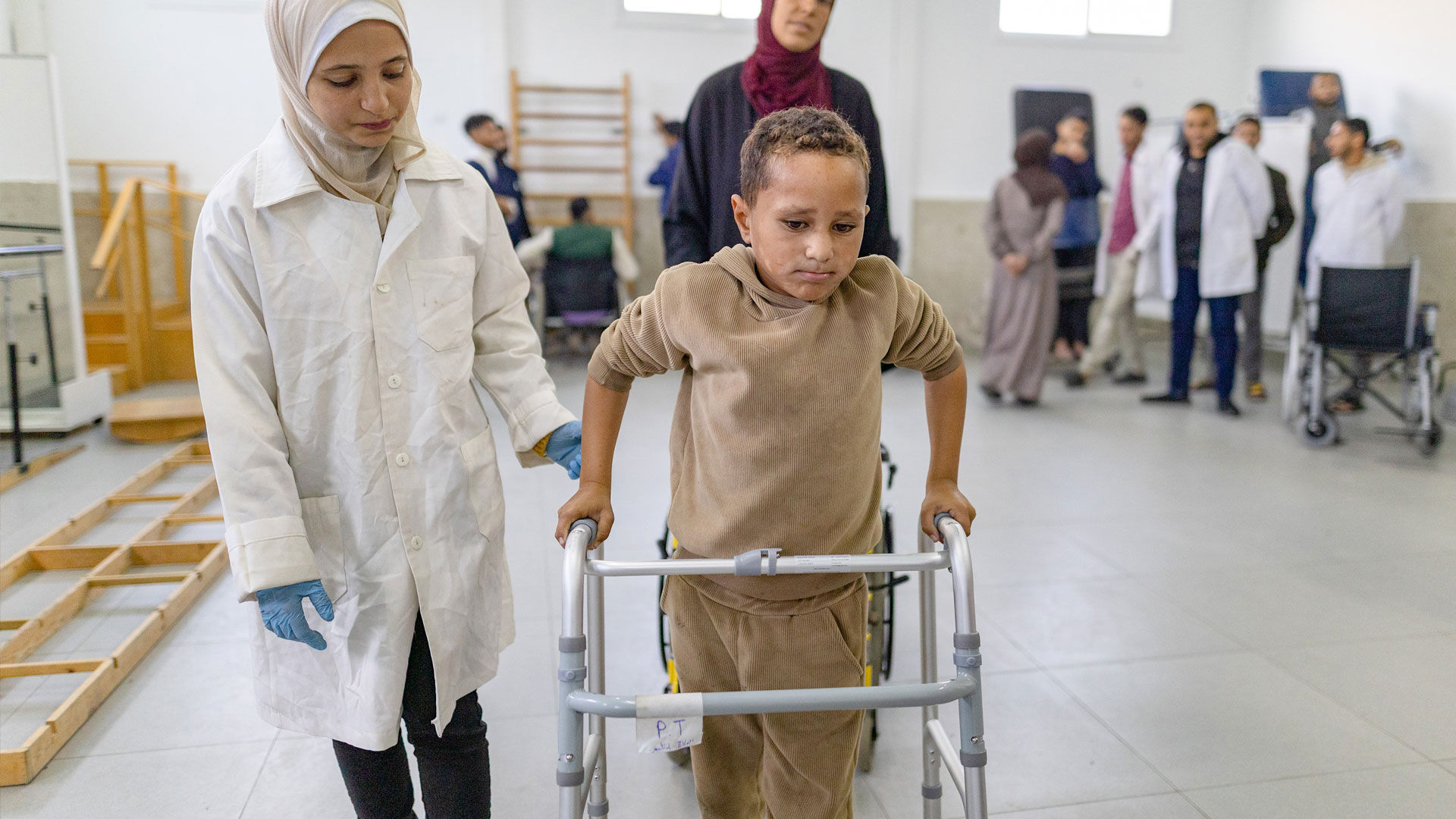 A young patient injured during the conflict in Gaza receives physical rehabilitation at Al-Amal PRCS Rehabilitation Hospital
Episode 2: Supporting Rehabilitation Needs
After two years of conflict, more than 42,000 people in Gaza are living with potentially life-changing injuries, including over 5,000 amputations and thousands of spinal cord injuries, burns, and complex limb injuries.
In this episode of Frontline Shift, health workers from NORWAC — an emergency medical team working in coordination with WHO in the Gaza Strip since February 2024 — alongside a WHO rehabilitation specialist, discuss the urgent needs, gaps, and challenges in expanding access to physical rehabilitation services. They share how the lack of functioning services and essential assistive devices is affecting patients’ recovery, independence, and quality of life.
 CADUS team members transfer a patient at Kamal Adwan Hospital to southern Gaza for further medical care
– April 2024
Episode 1: Patient Evacuation During Conflict
In this episode of The Frontline Shift, health workers from CADUS, an emergency medical team working in coordination with WHO in the Gaza Strip since February 2024, share experiences from the field.
The episode examines the challenges of patient transfers during conflict, including internal transfers from unsafe hospitals to facilities offering relative safety, medical evacuations via the Kerem Shalom Crossing for treatment abroad, and the emergency response to mass casualty incidents during food distribution.
Drawing on firsthand experience, CADUS team members highlight the challenges of access constraints, equipment shortages and prolonged delays, offering practical insight into what it takes to move patients safely and sustain care in an active conflict setting.
Upcoming episode

