


Published: 5 January 2026
 CADUS team members transfer a patient at Kamal Adwan Hospital to southern Gaza for further medical care
April 2024
Nothing about moving patients in Gaza is predictable — every transfer is a medical, operational, and emotional challenge.
In this episode of The Frontline Shift, health workers from CADUS, an emergency medical team working in coordination with WHO in the Gaza Strip since February 2024, share experiences from the field.
The episode examines the challenges of patient transfers during conflict, including internal transfers from unsafe hospitals to facilities offering relative safety, medical evacuations via the Kerem Shalom Crossing for treatment abroad, and the emergency response to mass casualty incidents during food distribution.
Drawing on firsthand experience, CADUS team members highlight the challenges of access constraints, equipment shortages and prolonged delays, offering practical insight into what it takes to move patients safely and sustain care in an active conflict setting.
Guests
Ayvery Cox, Head of Mission, CADUS
Amar Mardini, Medical Lead, CADUS
Matthew Whiting, Critical Care Paramedic, CADUS
Transcript
Egmond Evers (00:00:00)
Welcome to the first episode of the Frontline Shift, a podcast that takes you inside the heart of one of the most challenging health responses in the world. I'm your host, Doctor Egmond Evers, health emergency team lead for WHO in the occupied Palestinian territory.
Luca Pigozzi (00:00:20)
And then Doctor Luca Pigozzi, acting in charge for the WHO office in Gaza.
Egmond Evers (00:00:27)
In this series, we're stepping into Gaza to revisit some key moments of the emergency response in this two-year conflict. We'll discuss lessons learned and hear firsthand from emergency medical teams who delivered care in impossible circumstances.
Luca Pigozzi (00:00:38)
WHO has been coordinating the emergency medical teams in Gaza since December 2023. Since then, we have identified critical gaps in care and coordinated the entry and deployment of EMTs inside Gaza. The aim is simple but urgent to provide surge capacity to health systems struggling to keep services running amid violence, staff shortages and severe supply constraints.
Egmond Evers (00:01:05)
The journey has been challenging. Surgeons have operated through power cuts, doctors and nurses have cared for patients with little medical supplies. Medical teams have moved patients to safety through battlefields.
Luca Pigozzi (00:01:16)
Two years on, EMTs have stood shoulder to shoulder with Gaza health workers and ceasefire holds. They are now an integral part of rehabilitation and reconstruction efforts.
Egmond Evers (00:01:27)
This is a story of resilience, of medicine under fire, of what it takes to keep a health system standing when everything around it is falling apart. This is the frontline shift.
With us today are our colleagues from CADUS, an emergency medical team, which has been working together with WHO in Gaza since February 2024. Speaking from Gaza, we have Avery Cox, Head of Mission for CADUS, Amar Mardini, Medical Lead, and Matthew Whiting, Critical Care Paramedic.
Luca Pigozzi (00:01:58 )
Welcome, colleagues. Before working in Gaza, CADUS has many experiences in working in conflict zones, such as Ukraine and Sudan. Avery, what has the experience been like working in Gaza?
Avery Cox (00:02:11)
I would say especially having come directly from working on medevacs in Ukraine with CADUS, it's just, a it's a much more restrictive environment. So it's restrictive on when it comes to movements, and especially resources. So getting medical supplies for our team and restocking medical supplies, when it comes to having a fleet of ambulances, maintaining them, getting spare parts or even getting new ambulances has been extremely difficult. We've been running two ambulances and we're down to one at the moment just because it's so hard to get the spare parts and to get additional ambulances in at any given time.
Luca Pigozzi (00:02:54 )
In Gaza, CADUS has been one of the most critical EMTs in the response. They have supported pre-hospital care and trauma stabilisation points as well as supporting medical transfers and patients evacuations Since February 2024.
Egmond Evers (00:03:09)
Medical transfer and medical evacuation are critical functions of EMTs in a conflict like Gaza. Since the start of the war there have been over 20,000 internal transfers, meaning transfers within Gaza from hospitals that are unsafe into relative safety, and medical evacuation of over 10,000 patients from Gaza to other countries. CADUS has supported a lot of this.
Luca Pigozzi (00:03:31)
Avery, in time you have spent in Gaza, what has been the one pivotal or defining moment of your service there?
Avery Cox (00:03:39)
There have been a lot of pivotal moments, I'd say, but the siege of Kamal Adwan is what immediately comes to mind for me. We went there several times, especially early on. A lot of these missions were denied. Even when we did get access, after a number of attempts, evacuations from Kamal Adwan were never straightforward. They were always difficult.
The first time that we went and were successful at evacuating a patient, it was a ventilated child. While we were waiting for clearance to continue to Al-Shifa, while at Kamal Adwan, we actually had to bring the patient back up to the ICU because we were running out of oxygen in the ambulance. When clearance finally came, we then got stuck at the first holding point for several hours, which meant that we then were becoming critically low on oxygen once again.
It's missions like this. Every mission in and out of Kamal Adwan was extremely challenging medically, operationally, and especially emotionally for the team. Nothing about it was predictable.
Egmond Evers (00:04:45)
This has really been an unusual crisis where medics have dealt with situations that aren't typical, even in crisis situations. We've seen healthcare coming under attack and had to move patients from health facilities under siege.
Luca Pigozzi (00:04:57)
Yeah. In 2025, three key hospitals in North Gaza (Al-Awda, Indonesian, Kamal Adwan) were besieged necessitating transfer of patients. WHO, together with CADUS, conducted several missions to support these hospitals and keep them as functional as possible.
Amar, take us back to one of these missions you've been part of and walk us through some of the extraordinary challenges you faced.
Amar Mardini (00:05:26)
Yeah, I guess the mission to Al-Awda Hospital and the Indonesian Hospital. I will always keep in mind when I get home. It was incredibly difficult to reach the hospitals. It took us several hours just to get there. The roads were blocked by debris and we had sometimes to clear the way with our hands and a shovel. And even if we did that, we got stuck with our ambulance. We had to be towed by one or another of another car. And when you finally reached the hospital, it was chaos.
Sometimes it was engineers dismantling the equipment in the hospital. We try to treat some of the staff members, which were from the hospital, which were stuck there for days and needed some treatment.
The patients, We once had a patient which had a severe brain injury, and I was thinking about how should I get this patient back to the next hospital on this roads without causing him more injuries? And even if we manage to load the patients to the ambulance? I remember one time at Al-Awda hospital, for example, we just got the patients into the ambulance. We're talking about two, three patients at the same time with some relatives in the ambulance. And then suddenly a military activity started in just in front of us, so we had to wait until we could go back. And it went on for hours. And I remember back then I was thinking, did we do something wrong? Because it was probably safer for the patients in the hospital. We were stuck there. You could see the patients in the ambulance. They got nervous, they were anxious, and we tried to emphasize that we are here in a corridor. This is an authorized mission.
On the way back, it was the same thing. We had to cross the same roads. Sometimes we had to change the route because it was just not feasible to get to the other point. And one mission, we had to be towed to the full length to the hospital with our ambulance, all while we had a patient who was not stable. We had situations where we run out of our equipment in the ambulance. We were talking about oxygen. A way which you usually would have probably taken twenty, thirty minutes took us hours. We tried to have as much oxygen in the ambulance as we could, but at one point we just ran out of oxygen and it was difficult to handle those situations.
Also, while we were at Indonesian Hospital, I remember there's one situation when we just went to Al-Awda [Hospital] and went back. Then we headed to Indonesian Hospital and there was a patient on the way. When we had to rescue him from, honestly, it looked like a desert of concrete. It was just insane to even reach him. We had to shout for him. And then finally we found him. It was a patient in a wheelchair, and there was no way we could transport him to the ambulance. So we had to carry him on the back to our ambulance.
Egmond Evers (00:08:35)
Those are really some gripping stories, Amar.
Even now with the ceasefire, the medical needs in Gaza far outweigh the available services. As we said, there have been over 10 000 people who have already been evacuated to countries like Egypt, Jordan, Qatar but also some to Europe. There are still 18 000 priority patients awaiting medical evacuation for care elsewhere.
In the past, before the war, patients would be able to receive care outside of Gaza, in the West Bank and East Jerusalem. But that route is currently closed. The Rafah border with Egypt is closed right now as well. Right now medical evacuations to other countries are the only option for care that’s not available in Gaza. CADUS to support WHO with those evacuations. Tell us a bit about that work. What moments really stick in your mind?
Amar Mardini (00:09:25)
Yeah, maybe I start with comparing it to the last ceasefire. I remember during the last ceasefire, we did six times a week evacuations to the Rafah border, and those evacuations were always stressful. We faced quick handovers of the patients at the hospitals. Usually we had to deal with alternative medications because of the scarcity of the first line medications.
And as Avery said before, the toll on our ambulance back then was heavy. The maintenance was a big problem. But most importantly, again, it was the roads. It was very difficult even, to severe injury, to transport a severe injury to the border. Sometimes I felt like the helmet I was wearing during these missions was not to protect me from bullets or something like that, but because it kept bumping in the ambulance against all the stuff we have over there. And if we look at the moment for example, we are still not back to the previous ceasefire conditions. We are due around one medevac per week at the moment.
We get the patients the night before at a field hospital, around 20 to 40 patients and with their companions, which is in total around 120 to 180. We take care of the medical needs over the night and sometimes we have nights where we work until the early morning because we have to do wound dressings and anesthesia, and sometimes we face patients with known epilepsy which haven't taken their medications for a couple of days. So we have to figure out how to get these medications before the transport. And this is all because there's still this shortage of medications around.
Recently we see a lot of PTSD cases. Last time on the last medevac, I saw a five-year-old boy, was suffering from a blast injury from several blast injuries. He lost a hand and had a wound on his left limb, and the wound dressing was done for two weeks, so we had to change it. And just to be able to touch the boy, we had to give him some sedation because otherwise we wouldn't be able to do the wound dressing. And this just showed me how much more than just the medical side. Also, now we have, we treated the medical parts, but we also kind of still, we only see the beginning of the mental issues over here.
Early in the morning, we usually then load the patients into the ambulances and buses. And I remember, for example, one time where a mother tried to hide one of their children under the bus seat because she was only allowed to take three companions with her, and she had to choose between her mother and one of the kids. And she, it took a lot of talk from the side of the WHO with her, and at the end she decided to stay. I'm sometimes I'm glad that I am not native Arabic speaking because it's hard. It's really hard for the people who could understand this conversation because I don't know what I would do.
And then again, the missions at the moment are difficult because we still face a lot of delays. We have to stop at checkpoints, we have to wait for hours. There was one medical equation where we were stuck at the border crossing for ten hours, almost ten hours, with nine ambulances of the Palestinian Red Cross Crescent and one of our ambulances. And I remember back at that time, the whole fleet was not more than 15 to 18 ambulances of the of PRCS [Palestine Red Crescent Society]. So half of the fleet were stuck for ten hours at the crossing, which meant the first responders had just half the capacity at that moment.
This is all the things we have to think about when we do these missions in this kind of conflict at the moment.
Egmond Evers (00:13:39)
You mentioned a shortage of medicines and supplies. Could you tell us about a time when you've had to improvise, when you didn't have the supplies available?
Amar Mardini (00:13:48)
I remember when we had evacuations where we knew we would not meet the needs we will face at that time. So we had to ask several partners in the field if they could supply us or help us with the supplies. At that time, just to be prepared in case we need it. And also when we reach the hospitals, many, many times we saw patients which were from the ICU, which were already taking medications, which is not first line. So we had to change the medication just and it was all in a in a very shortly manner. We had to do that just before we had to leave. So it was it was difficult. It was very difficult.
Luca Pigozzi (00:14:29)
Another major challenge of the conflict in 2025 was the severe blockade of humanitarian aid, including food – leading to violence, looting and mass casualties. With the support of WHO, CADUS positioned its ambulances near convoy entry points (Mouraj corridor) between Rafah and Khan Younis, to provide immediate rescue to the casualties. Matthew, could you give us some examples of some of the casualties you came across?
Matthew Whiting (00:15:08)
Yeah, absolutely. The Mouraj corridor was very difficult. Large numbers of children and adults seemed to be just swarming the aid trucks, trying to secure food for their families. On one occasion, we were there for maybe two, two and a half hours. In that time, with 37 patients, including fatalities. Many patients had multiple traumatic injuries. Sadly, this was prolonged and delayed transport due to the arranging for external ambulances from our partners to come and collect them and take them to hospitals.
During the time on the Mouraj, we became very quickly overwhelmed with patients and were forced to take patients outside. And obviously outside at that time, it was 30, 35 degrees with no shade for them and providing prolonged field care for these patients. A lot of them eventually managed to get onto the hospitals. They went via ambulances from the PRCS. We had some taken away on donkey carts. We had some go in taxis. It was just very lucky that there was a lot of supporting people around who would happily evacuate our patients. But as I said this, you can see why they were trying to get the aid. Because these people, the children, the adults have had nothing for months and were just desperate to feed their families.
Egmond Evers (00:16:30)
Matthew – As CADUS, you all have a wealth of experience from the past two years. For new EMT colleagues coming in, what advice would you have?
Matthew Whiting (00:16:41)
I think the main thing for new staff coming into Gaza, they have to come with an open mind. They have to come prepared to see sites that you're not going to see anywhere else in the world. See desperation that I've not seen in other conflict zones around the world. I think you need to have a good support mechanism back home, so that on your wobbly days you can phone someone. CADUS, we're very lucky, we've got a wellbeing team, and we're a close knit team, so we all rely on each other for sort of psychological emotional support. But I think the main thing in Gaza, you need to be flexible and open to change. No two days are ever the same in Gaza.
Luca Pigozzi (00:17:23)
Since the beginning of the conflict. The emergency medical teams assisted more than 3.5 millions of patients across the entire Gaza Strip, surging and supporting the health system in Gaza at all levels of care in future. The emergency medical teams will continue to be critical and support local health care workers in further developing their skills and contribute significantly to the early recovery efforts in Gaza.
Egmond Evers (00:17:57)
Thanks so much to all of you, for taking some time in between your shifts here in Gaza to share your experiences and for the great work that you’re doing. This has been insightful and inspiring.
Hopefully the ceasefire will last – if so, we will move into a new phase here in this emergency where we focus more on rebuilding the health system. We will come back to that in the coming episodes. We will be back soon to discuss that and other aspects of this emergency response.
This has been the frontline shift. These are your hosts Egmond and Luca signing off.
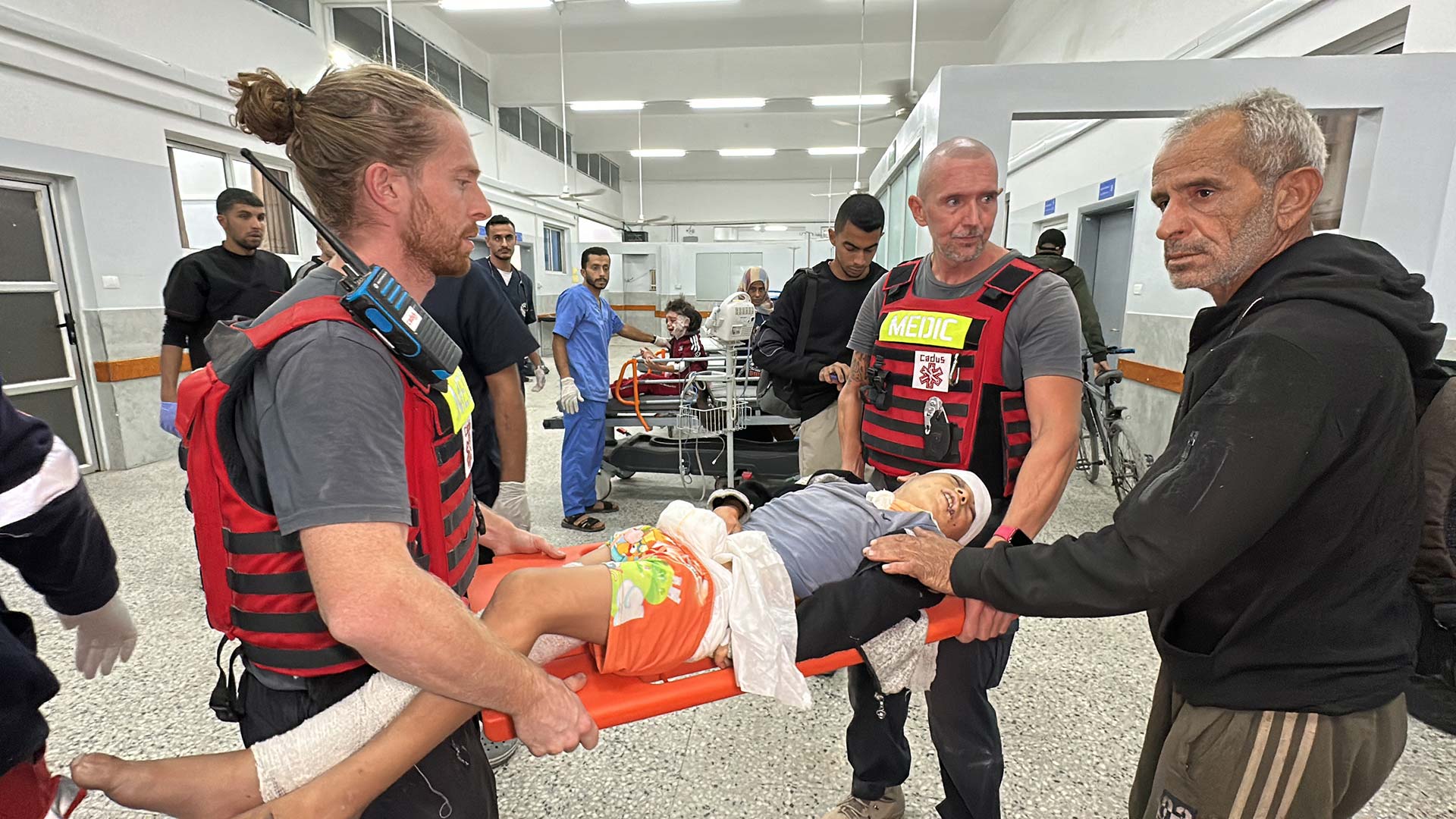 CADUS team members transfer a patient from Al-Shifa Hospital to southern Gaza for further transport for medical evacuation abroad
October 2024.
