


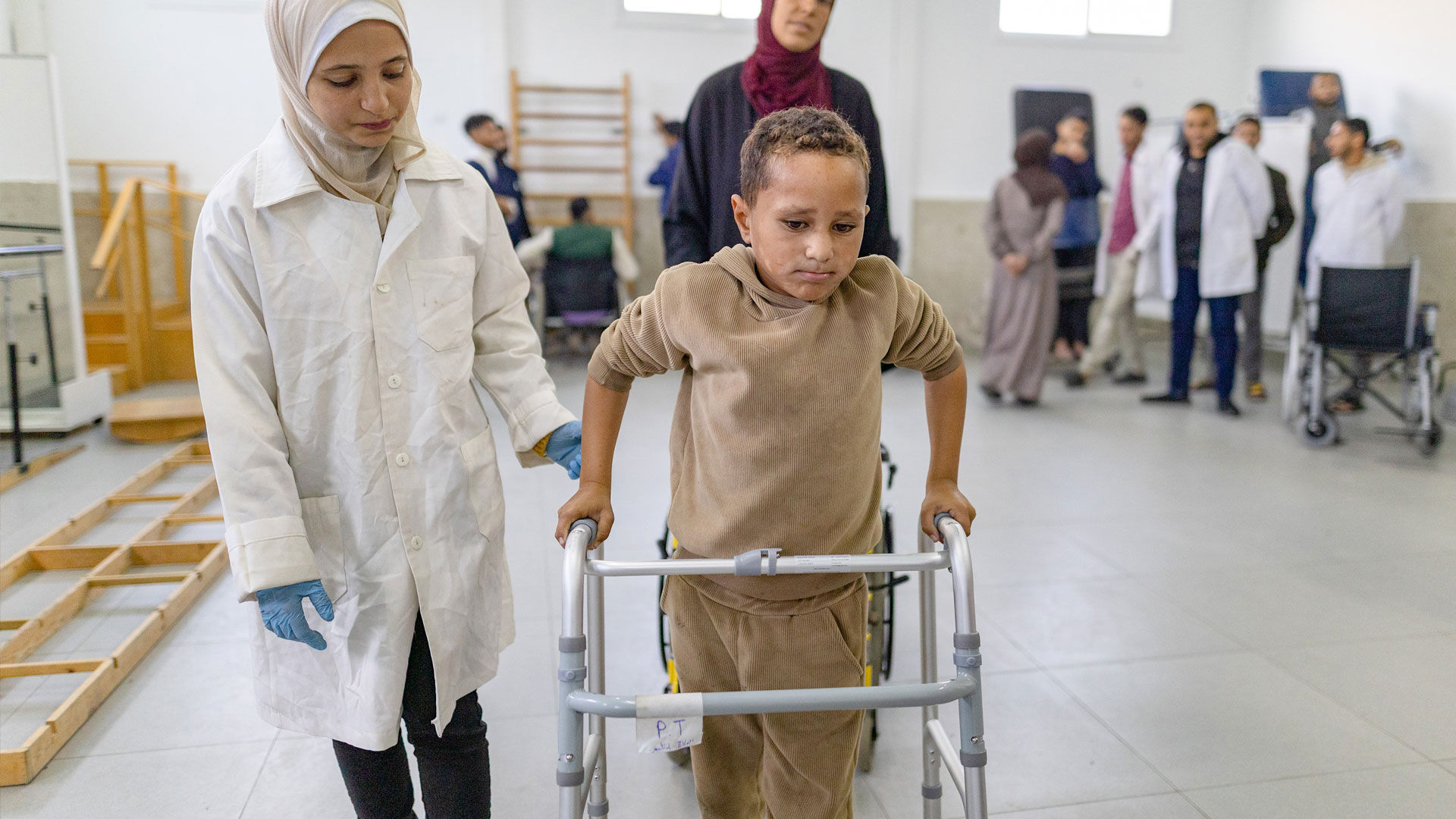
 A young patient injured during the conflict in Gaza receives physical rehabilitation at Al-Amal PRCS Rehabilitation Hospital
These are injuries you might see once in a career — in Gaza, we see them every day. Without rehabilitation and assistive devices, recovery simply stops.
After two years of conflict, more than 42,000 people in Gaza are living with potentially life-changing injuries, including over 5,000 amputations and thousands of spinal cord injuries, burns, and complex limb injuries.
In this episode of Frontline Shift, health workers from NORWAC — an emergency medical team working in coordination with WHO in the Gaza Strip since February 2024 — alongside a WHO rehabilitation specialist, discuss the urgent needs, gaps, and challenges in expanding access to physical rehabilitation services. They share how the lack of functioning services and essential assistive devices is affecting patients’ recovery, independence, and quality of life.
While some progress is underway, with WHO and Emergency Medical Teams working to restore and expand rehabilitation services, strengthen referral pathways, and train and support the health workforce, the scale of needs remains immense.
With much of Gaza’s rehabilitation infrastructure damaged or non-operational, and many professionals killed or displaced, rebuilding services requires coordination, sustained investment, and reliable access to supplies.
Rehabilitation is not a luxury — it is essential to recovery, dignity, and long-term resilience.
Guests
Morten Eng, Country Director for Palestine, NORWAC
Kaja Flatoy, Emergency Nurse, NORWAC
Peter Skelton, Lead for rehabilitation in Emergencies, WHO
Transcript
Egmond Evers (00:05)
Welcome back to the Frontline Shift a podcast by WHO that looks at what it really takes to keep healthcare going in Gaza through coordination and deployment of emergency medical teams to support the health system.
Luca Pigozzi (00:18)
And now after two years of conflict emergency medical teams supported by WHO remain an integral part of the health system, rehabilitation and reconstruction efforts.
Egmond Evers (00:28)
I'm Dr. Egmond Evers, Health Emergencies Team Lead for WHO in the Occupied Palestinian Territory.
Luca Pigozzi (00:34)
And I'm Dr. Luca Pigozzi, acting in charge of the WHO office in Gaza.
Egmond Evers (00:38)
Today, we're looking at the heavy toll the conflict has taken on the people in Gaza, particularly through traumatic injuries. More than 42 000 people are now living with potentially life-changing injuries. Think of spinal injuries, amputations, complex limb injuries, burns.
That's around 25% of all people injured during the two-year conflict.
Luca Pigozzi (00:59)
This includes over 5000 people with amputations and nearly 3500 people with severe burns alongside many other serious injuries. The result is an enormous and growing need for both physical and mental rehabilitation.
Egmond Evers (01:14)
For our discussion today, we're focusing on physical rehabilitation in Gaza. We'll hear directly from our emergency medical team colleagues on the ground, what worked, what didn't, and what these experiences tell us about what's needed next.
Luca Pigozzi (01:27)
Because this response is only about emergency care. It's about sustaining services over time and rebuilding what's been damaged.
Egmond Evers (01:35)
This is the frontline shift
Egmond Evers (01:42)
With us today, we're joined by colleagues who have just wrapped up their deployments in Gaza, Morten Eng, country director for Palestine and Kaja Flatøy, emergency nurse. Both of them work with NORWAC, which has been supporting the Gaza response since January, 2024.
We also have Pete Skelton, the lead for rehabilitation in emergencies at WHO headquarters in Geneva. Thank you all for being with us.
Morten Eng (02:05)
Thank you for having us.
Kaja Flatøy (02:06)
Pleasure to be here.
Luca Pigozzi (02:07)
Pete, you have worked very closely with colleagues in Gaza supporting efforts to strengthen physical rehab. How well is the health system able to respond to the sheer scale of rehabilitation needs right now?
Peter Skelton (02:20)
Thanks, Luca, and thanks for the invitation to join today. Listen, I think that it's worth saying to begin with that Palestinian and international EMT colleagues have been doing really incredible work in Gaza under near impossible circumstances throughout this conflict.
I think the numbers of injured that we've seen are really unbelievable. And They'd be enough to overwhelm even the strongest health system, but in an area that's as small and compact as Gaza, the impact is really catastrophic.
It's equivalent to about 2% of the population that we see that have potentially life-changing injuries now. All of these people that have been injured during the conflict needed media and ongoing access to rehabilitation to be able to prevent complications and to make sure they get the best possible outcomes after being injured. But in addition to the injuries that you guys have already mentioned, there's also a whole really quite significant proportion of the population that also need access to rehab services. So are people like older people with strokes or children with cerebral palsy.
And they faced enormous challenges in not being able to access the services or the equipment that they would normally depend on during the war. Not only that, but they've also been displaced. So they're living in very, very difficult situations
At the peak of the conflict, we know that more than two thirds of the pre-existing rehabilitation services in Gaza were not operational. And that includes everything from services on the primary care level right through to the more specialised inpatient rehabilitation centres, as well as both of the prosthetic and orthotic centres in Gaza City as well.
What that means is that people simply can't access what they need, but also people that should have been able to access rehabilitation on an inpatient level by being referred into facilities were then having to be managed by mobile teams in the community in places like shelters and tents, which is obviously incredibly difficult if you have a new major injury.
The impact was beyond the destruction of the or the damage of the services as well. We have reports that over 50 rehabilitation professionals were killed during the conflict. So this also has a really major knock-on effect on the services that are able to be delivered.
But also the workforce themselves are living through the war and in them themselves are displaced and directly affected. And I think we can't underestimate the impact of that on our Palestinian colleagues in particular as they're striving to continue to try and deliver these essential services to people.
I think while things are improving following the ceasefire, there are still new injuries each day and we still have the threat of deregistration hanging over a number of really key rehabilitation providers at the moment, which is bringing new challenges.
There's still a lack of essential equipment and supplies, and there's still a really urgent need to expand services. So we're working together with EMTs and other partners to support existing services and to reopen services and expand services.
But the needs are so in enormous that we need to keep on working
Egmond Evers (05:32)
Thanks a lot, to Pete. Morten, you've been on the ground for four months. What have you seen? What stood out to you the most?
Morten Eng (05:39)
I think the first thing that comes to mind is the complexity of the injuries, especially in the young patients. M I think from the from going back to kind of this time last year when I was in Gaza, there was a and a four-year-old with a traumatic brain injury after an exposure explosive injury. And, you know, you treat these cases while they're in ICU and follow them up in the wards. And then coming back in September to Nasser, there was, again, ICU, another four-year-old and several four-year-olds coming in during my time there.
So you have these type of injuries that you think normally you'd see and only once in a while. But in Gaza, they come in time and time again, and you see the patients that you've and that you followed for a while. And just as you think you're going to manage to and to get somewhere with them and get them discharged, they end up with new case coming in with similar injuries or also of a young age. I think the time spent in Gaza, you start noticing now that a lot of the cases from earlier in the in the conflict have developed all the kind of complications that you normally try and prevent. So you have all the issues that normally the both fiscal rehabilitation and the nursing and medical care that they receive are supposed to prevent and now they've, because they've been discharged into their into their homes without the follow-up that would normally be needed to prevent these complications, they're they're having a lot more issues than you would normally see.
This goes from and from the cases with spinal cord injury, not having the necessary equipment available, the cases of traumatic brain injury that require a lot of and rehabilitation and this is not available. But also some of the kind of orthopaedic injuries and things that would normally be surgical and surgically managed early on, that now they have to wait a long time for this to be available and they're still waiting at this moment in time.
Egmond Evers (07:31)
As you've both described, the rehabilitation needs are fast. WHO and partners are working to improve the immediate availability and access to rehabilitation services while building the system as a whole.
That means strengthening rehabilitation capacity in hospitals through dedicated outpatient clinics and inpatient capacity for an additional 70 beds. It also means integrating rehabilitation in many primary healthcare centers and reaching out to people in communities. Also improving referral pathways so patients don't fall through the cracks in between.
Another key aspect will be ensuring people have access to assistive devices, as was mentioned before. And finally, strengthening health information systems to track needs and outcomes. All of these elements are, of course, interconnected.
Luca Pigozzi (08:23)
Morten, you are working hands-on across several of these areas Egmond just described. The goal is to meet urgent, short-term needs while also building longer-term capacity in the health system.
What does that look like in practice?
Morten Eng (08:38)
So at the moment, we're trying to and work closely with the national staff, both in the acute hospitals like Al-Shifa and Nasser, but also with the and but the teams working with the long-term rehabilitation units. The multidisciplinary team in these hospitals are... And working very hard to meet the demands and to and coordinate both the care patients need during their inpatient stay, but also their follow up and an ongoing treatment. And we're trying to help them implement a comprehensive multidisciplinary approaches in all aspects of the patient's care, specifically aimed towards those cases with traumatic injuries.
The international teams are always working alongside the local staff with the focus on transferring the knowledge and the ways of working that are may be sometimes different. Or A lot of the times these were things that were in place before the conflict but now have and been lost in the in the chaos of the and of the situation that's been and obviously going on for so long. This is apart with the fatigue and burnout that you see in the staff, but also with and so many hospitals having been shut down at times and then built back up again.
We have teams coming in there working on strengthening the physical therapy aspect, but also the nursing care provided in the acute stages. Trying to get the team to work as a whole to and mobilize patients, encourage them to and get their function back, prevent these complications, as I mentioned already, and to try and get the multidisciplinary team, so both the nurses, physiotherapists, doctors, to all work together on planning discharges, making sure that there's a plan in place for referrals onwards to either the rehabilitation services or the primary healthcare clinics and outreach services that are, in some places at least, available.
We are looking at the kind of initial phase of looking more on the acute side of the, both in the ICU and in the wards and acute hospitals. But we're also looking to expand our support to the tertiary rehabilitation, looking at how they're, and you know, now providing this rehabilitation for these complex injuries in the in the rehabilitation units that are being and able to start working again. And But there's obviously a real need for both capacity building. There's a lot of staff that previously and worked in this area that has either left Gaza or had been killed during the conflict. So there's a real need for encouraging the newer members of staff of kind of upscaling there and their services, improving their knowledge and management, and specifically with regards to these more complex injuries, how to and to get the whole multidisciplinary team involved early on and to work together throughout the entire and treatment.
Egmond Evers (11:27)
So, uh, Kaja, picking up on what Morten said, you've worked closely with local healthcare workers throughout the process. , what have those interactions been like? What, what can you tell us from a capacity building perspective?
Kaja Flatøy (11:40)
First of all, I have to say I'm amazed by the flexibility and the creativity within the Palestinian healthcare workers because they have to they have to flip a lot between the different wards that they work in.
And in every part of the world, these are difficult injuries. As Morten was saying, they're very complex and they need a close cooperation between the physiotherapists and the nurses and doctors to be able to rehabilitate these patients.
Back to a good quality of life. And they also require a lot of sanitary, and the sanitary situation isn't really built for that. Now in Gaza, the living conditions and the shelter from the cold and the wet environment at the moment. So there are a lot of obstacles. Also, the access for pain relief medicines and just the regular medications that people usually take to for their there and general diseases that is no longer available. So there are a lot of things and making it difficult to to treat these patients. We had a project where we did some teachings, some simulation teachings at the Al-Al-Shifa hospital, where we looked at the cooperation between the physiotherapists and the nurses to be able to work closer together help.
Change the wounds at the right time, give the pain relief medications at the right time so that the mobilization could be more effectful. So there are some ways to look at this and to work with this, but it's a very complex situation, of course.
I work closely together with the wound care team and just the pressure wounds alone is a very big problem in Gaza right now. So we looked at the possibility to try to prevent these infections.
Kind of complications from the beginning, just already from the from the ED and then from the start of the hospitalization of the of the patients. But during these conditions and the lack of staff and everything, it's very difficult to to prevent these kind of complications, which makes which makes it even more complex with the rehabilitation.
Morten Eng (13:47)
Yes, since during our and our stay, together, me and Kaja both and provided some training for and for the staff and how to identify the cases that would need and to be and mobilized, would need to be encouraged to regain their independence and function. And this is normally done as a multidisciplinary approach. And this is something that's kind of lost in the and in the time during the conflict. So we've had sessions where doing both simulation exercises, but also having discussions around how to get back to the level of care that they provided before the conflict.
And this was, for me, it was very interesting to see how and It seemed to us that they hadn't had time to reflect on how they were working now and how they could potentially get back to the ways they were working before and to identify those things that were missing for and for them to be able to do a better job.
Certainly from the point of view of and the clinical management of cases, we've had training focusing on this as well. But they do have and a workforce that has a level of experience working with complex injuries that's probably unparalleled paralleled in the in the world. And But at the same time, they are and the opportunity to discuss with someone from outside with a slightly different background than maybe a and different kind of input turned into quite good discussions around then both individual patient management, but also how to run kind of an acute hospital with the level of injuries that they saw, that the issues with the regards to equipment.
Peter Skelton (15:15)
I just want to come in then on the importance of referral pathways as well, because I think this is a really important issue. So rehabilitation care starts in acute care in the big trauma hospitals where people are referred to, but we need continuity throughout. So that means that somebody needs to know when they're leaving that acute hospital, where they're going to continue to receive their care from next. And that might be going on to a specialized inpatient unit in another facility, if that exists, throughout the conflict in Gaza, those resources were incredibly limited. What it more often needs means in this context is going out into the community. So again, being displaced, but needing access to and rehabilitation either through mobile teams that are providing services in the community or even through primary care settings.
So a lot of the work that we're doing is to make sure that we're building services throughout that continuity of care. So that people start in a timely manner at the beginning, as close as possible to when they're injured, but that they receive care that they need on an ongoing basis. So thinking around amputations, for example. It's not simply a case of providing a one-off prosthetic. You need rehabilitation immediately after the amputation to prevent complications, to get stronger. Then you need the prosthetic to be fitted. You need to learn to use it. And then that prosthetic has to be refitted and modified and parts replaced over the life of that person. So it's really an ongoing process. And a lot of the work that we do is
Looking at how we meet the immediate needs, but also making sure that the rehabilitation response is sustainable and linked to recovery as well, so that we're we're ensuring that services in Gaza are rebuilt and will remain available for people that need them for the future. And I think an important part of that is the rehabilitation task force, and so this is part of WHO's role. In very close coordination with both EMT coordination and the health cluster, is really making sure that we have a very strongly coordinated response across a whole range of different partners that are working together to put these services in place now,
Luca Pigozzi (17:38)
Thanks a lot, colleagues. And You also mentioned that ensuring patients are matched with the right assistive devices, which raises a critical point. Scaling up rehabilitation requires the facilitation of humanitarian assistance, including increased the entry of medical supplies, rehabilitation of damaged facilities, and expansion of essential services.
Egmond Evers (17:58)
Pete, access to medical supplies remains a major challenge, especially for assistive devices. What are your observations on that front?
Peter Skelton (18:07)
Thanks, Egmond. Yeah, I think it's helpful to start with what we need to deliver essential services anyway, right? So we need the staff. And in Gaza, we have an incredible workforce, but we have these huge and overwhelming numbers, and we need to increase training for that workforce and capacity of that workforce as well, and it needs international support. We need the systems, and that's where the coordination piece comes in.
We need the space, and a lot of these buildings are damaged and destroyed, and so we're working from temporary facilities. But we also need supplies, we need the equipment component and that's been a huge challenge for us in Gaza in particular. And like many, many other essential supplies and essential medical supplies, access to the basic assisted products that we need like crutches and wheelchairs has been a real challenge throughout but also access to more complex devices. So things like prosthetics and hearing aids has been a major, major constraint. Now, people might not consider these devices to be sort of essential or life-saving, but it's worth thinking that, you know, without crutches, a patient can't walk out of a hospital. So they end up being stuck in the hospital or they're stuck in bed in a tent on hard ground. They're not safe.
They will develop complications and and they'll make the whole response less efficient as well. So we really consider these basic things like crutches and wheelchairs to be essential in emergency settings and particularly in a context like Gaza.
So in collaboration with the EMT and the health cluster, as I said, we really coordinate the delivery of assisted products and the supply of assisted products to those that need them. And we've put a lot of systems in place because it's such a scarce resource to really try and prioritize those devices that we have to track distributions and ensure really that it's those that are in the greatest need get access to the products that they need but it's really an ongoing challenge to get the quantity but also the right type of equipment into gaza that is required
We've all encountered different barriers that have met, and for partners in particular, it's been really challenging and often impossible for them to get the supplies in that they need. As a result of that, we've seen some really nice things like innovation locally, so people manufacturing crutches, using local resources, people making splints, people making more specialised burns, garments that are needed after major burns injuries. All being manufactured locally by NGOs, by partners using local equipment and resources. But that's really just a kind of a sticking plaster in terms of it's it's not a solution to meeting the huge needs that we that we have. And there are some things really like prosthetics and wheelchairs, which it simply isn't safe.
Or possible to manufacture locally, we can only bring those in internationally into Gaza and we need you know unhindered access to be able to bring all of these things in.
Egmond Evers (21:07)
Thanks a lot, Pete. Kaja, from a clinical and quality of life perspective, how does the lack of assistive devices affect patients?
Kaja Flatøy (21:16)
Well, hugely, I think. Coming from Norway, where we have this equipment very available and we're very lucky in that way, it's it's very it was really hard to see how like simple tasks are made impossible because of the lack of these helping devices and equipment.
And also, as we were talking about, just the nutrition and the shelter and everything that is needed to be able to get by from day to day is of course a very important part of the of the situation down there and and what people are thinking about and worrying about. So the whole the whole complex situation and makes it difficult to get all these parts working together. But also as Pete was saying, yeah i'm i'm So amazed by all the creativity and that all the ways that they make life work and the the ways they use what they have to be able to live as best as possible and the way people help each other. So there's this kind of warmth in the environment. Palestinian environment that I was really struck by and that was moving, being a witness to. So I just hope that we can provide more of the useful equipment and and help the conditions being in a way that it's possible to come back to a quality of life. And also the medications, the access of pain relief medications and the normal medications for diabetes and and other conditions that would be very, very important effects from if they're not treated.
Morten Eng (22:56)
I think also of thinking that there's some equipment that's getting in. There was a 17-year-old with a spinal cord injury after a shrapnel injury that I treated. That you know Initially, he it took a few weeks before he had a wheelchair when normally these cases would get up and sit in a wheelchair quite early on. And But he had a large like had a big problem with the... And with the hypotension, with this but blood pressure dropping. Normally you'd use pressure garments, and abdominal binders and compression stockings to to prevent this, but this was not available. And the whole kind of early progress that he had was very limited by this. And The wheelchair he got did not have a suitable pressure relieving cushion resulting in him having a pressure sore. When I met him again a few months later, he had developed a pressure sore that's likely gonna require surgical management, which at the moment is not available in Gaza. So you have this and this initial problem of equipment not being available or not the suitable equipment being available and then the kind of compounding of issues and developing from this.
Luca Pigozzi (23:59)
While the needs remain in many, there is also hope for the future. Important work is underway in Gaza to strengthen physical rehabilitation capacity, as our colleagues were working us through.
But what needs is sustained investment in the health system to rebuild it better. This is not an overnight fix and attention must not fade.
Egmond Evers (24:20)
This has been a really insightful discussion. We hope WHO, the emergency medical teams and partners continue to be able to scale up this critical work.
Luca Pigozzi (24:29)
Thank you all for taking the time, especially in between demanding shifts, and to share your experiences and the work you are doing. It has been both insightful and definitely inspiring.
Egmond Evers (24:40)
These are your hosts Luca and Egmond signing off.
 A woman injured during the conflict in Gaza is guided by her physiotherapist during a session aimed at improving her mobility
