


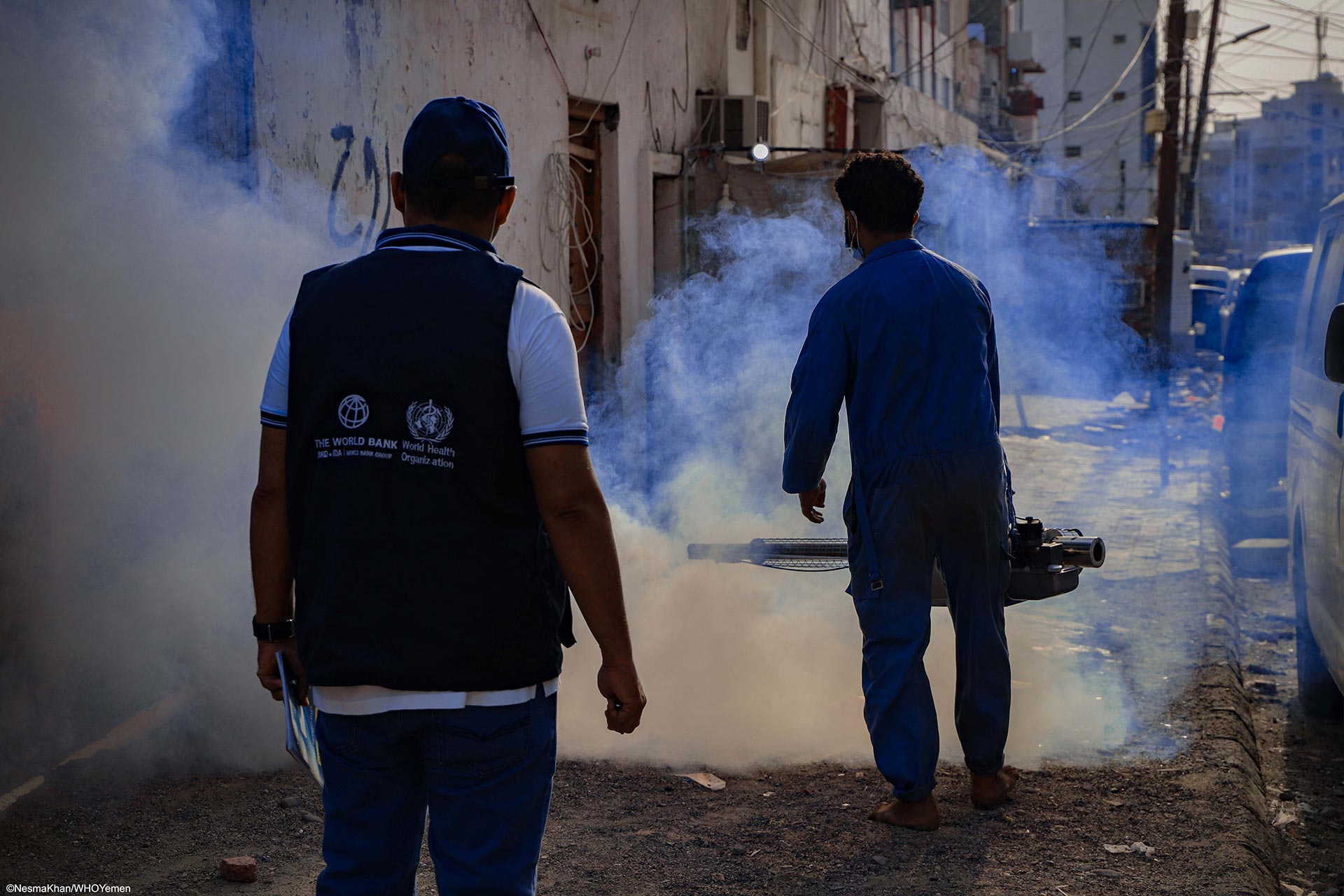
 Dengue control emergency campaign, which was held in 8 southern governorates and 24 districts in Yemen. Copyright: WHO / Nesma Khan
Invasive vectors, including the malaria vector Anopheles stephensi and dengue vectors, Aedes aegypti and Aedes albopictus are expanding regionally and globally due to the several driving factors, particularly global trade and travel, climate change, unplanned urbanization, insecticide resistance and inadequate vector control capacity.
Anopheles stephensi has been expanding its range from South Asia into Africa . In the Horn of Africa of the Eastern Mediterranean Region, An. stephensi is now established in Djibouti, Somalia, Sudan and Yemen. Upon arriving in new areas, these species increase the local risk of malaria particularly in urban settings.
For more information check: Malaria threats map
Aedes aegypti and Aedes albopictus are also expanding in distribution.
Aedes aegypti is established in 13 countries and is the main vector for dengue in Afghanistan, Djibouti, Egypt, Islamic Republic of Iran, Oman, Pakistan, Saudi Arabia, Somalia, Sudan and Yemen. Ae. aegypti is currently responsible for frequent outbreaks of dengue in these countries, that burden the already weak health systems in fragile and conflict-affected countries such as Afghanistan, Somalia, Sudan and Yemen.
Aedes albopictus is also spreading and has been reported in 13 countries: Afghanistan, Islamic Republic of Iran, Jordan, Libya, Lebanon, Morocco, occupied Palestinian territory, Oman, Pakistan, Sudan, Syria, and Yemen.