

 In 2017, the World Health Assembly endorsed the Global vector control response 2017–2030. This strategy urges countries and development partners to strengthen vector control as a fundamental approach to prevent and eliminate disease and respond to outbreaks. It seeks to reduce the global burden of vector-borne diseases through effective, locally adapted and sustainable vector control.
WHO launched its first Global Arbovirus Initiative in March 2022 to specifically address arthropod-borne viruses. This initiative aims to lead the epidemic preparedness plan and build a global coalition of countries and strategic partners to tackle the increased risk of arbovirus transmission through an integrated and coordinated approach. Work on various global-level aspects of the initiative has already begun. The aim is to now inject momentum at the country level, initiate the implementation of key activities and promote country ownership of actions against arboviral diseases.
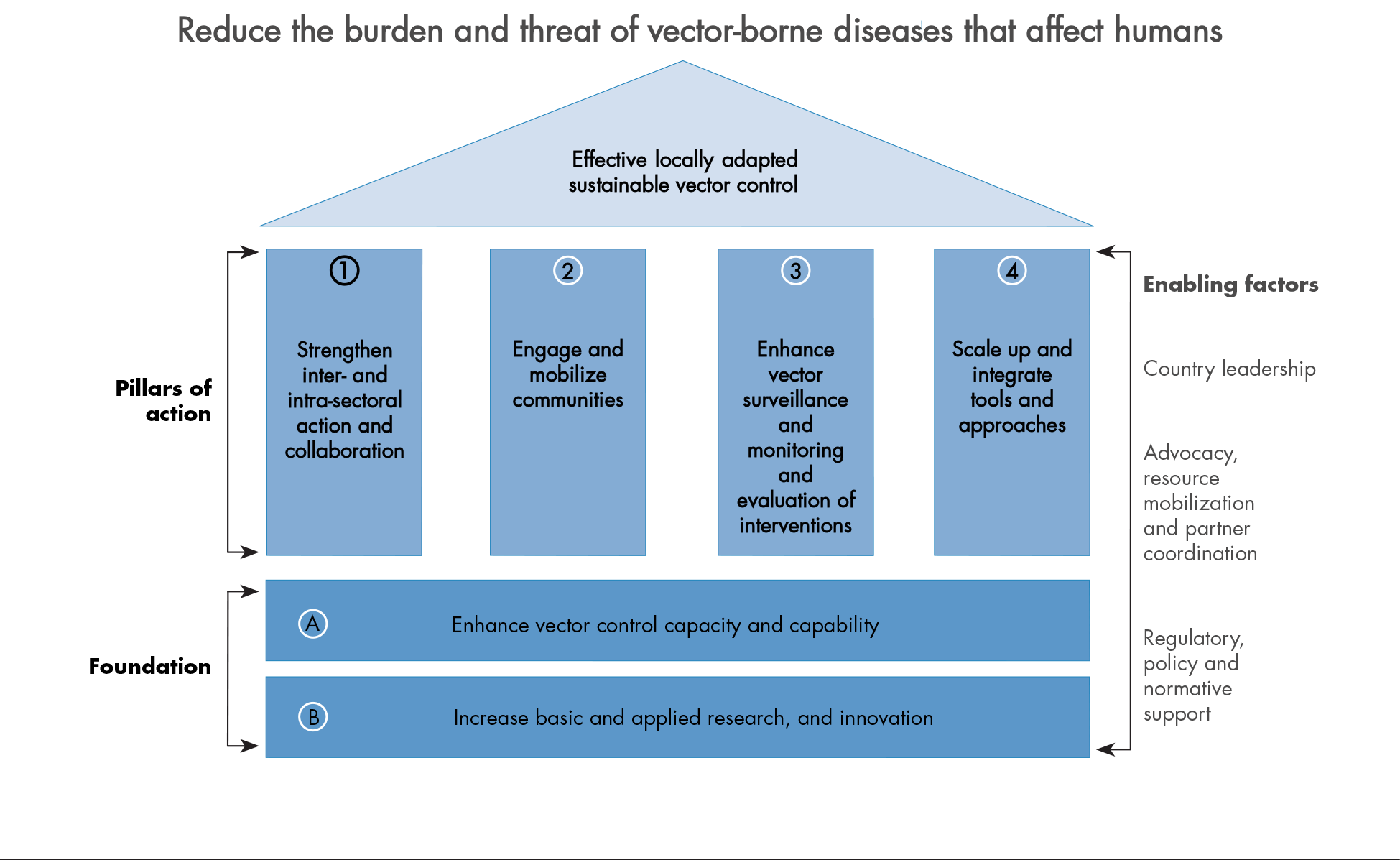
The WHO Regional plan of action 2019–2023 for implementation of the Global vector control response 2017–2030, for the Eastern Mediterranean Region, includes these steps:
 The WHO The entry point for improvement is an updated vector control needs assessment that describes the national situation and identifies the prioritized needs.
- Countries must then develop a national vector control strategy across diseases that is consistent with the Global vector control response 2017–2030. This strategy would provide high-level guidance and backing for vector control.
- In countries across the Eastern Mediterranean Region, implementation requires activities that are owned by countries and mainstreamed:
- A vector control unit with cross-disease mandate should be established.
- Investment in capacity-building of the entomology and vector control workforce for implementation of quality surveillance and control activities. The human resource is based on the needs assessment and must include in-service training on vector surveillance and control conducted.
- Countries need to establish a vector surveillance system integrated with disease surveillance, within the health information systems. An integrated surveillance system with routine monitoring of disease vectors guides evidence-based decisions on vector control.
- Investments must strengthen pesticide management, through staff training and monitoring or pesticide exposure, which will lead to reduced pesticide poisoning and environmental pollution.
Capacity-building is needed at the regional and country levels to improve integrated vector surveillance in the Region to address malaria, dengue, chikungunya, leishmaniasis and other major disease vectors. Countries must also be provided with more support to adopt a multisectoral approach to control vector-borne diseases, with a focus on community engagement for vector surveillance and control.
It is also useful to expand networking with international partners to support capacity-building in entomological surveillance, as well as further investigation and resource mobilization.
More research on entomology and vector control, particularly novel tools is essential for the effective control of vector-borne diseases, at both the regional and country levels. The evidence generated should be shared widely, including with relevant stakeholders.