


12 January 2026 – In 2025, WHO’s polio programme in the Eastern Mediterranean Region advanced critical areas of eradication despite conflict, humanitarian crisis and funding pressures. From refining strategies in endemic countries to expanding laboratory capacity and political engagement and accelerating integration with routine immunization, the year marked important progress across multiple fronts.
1. Refining strategies in polio-endemic countries
 A child in Afghanistan receives polio vaccine. Photo credit: WHO Afghanistan
Afghanistan and Pakistan continued to intensify efforts to interrupt wild poliovirus transmission in 2025, guided by Technical Advisory Groups - which meet regularly to assess efforts to end polio and share independent technical guidance to interrupt poliovirus transmission - and strengthened national and regional oversight. Both countries further narrowed their focus on critical transmission zones, reinforced community engagement and enhanced cross-border coordination.
In Afghanistan’s East Region, the strategic reset accelerated through intensified tactics, including expanding the number of health facilities offering polio vaccination, revised microplans to reduce the distance between households and vaccination sites, and stronger community engagement. These measures sustained high campaign quality and delivered sharp declines in virus detection, demonstrating how adaptive approaches can succeed even in highly complex settings.
In Pakistan, targeted operational adjustments focused on the most consequential transmission areas, including southern Khyber Pakhtunkhwa, Quetta bloc and Karachi, alongside strengthened accountability and enhanced vaccination strategies to rapidly boost population immunity. Cross-border coordination between the two countries was further strengthened through synchronized campaigns, joint investigations and routine data exchange along major population movement corridors.
At the same time, transmission persists in a number of critical areas where insecurity and restricted access continue to limit vaccination reach. With transmission now declining – Pakistan reported fewer than half as many cases in 2025 as compared to 2024 – the current low-transmission season represents the strongest epidemiological opportunity in years to interrupt wild poliovirus transmission in both countries.
2. Galvanizing regional support to end polio
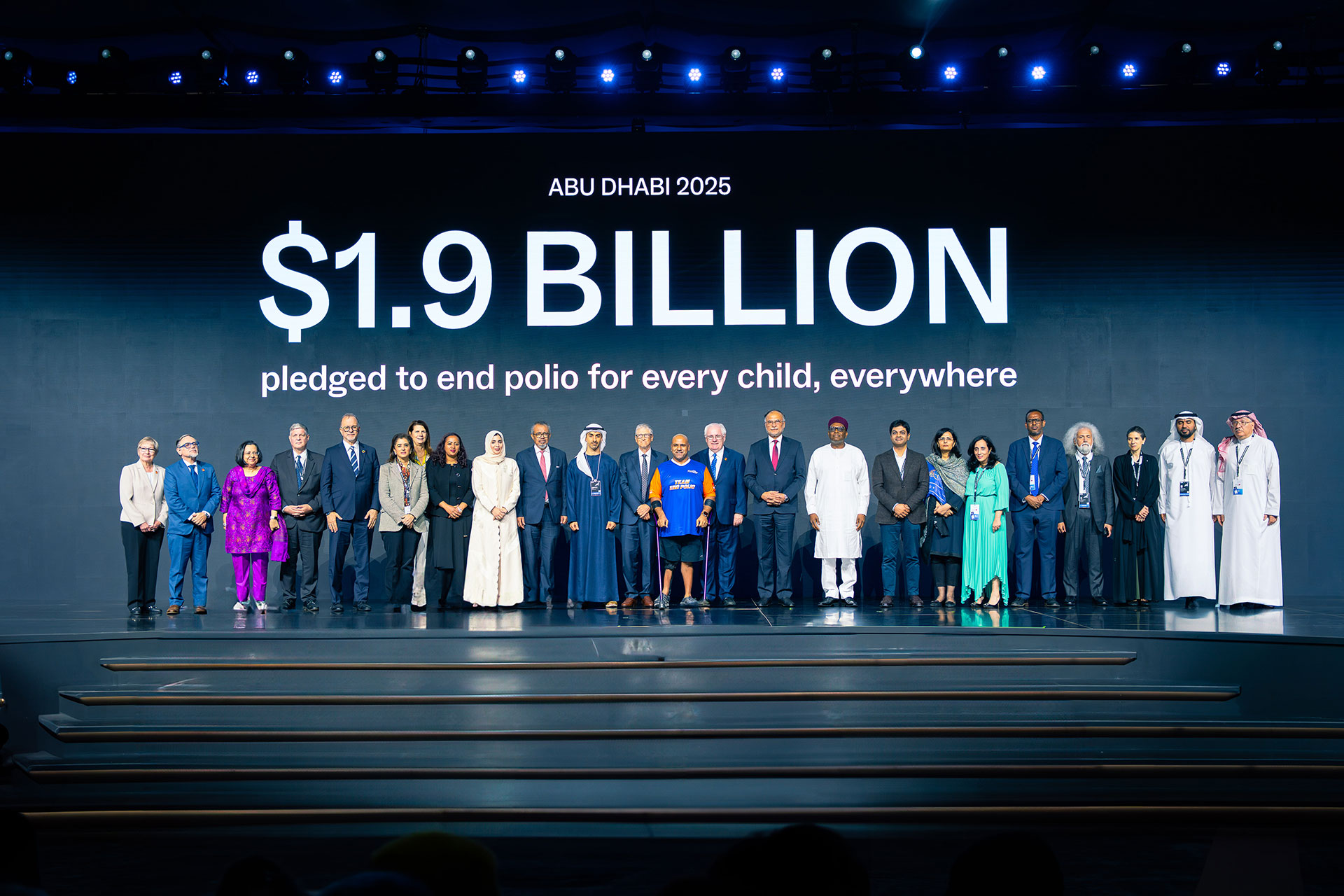 Global leaders came together to pledge US$1.9 billion to end polio at a high-level session convened by the Mohamed bin Zayed Foundation for Humanity in Abu Dhabi in December 2025. Photo credit: Mohamed bin Zayed Foundation for Humanity
Member States across the Eastern Mediterranean Region have continued to rally together to support countries grappling with wild and variant polioviruses in the midst of severe humanitarian crises. This collective commitment was reinforced through two meetings of the Regional Subcommittee for Polio Eradication and Outbreaks in 2025, alongside high-level engagement with Member States, donors and partners to address the most urgent needs faced by countries affected by poliovirus.
The regional solidarity has also translated into concrete financial and operational support. In February 2025, the Kingdom of Saudi Arabia reaffirmed its landmark US $500 million commitment to the GPEI, catalyzing immediate operational support to advance lifesaving vaccination and surveillance activities in priority countries. In September, the King Salman Humanitarian Aid and Relief Centre (KSRelief) co-hosted a side-event at the 80th UN General Assembly with WHO, UNICEF and GPEI, bringing attention to the need for sustained financing and the final push to eradicate polio. KSRelief formally joined as an official member of the GPEI Polio Oversight Board, reinforcing the Kingdom’s ongoing strategic role in global governance for eradication.
The United Arab Emirates also stepped in to support the polio outbreak response in the Gaza Strip, underscoring continued regional solidarity with countries affected by poliovirus in complex humanitarian settings. In December, the Mohamed bin Zayed Foundation for Humanity convened a major pledging moment in Abu Dhabi that raised a collective US$1.9 billion in pledges to accelerate the final stages of the eradication effort—including a new commitment of US$140 million from the foundation.
At the same time, the Kingdom of Saudi Arabia, Qatar and the United Arab Emirates have lent support to the Polio Legacy Challenge in Afghanistan—administered through the Islamic Development Bank—to strengthen health infrastructure while advancing polio eradication.
3. Creating pathways to children amid complex contexts to stop poliovirus transmission
 Children show off their finger-marking after receiving oral polio vaccine during a campaign in central Gaza in February 2025. Photo credit: WHO oPt
Amid the humanitarian crises in the Gaza Strip, Sudan and Yemen, the polio eradication programme and its partners continued reaching children with vaccines in 2025, underscoring that humanitarian access, peace and strong partnerships are vital for delivering health services.
In the Gaza Strip, improved access and ceasefire arrangements enabled the third vaccination campaign since detection of circulating vaccine-derived poliovirus type 2 (cVDPV2) in July 2024 to reach over 602 000 children in February 2025. Since March 2025, cVDPV2 has not been detected through acute flaccid paralysis (AFP) or surveillance or in environmental samples, suggesting a possible interruption of transmission.
In Central and West Darfur states of Sudan, an outbreak of cVDPV2 was responded to with two vaccination campaigns, the first of which reached more than 91% of targeted children.
Efforts were also made to respond to the cVDPV2 outbreak in the southern governorates of Yemen, while opportunities for reaching children with novel oral poliomyelitis vaccine type 2 (nOPV2) continued to be explored.
Egypt interrupted cVDPV2 transmission in North Sinai in April 2025, following intensified immunization efforts. The country took special steps, including establishment of a vaccination clinic at the border, to reduce any risks of poliovirus importation from the Gaza Strip.
4. Stepping up political momentum and action for a polio-free Horn of Africa
 A health worker notes a child’s vaccination records, during an nOPV2 nationwide campaign in Somalia in April 2025. Photo credit: WHO Somalia
In October 2025, health ministers and partners from Djibouti, Ethiopia, Kenya, Somalia, South Sudan and Yemen came together for the first virtual quarterly Interministerial Meeting on Variant Poliovirus for the Horn of Africa and Yemen. This united front demonstrated strong political will towards ending polio outbreaks in the subregion. Leaders reviewed hard-won progress and committed to urgent, coordinated and high-impact action to confront persistent challenges and drive variant poliovirus transmission to zero.
As a result of these commitments, polio teams from these countries are intensifying coordination to synchronize polio vaccination campaigns, conduct joint surveillance reviews and improve information sharing across borders.
Political leadership has also been strengthened at national level, including through the establishment of a national taskforce in Somalia to protect children from polio and other vaccine-preventable diseases.
5. Enhancing laboratory capacity across the Region
 A laboratory technician examines a sample for poliovirus at the Regional Reference Laboratory for Polio at the National Institutes of Health in Islamabad. Photo credit: WHO Pakistan/ Hamid Inam
In response to continued innovations and to support efforts to strengthen poliovirus detection and response, in February 2025 the Sultanate of Oman inaugurated a modular, state-of-the-art poliovirus laboratory in Muscat, Oman, in collaboration with WHO and other Global Polio Eradication Initiative (GPEI) partners.
The laboratory focuses on testing wastewater samples from Oman and other countries in the Region for poliovirus. It will complement Oman’s National Polio Laboratory, which has played a pivotal role in testing stool samples from children with acute flaccid paralysis across the Gulf – including Bahrain, Qatar, the United Arab Emirates and Yemen.
Meanwhile, in Tunisia, the Regional Reference Polio Laboratory was capacitated in early December to test wastewater samples for poliovirus.
These efforts will advance regional and global health security.
6. Joining forces to protect children from polio and other vaccine-preventable diseases
 A young child in Afghanistan receives a vaccine dose to protect against preventable disease. Photo credit: Afghanistan/Zakarya Safari
In 2025, the Region’s polio eradication programme was integrated with the Essential Programme on Immunization (EPI) to strengthen collaborative efforts to protect children from vaccine-preventable diseases, including polio.
This strengthened approach supports closer integration of key functions, including disease surveillance, preparedness, diagnosis and response, while reinforcing health systems in high-risk areas and hotspots, in line with the GPEI Strategy 2022 –2029 and the Immunization Agenda 2030.
Persistently low routine immunization coverage in endemic and outbreak-affected countries continues to heighten the risk of poliovirus transmission, making integration with essential immunization critical to both outbreak control and broader health system resilience.
7. Advancing gender equity
 WHO Regional Director for the Eastern Mediterranean, Dr Hanan Balkhy, administers polio drops to a child at a hospital in Mogadishu after engaging with health workers and caregivers . Photo credit: WHO Somalia
Reinforcing the commitment of the WHO Eastern Mediterranean Region to gender equity in global health, WHO Regional Director for the Eastern Mediterranean, Dr Hanan Balkhy, assumed the role of the Global Polio Eradication Initiative Gender Champion.
The first woman to serve as WHO Regional Director for the Eastern Mediterranean Region, Dr Balkhy has continued to use her platform to highlight the critical role women play in efforts to stamp out polio, from delivering vaccines at communities’ doorsteps to testing for poliovirus in laboratories. She also advocates with decision-makers to ensure gender perspectives are reflected across the programme’s work at all levels.
Her leadership underscores the role gender plays in influencing vaccine access, community trust and the composition of the frontline workforce, ensuring gender equity remains a priority in the final phase of polio eradication.
Related links
- Oman introduces a new laboratory to boost testing for poliovirus in the Region
- Oman’s new polio lab strengthens regional preparedness
- Global health experts convene in Pakistan for emergency measures to stop endemic poliovirus once and for all
- Technical Advisory Group urges strong action to eradicate polio in Afghanistan
- GPEI Action Plan 2026
- Kingdom of Saudi Arabia confirms US$ 500 million commitment to global polio eradication effort
- Humanitarian access improves quality of polio vaccination campaign in the Gaza Strip
- Horn of Africa health ministers commit to bolster polio eradication efforts
- Health leaders unite to tackle polio across the Horn of Africa and Yemen
- GPEI Gender Equality Strategy
- Women at the forefront of polio eradication mission
