


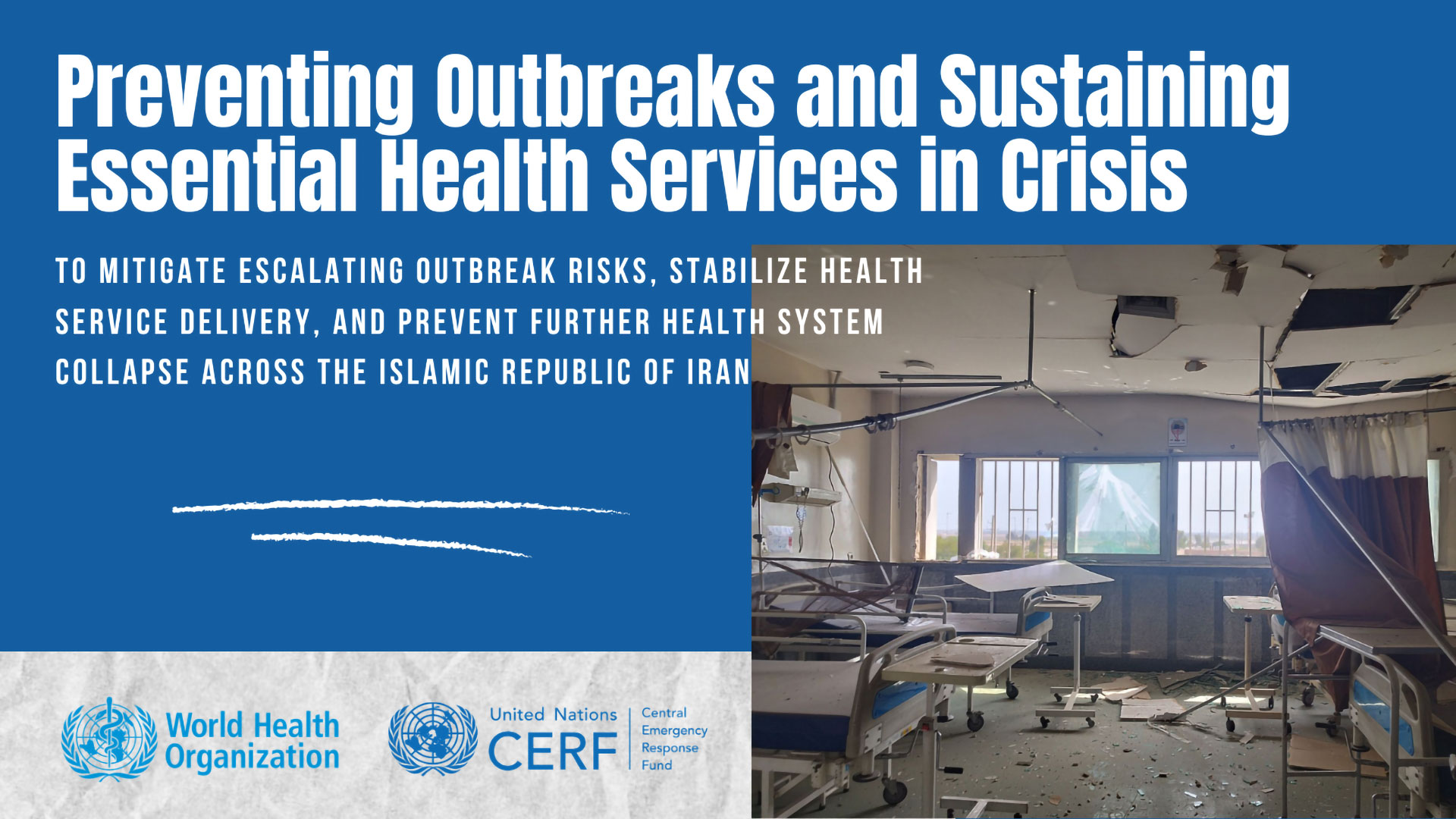
 3 June 2026, Tehran, Islamic Republic of Iran: In response to the multiple crises severely impacting the country’s public health infrastructure, the World Health Organization (WHO), in close coordination with the Ministry of Health and Medical Education and health sector partners, has launched a US$ 2 million emergency project to prevent outbreaks and sustain essential health services. Supported by the United Nations Central Emergency Response Fund (CERF), the initiative specifically aims to mitigate outbreak risks, stabilize health service delivery and prevent further health system collapse across the south of the country.
Since 28 February 2026, aerial bombardments have critically undermined the country’s capacity to deliver life-saving health services. The toll on civilian health infrastructure has been devastating, with an estimated 229 health care centres, 49 hospitals and 78 pharmaceutical facilities, laboratories and warehouses damaged, as well as 56 emergency services bases struck, 9 hospitals evacuated, and 47 ambulances and 10 support vehicles destroyed. Furthermore, attacks on or near pharmaceutical and diagnostic production facilities have severely disrupted domestic medical supply chains, interrupting the delivery of critical care.
Simultaneously, the southern part of the country faces the risk of a public health emergency driven by extreme weather events. Irregular and above-average rainfall following prolonged dry periods has led to localized flooding and standing water. As a result, high-risk provinces, including Sistan and Baluchistan, Hormozgan, Kerman, and Khuzestan, are seeing an increase in contaminated water sources. This has combined with conflict-related disruptions to water, sanitation and disease surveillance infrastructure, to create a significantly heightened risk of vector-borne and waterborne diseases, particularly cholera and acute watery diarrhoea.
"The combined weight of ongoing conflict and severe climatic shocks has placed an unprecedented strain on Iran's health infrastructure, leaving vulnerable communities at severe risk," said Dr Jean Jabbour, WHO Representative and Head of Mission to the Islamic Republic of Iran.
"This timely and critical emergency response is instrumental in preventing further health system collapse. It allows us to act immediately to safeguard essential supply chains and ensure that life-saving care remains accessible to the populations most acutely affected by this crisis."
Without urgent action, localized transmission could rapidly escalate into widespread outbreaks, causing preventable morbidity and mortality. To catalyse an immediate response, WHO is deploying a focused package of high-impact interventions to strengthen early warning surveillance systems and pre-position priority outbreak response commodities, including rapid diagnostic tests for malaria, dengue and cholera. In addition, the distribution of insecticidal nets, spraying equipment and larvicides, alongside rapid technical assistance, will reinforce integrated vector management in high-risk districts.
Furthermore, WHO is restoring vital testing capacity by replacing destroyed real-time polymerase chain reaction devices and ensuring uninterrupted access to essential medicines, including immediate malaria treatment.
With standing water from recent floods and severe damage to local health facilities, the risk of disease outbreaks is dangerously high. By rapidly deploying these diagnostic tools, vector control materials and essential treatments, WHO is augmenting our early warning capacities to intercept these threats before they escalate into wider public health emergencies.
Over the next 6 months, it is estimated that the project will directly benefit over 100 000 people through augmented epidemic control and restored medical access, with more than 250 000 people protected indirectly through the strengthened response capacities and reduced outbreak risk. Ultimately, this comprehensive effort seeks to avert avoidable outbreaks and sustain essential health services when they are needed most.
