


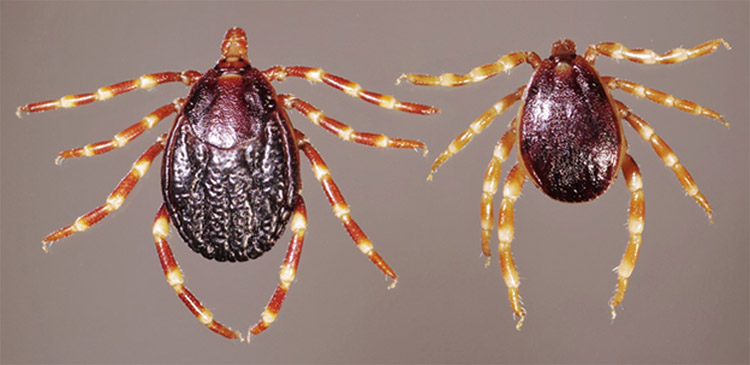
 Hyalomma ticks are the main vector for CCHF (Photo: Daktaridudu/Wikimedia Commons)
Overview
Crimean-Congo haemorrhagic fever (CCHF) is a widespread and serious viral illness spread by ticks. It is a severe viral haemorrhagic febrile illness that causes outbreaks, with a case fatality ratio ranging from 10% to 40%. CCHF is endemic in Africa, the Balkans, the Middle East, and Asia, in countries south of the 50th parallel north. It spreads to people through the bite of infected Hyalomma ticks or through direct contact with infected animal blood or tissues, particularly during or immediately after the slaughter of livestock. These animals often do not show signs of illness. The virus can also spread from person to person via unprotected contact with the blood or other body fluids of an infected person. Although an inactivated, mouse brain-derived vaccine against CCHF has been developed and used on a small scale in eastern Europe, there is currently no safe and effective vaccine widely available for human use.
In the WHO Eastern Mediterranean Region, sporadic cases and outbreaks have been reported in Afghanistan, Islamic Republic of Iran, Iraq, Kuwait, Oman, Pakistan, Saudi Arabia, Sudan and the United Arab Emirates. Five variants (genotypes) of the CCHF virus have been detected in the Region. Control of CCHF relies on successfully raising public awareness of risk factors and ways to prevent the spread. WHO collaborates with partners to boost surveillance, diagnostic and clinical capacity, infection prevention and control and outbreak response activities.
Symptoms
Following infection by a tick bite, the incubation period of Crimean-Congo haemorrhagic fever (CCHF) is usually 1–3 days, with a maximum of 9 days. Following contact with infected blood or tissues, the incubation period is usually 5–6 days, with a maximum of 13 days.
Onset of symptoms is sudden and can include fever, muscle ache, dizziness, neck pain, backache, headache, sore eyes and photophobia (sensitivity to light). There may be nausea, vomiting, diarrhoea, abdominal pain and sore throat early on, followed by sharp mood swings and confusion. After 2–4 days the agitation may be replaced by sleepiness, depression and lassitude, and the abdominal pain may localize to the upper right quadrant, with detectable hepatomegaly (liver enlargement).
Other clinical signs include tachycardia (fast heart rate), lymphadenopathy (enlarged lymph nodes), and a petechial rash (a rash caused by bleeding into the skin) on internal mucosal surfaces, such as in the mouth and throat, and on the skin. The petechiae may give way to larger rashes called ecchymoses, and other haemorrhagic phenomena. There is usually evidence of hepatitis, and severely ill patients may experience rapid kidney deterioration, sudden liver failure or pulmonary failure after the fifth day of illness.
Treatment
Early intensive supportive care, including fluid management and treatment of specific symptoms, can improve survival chance. There is currently no specific treatment approved for Crimean-Congo haemorrhagic fever.
The mortality rate from CCHF is approximately 30%, with death occurring in the second week of illness. In patients who recover, improvement generally begins on the ninth or tenth day after the onset of illness.
It is difficult to prevent or control CCHF infection in animals and ticks as the tick-animal-tick cycle usually goes unnoticed and the infection in domestic animals is usually not apparent. Furthermore, the tick vectors are numerous and widespread, so tick control with acaricides (chemicals intended to kill ticks) is only a realistic option for well-managed livestock production facilities.
There are no vaccines widely available for human or animal use. In the absence of a vaccine, the only way to reduce infection in people is by raising awareness of the risk factors and educating people about the measures they can take to reduce exposure to the virus.
Information resources
 Photo: Semantic Scholar
Protect yourself from Crimean-Congo haemorrhagic fever
Related topics
 Photo: Wikimedia commons/ Friend of Darwinek
Pandemic- and epidemic-prone diseases

