Changing minds and protecting lives in Yemen

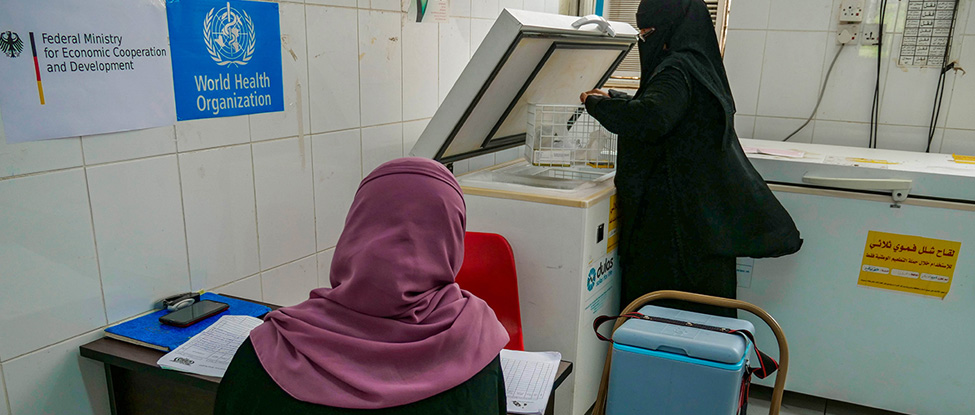
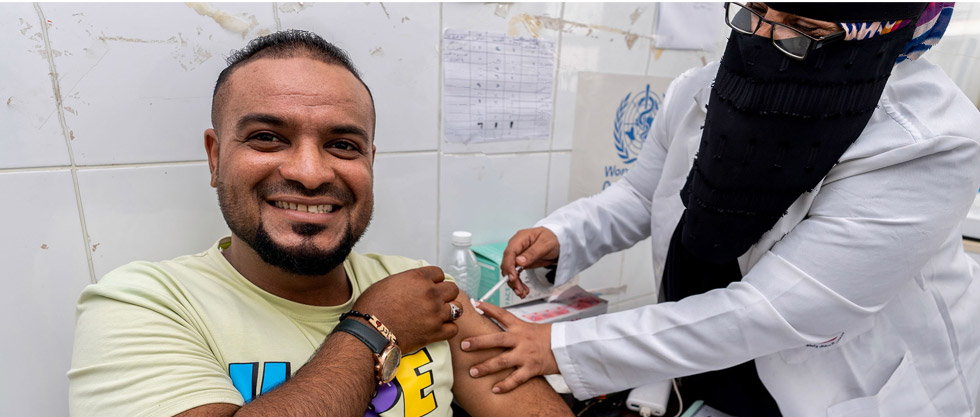
12 September 2022 - In Yemen as elsewhere, widespread misinformation about COVID-19 vaccines has posed a major public health threat. With support from the King Salman Humanitarian Aid and Relief Center (KSrelief), WHO has trained more than 1,100 health workers and community volunteers to communicate factual information about the vaccines – prompting many more Yemenis to accept them.
WHO and EU partner to provide Yemenis with emergency medical services
4 September 2022 – The World Health Organization (WHO) has launched a 12-month project to sustain the delivery of life-saving emergency health services for the most vulnerable in conflict-affected zones across Yemen thanks to a €2.5 million contribution from the European Union.
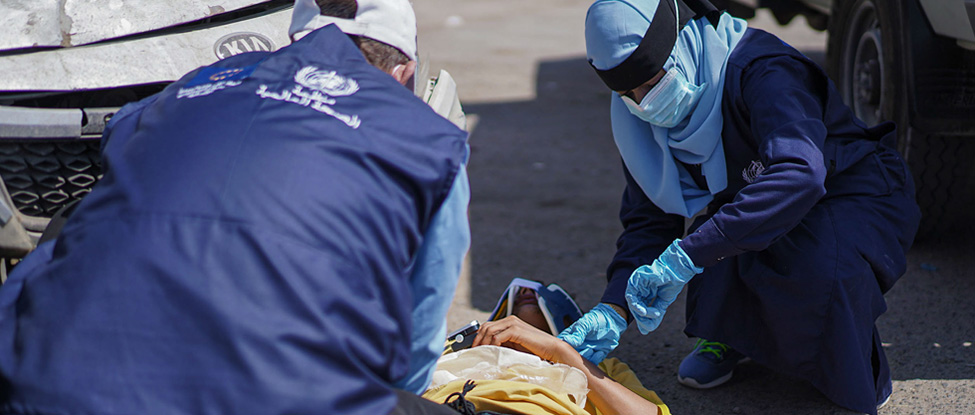
The partnership aims to directly assist more than 152,000 Yemenis, including 33,000 children and 30,500 internally displaced people. Seventeen hospitals across Yemen will receive support in four main areas of humanitarian health service delivery: trauma care and emergency care referral services; mental health and psychosocial support; strengthening of the national health information management system; and early response to outbreaks.
“The health care system in Yemen is devastated and on the brink of collapse, while the health needs of the most vulnerable people have increased by 11% overall since 2021,” said Dr Adham Rashad Ismail Abdel-Moneim, WHO Representative to Yemen. “Through this project, and in partnership with EU Humanitarian Aid, we can better address many of the acute and urgent health needs of the most vulnerable people with a comprehensive range of essential health care services.”
The project will also address trauma care and emergency care referral services, ensuring continued provision of ambulance services, fuel, medical equipment and other supplies as well as training at Yemen’s only pre-hospital system facility, based in Aden city.
“Currently, more than 21.9 million Yemenis lack access to critical health services. Seven years of conflict have not only left the health sector in tatters but have severely depleted people’s resilience. Indiscriminate attacks, food insecurity and disease outbreaks are having a devastating impact on their well-being,” said Janez Lenarčič, European Commissioner for Crisis Management. “One of the EU’s humanitarian priorities in Yemen is to alleviate people’s suffering, both physically and mentally, and ensure they can access quality health care.”
The hospitals supported by this project will benefit from plans to establish mental health units that provide mental health and psychosocial support services and psychotropic medications. Medical and non-medical staff will also be trained to assess and manage mental health disorders of vulnerable groups, including women, children, internally displaced, refugees, migrants and people with disabilities.
Yemen’s fragmented health information system will also receive support to improve information sharing between health partners to ensure informed decision-making and strengthen operational processes in health emergency response. This includes building national capacities to improve and operate the District Health Information Software (DHIS2) data collection system that is hampered by frequent electrical outages and weak internet connectivity.
One child at a time, WHO and the World Bank transform the lives of millions of children exposed to a silent disease – schistosomiasis

31 August 2022, Aden, Sana’a – Schistosomiasis is an acute and chronic parasitic disease caused by infection with blood flukes (trematode worms). This disease infects vulnerable communities in Yemen exposed to infested water – putting many lives at risk, especially those of young children.
Through the Emergency Health and Nutrition Project and its successor the Yemen Emergency Human Capital Project, the World Bank’s International Development Association and WHO are working to detect, diagnose, treat and care for infected patients with schistosomiasis across Yemen.
The importance of tackling this often-overlooked disease is critical. Schistosomiasis transmission occurs when people suffering from the disease contaminate freshwater sources with their excreta containing parasite eggs, which then hatch in water. Inadequate water, sanitation and hygiene and snail control increase schistosomiasis transmission. Children are especially vulnerable to infection, as lack of education and playing habits expose them to dangers. Freshwater snails can penetrate the skin when children come in contact with contaminated water.
The disease severely impacts a child’s performance in school, ending in stunted growth, reducing productivity, and affecting their learning abilities and physical and cognitive development. Schistosomiasis-associated anaemia is also prevalent, contributing to fatigue, weakness, and reduced focus. The disease is often fatal; if left untreated, schistosomiasis will eventually lead to debilitating long-term irreversible health complications in the urinary tract, liver fibrosis, kidney failure, bladder cancer, nephropathy, gastrointestinal bleeding, gastrointestinal obstruction, malnutrition, infertility, and pulmonary hypertension etc. Tackling schistosomiasis will give Yemeni children an equal opportunity in life, an equal opportunity for their right to education and lead the lives they deserve without disease holding them back in a vicious cycle of poverty.
To this day, schistosomiasis is one of Yemen’s most prominent health problems, as an estimated 6 million people are at risk of infection and 3 million are infected. The COVID-19 pandemic has disproportionately overshadowed the importance of eliminating neglected tropical diseases – especially schistosomiasis. Although schistosomiasis doesn’t receive as much attention as other conditions, its prevalence and potential risk are very high.
The World Bank and WHO are at the forefront of the health response to eliminate schistosomiasis. After years of making progress, scale-up interventions were implemented to break the vicious cycle of the socio-economic impact that the disease has on Yemeni communities.
Despite the severity of the condition, it is fully treatable. WHO and the World Bank delivered life-saving treatment across 9 governorates and 40 districts in Yemen. National schistosomiasis and deworming mass distribution campaign in May 2022 distributed anti-helminthiasis medication (albendazole) and anti-schistosomiasis (praziquantel) to a total of 1 859 469 people above the age of 6, reaching 80% of the target population.
The ongoing schistosomiasis campaign aims to eliminate the disease from communities in Yemen by transforming lives and alleviating children’s suffering from diseases that could otherwise be treatable and preventable. Protecting children from schistosomiasis and safeguarding their educational rights and socioeconomic well-being bring hope to communities in Yemen.
Yemeni women at the forefront of the COVID-19 response
Aden, 31 August 2022 – For the past 13 years, Yemen has ranked last in the World Economic Forum’s Global Gender Gap Index. Where women lack access to participate in health, education, the economy and politics, societies and future generations suffer. That’s why achieving a basic level of participation of women in the workforce against COVID-19 was a key result indicator in the design of the Yemen COVID-19 Response Project implemented by WHO and the World Bank.
Dr Adham Rashad Ismail Abdel Moneim, the WHO Representative to Yemen explains, “The Yemen COVID-19 Response Project Results Framework included a target of females accounting for one in three COVID-19 vaccinators. One year later however, women make up more than half the COVID-19 vaccination workforce.”
Several key enablers of success contributed to this target being so dramatically exceeded.
First, the partnership between the Bank and WHO on the Yemen COVID-19 Response Project from April 2020 onwards, built on the foundations of the Emergency Health and Nutrition Project since 2017, in which gender-responsive and gender-sensitive programming was integral to the project management approach.
Meaningful consultations with female health workers and community members, and awareness sessions on gender, were built into the Emergency Health and Nutrition Project design, done routinely, and reported on every 6 months. This helped to sensitize the parties involved and built acceptance at the outset of the Yemen COVID-19 Response Project, of the need for gender-sensitive services to better meet the needs of Yemeni women and the wider community.
Advocacy with the health authorities in the design of Yemen COVID-19 Response Project and in the development of the project operational plan helped to draw attention to the importance of increasing the participation of women in the health workforce. This included a gender-sensitive model being used in the development of the COVID-19 vaccination plan. In this way, the project successfully implemented top-down approaches and involved managers to reduce gender discrimination and build a stronger workforce.
Throughout the project’s implementation, this advocacy continued, along with continued engagement and consultation with female health workers and beneficiaries, and awareness sessions for all health workers on environmental and social safeguards. The Yemen COVID-19 Response Project project team also made regular requests for, and investments in, sex-disaggregated data both on vaccinators and people receiving vaccination. The availability of female vaccinators was closely monitored by WHO, in line with the Results Framework, and coupled with political will at the outset to recruit more female vaccinators in order to ensure the target was achieved.
It was hoped, and advocated for, that having more female vaccinators, would lead to higher levels of vaccination uptake among women. However, the data so far indicate that for every 3 men, only one woman, has received a COVID-19 vaccine. Noting that while recruitment of female vaccinators is within the scope of the health sector, assuring vaccine demand requires all-of-society action. Additional factors include that international travel may have been a key motivator for vaccination, and most travellers out of Yemen are men. In some governorates, there are restrictions on women travelling alone and men take decisions as to when and why women should seek health care, which may also have limited female access to vaccination sites.