

Sélectionnez votre langue
First aid worker severely injured in both legs while providing care, May 2018
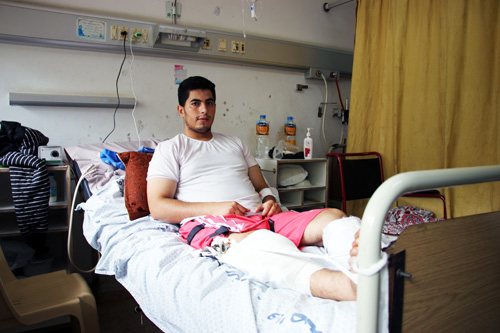 6 May 2018 – Ahmed is 25 years old and a volunteer first aid worker with the Palestinian Medical Relief Society (PMRS) in Gaza.
On 6 April 2018, Ahmed attended with PMRS first aid workers east of Khan Younis to assist those injured during demonstrations as part of the Great March of Return. At approximately 3pm, Ahmed was shot by a bullet that went through both his legs as he was in the field assisting a victim of teargas inhalation. The bullet broke a bone and ruptured blood vessels in his right leg, as well as injuring his left leg. He describes the incident:
“Another volunteer and I saw a few people injured about 50 meters from the fence. We rushed forward to help them and to get them to somewhere safe. Suddenly I felt something hit my legs and I fell down. I saw blood gushing out of both my legs, so I immediately took off my t-shirt to tie it around and called out for help. Instead of rescuing people I found myself being rescued! I was carried out on the same stretcher we’d brought with us to evacuate the injured.”
Ahmed has been volunteering with PMRS for the last year and a half:
“I’m passionate about helping others and I recently found out about the shortage of health workers and volunteers. So I signed up to volunteer with the PMRS. Before I was shot, we managed to evacuate about ten injured people that Friday. Some have been exposed to teargas and others injured with live ammunition.”
After Ahmed was evacuated, he was treated at the closest Trauma Stabilizing Point (TSP), receiving first aid to control the bleeding and a splint for his legs. He was then taken by ambulance to the European Gaza Hospital (EGH) in Khan Younis. “When I arrived to the EGH my leg was blue and I was in a lot of pain. I was quickly rushed to the operating room to fix the ruptured blood vessels and the fractured bone.” Ahmed stayed in hospital for 10 days. He had an external fixator for his bone fracture and required a skin graft. After he was discharged, PMRS provided home care with regular dressings, but he was re-admitted to hospital after he developed a wound infection and became feverish. “Today is my seventh day in hospital after I had to come back. Physically I’m feeling better, but mentally I feel destroyed. It’s hard to believe that I was shot. As paramedics and volunteers helping the injured we should be protected. I was wearing a vest that clearly showed I am a health worker. I was shot providing care to a guy who was suffering with teargas inhalation. Imagine.”
Ahmed graduated in Business Administration from Al-Aqsa University in 2016. He works intermittently because of the lack of work opportunities in Gaza. He is married and lives with his extended family in the village of Bani-Suhaila, east of Khan Younis in the south of the Gaza Strip. He and his wife are expecting a child in a few months.
WHO visits communities in Area C to demonstrate support, April 2018
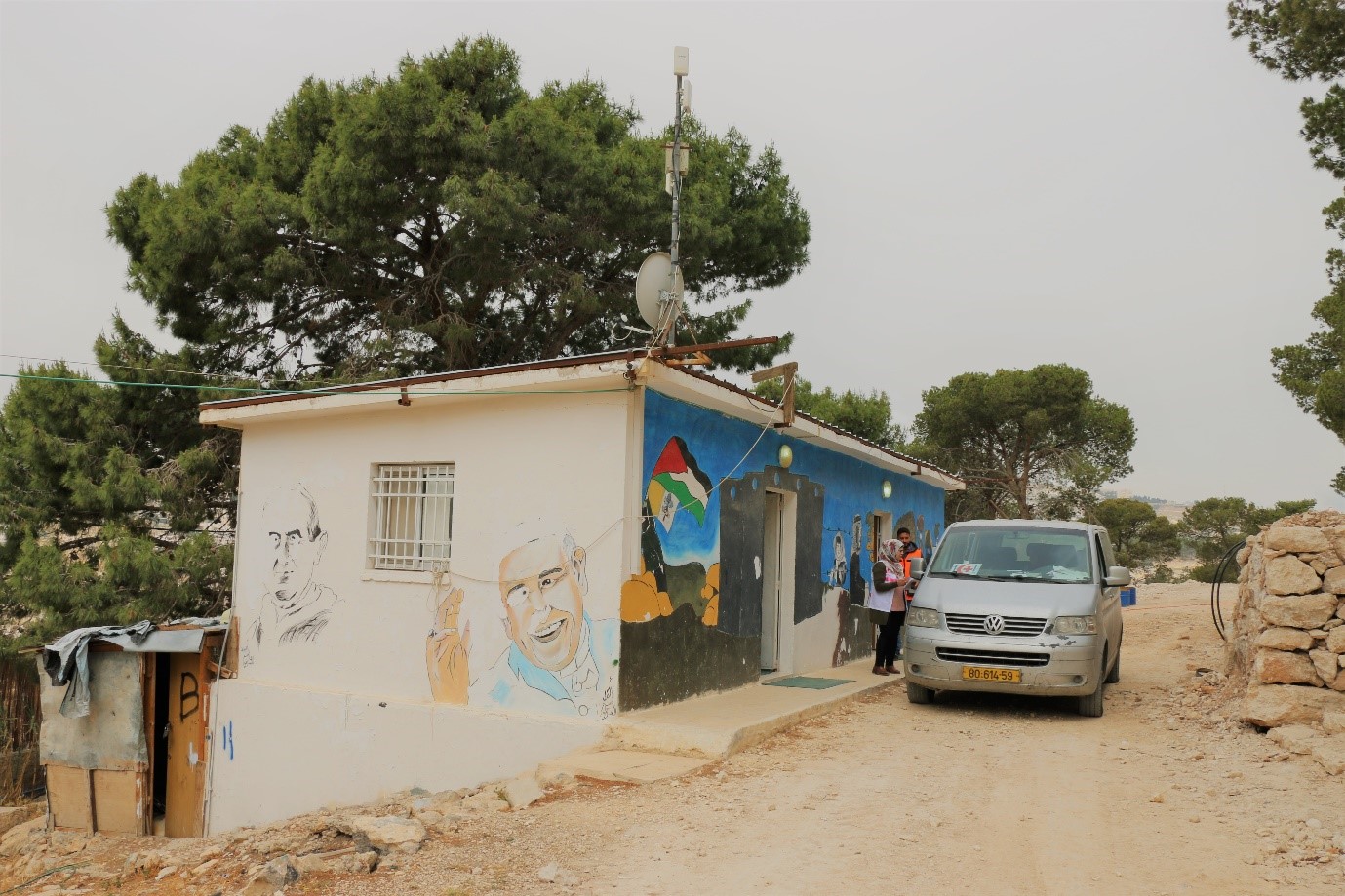 On 25th April, WHO visited Jabal al Baba and Khan al Ahmar with the Palestinian Medical Relief Society (PMRS) and Medico International to demonstrate its support for communities in Area C facing potential demolition of homes and humanitarian structures, including health clinics.
All buildings in Jabal al Baba have been threatened with demolition since November 2017. The building housing the mobile clinic in Khan al Ahmar is also threatened with demolition. There was a court hearing for the community on 25th April, but the decision was postponed for another week to 3rd May. Both communities are part of an area marked E1 plan by Israeli authorities for the expansion of settlements east of Jerusalem. Together they comprise a population of more than 1,600 residents.
PMRS is one of 10 health cluster agencies running 22 mobile health clinics to 189 communities in Area C of the West Bank. Area C comprises over 60% of the West Bank that is under Israeli civil and military control. Communities living in this Area are among the most vulnerable in the occupied Palestinian territory, facing violence from Israeli settlers and the military, night raids on their homes, destruction of their crops and livelihoods, and substantial barriers to development including demolitions of buildings and displacement. From 2009 to April 2018 there were at least 5,441 structures demolished, of which over 80% were in Area C. The structures included 917 that were donor-funded and 498 related to water and sanitation. Over 45,000 people have been directly affected by demolitions and 8,681 people displaced.
The threat to communities in Area C prevents the development of infrastructure and critical services, including health facilities and infrastructures for the adequate provision of water, sanitation and mains electricity. Among the approximately 300,000 Palestinians living in Area C, almost half (47%) have no connection or an irregular connection to the water network. The threat over communities creates insecurity, anxiety and fear.
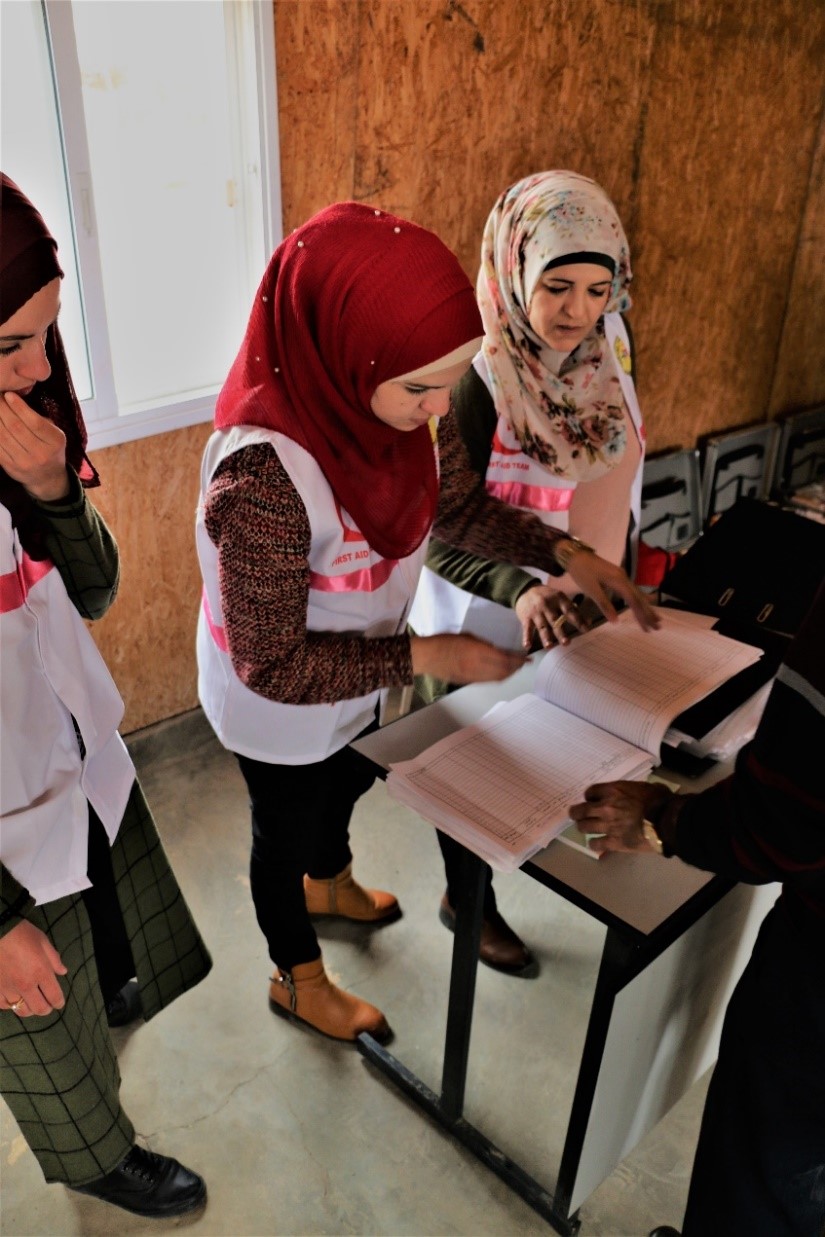 In 2017, seven mobile clinics run by PMRS, UNRWA and Humanity & Inclusion were denied permits by Israeli authorities to access communities they previously served regularly in Area C. On top of this, funding shortages undermine the continuity of service delivery to already vulnerable communities. Since the beginning of 2018, 35 clinics have closed and 82 are at risk of closure due to funding shortfalls.
Dr Gerald Rockenschaub, Head of WHO Office in the occupied Palestinian territory, stated: “The right to health should be respected, protected and fulfilled for all Palestinians, including those living in Area C. This means ensuring that the members of the public can access the health services they need, as well as ensuring that communities are able to develop the infrastructures necessary to improve the underlying social determinants of health – such as structures for water and sanitation, electricity and livelihoods. Ensuring the right to the highest attainable standard of health for all means proactively putting in place policies that empower individuals and communities to realize healthy living at all stages of life. The coercive environments that many residents of Area C face is clearly a barrier to achieving this.”
WHO talks to Yousef, journalist shot in leg during protests, after referral out of Gaza
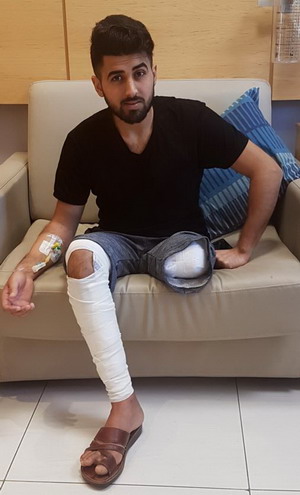 In spite of clearly identifying himself as a journalist, Yousef received bullet wounds to both legs during protests in Gaza. Surgeons operated successfully on Yousef’s right leg at Shifa Hospital, but they were unable to save his left leg and on 9 April Yousef had an above-knee amputation26 April 2018 – After a first meeting on 11 April, WHO met again with Yousef after his referral out of Gaza to Istishari Arab Hospital in Ramallah in the West Bank. Yousef was transferred to Shifa Hospital in Gaza after he was shot during protests on 30 March. Yousef is studying Media Studies and Public Relations at Al Azhar University in Gaza and he attended the first demonstrations on 30 March east of Al Bureij refugee camp as a photojournalist. He was wearing a vest that clearly marked him as ‘PRESS’ when he was shot in both legs. Surgeons managed to save Yousef’s right leg, but on 9 April he had an above knee amputation to his left leg.
“You know, when I first woke up I still had hope that both my legs would be saved and I would return to my normal life. I was absolutely devastated when they decided to amputate my leg.”
After WHO met Yousef in Gaza he was discharged from hospital on 12 April. On 16 April Yousef’s appeal through Al Mezan Center for Human Rights to the Supreme Court in Israel was upheld and he was granted a permit to travel to Istishari Arab Hospital in Ramallah. Yousef describes the process of having to apply for a permit to travel:
“Of course it was stressful. My father and uncles were going every day to follow up on the application with the Coordination and Liaison Office and human rights organizations, including Al Mezan Center for Human Rights. Finally I was given a permit to travel, but 12 of my relatives – my dad, my mum, my siblings and some uncles – were all refused permits to travel with me. In the end my grandfather of 85 years has come with me. Our family is paying for him to stay in an apartment near the hospital. My cousin is from Hebron and he comes to see me too.”
When WHO met Yousef in Gaza he was one of 6 patients who had applied to Israeli authorities for a permit to travel for health care. At that stage, all permit applications had so far been unsuccessful. Following the Supreme Court decision on 16 April, patient permit applications to exit Gaza were approved. As of 24 April, 9 out of 20 applications by patients injured in protests since 30 March in Gaza were approved and 11 denied.
Immediately after receiving his approval to travel, Yousef went by ambulance to Erez checkpoint, to exit the Gaza Strip to Israel and onto Istishari Arab Hospital in the West Bank. They were kept waiting at Erez for 2 and a half hours and Yousef was searched before being transferred to another ambulance on the Israeli side.
Yousef talks about his hopes for the future: “I still want to become a photojournalist and to finish my studies, but right now my main priority is to get an artificial limb so that I can walk again … I’m realistic. When things are bad I recognize they’re bad. When things are getting better, they’re getting better. I’m used to being my own support.”
Related link
Journalist denied exit from Gaza for health care loses his left leg from a gunshot wound
15 April 2018
WHO concerned over increasingly overwhelmed health services in the Gaza Strip
 17 April 2018, Gaza – Mass demonstrations in Gaza have left at least 33 Palestinians dead and more than 4279 injured since 30 March, according to the Palestinian Ministry of Health. The escalating violence has also led to the injury of 41 health staff, of whom 3 were injured by bullets, with 13 ambulances damaged by bullets and tear gas.
“The deteriorating humanitarian situation is extremely worrying. Hospitals in Gaza are overwhelmed with the influx of injured patients. With further escalations expected during the coming weeks, the increasing numbers of injured patients requiring urgent medical care is likely to devastate Gaza’s already weakened health system, placing even more lives at risk,’ said Dr Gerald Rockenschaub, WHO’s Head of Office for the West Bank and Gaza.
“We are especially concerned over the impact of the violence on health care workers and ambulances, especially in this current context,” added Dr Rockenschaub. “Health services in Gaza are already extremely limited due to chronic shortages of medicines, medical disposables, and inadequate supplies of electricity and fuel for emergency generators in hospitals.”
In response to increasing health needs, the Palestinian Ministry of Health has established 5 medical camps equipped with emergency supplies to stabilize injuries before referring them to nearby hospitals. The medical camps are staffed with up to 10 doctors and 15 nurses, supported by volunteers, and ambulances are on stand-by. Each camp is equipped with first aid medication, and had 3-4 beds; mattresses were also used to support the increasing number of casualties. They are complemented by 5 advanced medical posts managed by the Palestinian Red Crescent Society. An additional 5 primary health centres were opened to provide support.
However, shortages of medicines and medical supplies are impeding the ability of health authorities to effectively respond to the immediate needs of casualties. The Palestinian Ministry of Health and health partners need urgently to replenish 75 types of essential medicines, 190 types of essential medical disposables.
To fill critical gaps, WHO and health partners are currently in the process of delivering 10 types of essential medicines and 16 types of medical disposables to meet emergency medical needs.
“WHO continues to monitor the situation and identify urgent health needs that are required to save lives. However, without additional funding for trauma and surgical medicines and supplies, very little can be done. WHO and health partners urgently require US$ 4.4 million to respond to immediate emergency needs in Gaza. Further funding will be needed for emergency preparedness and response over the comings weeks as the demonstrations and clashes continue,” said Dr Rockenschaub.
Situation report