

Sélectionnez votre langue
Health Cluster sets up preparedness measures for Khan al-Ahmer, May 2018
 Deputy Minister of Health Dr Assad Ramlawi speaks at the Health Cluster meeting on 31 May 2018May 2018 - Members of the oPt Health Cluster met to review the preparedness and response plan in advance of the potential mass demolition and forcible transfer of the Palestinian Bedouin community of Khan al Ahmar – Abu al Helu, located on the outskirts of East Jerusalem in the occupied West Bank.
The Health Cluster discussed their joint operational response, as well as avenues of interaction with other sectors in advocating for the protection of this community and preventing the demolition.
More than 200 people, representing 32 families, live in this small Bedouin community, where most are Palestinian refugees and nearly 50% are children. Villagers of Khan al-Ahmer today also include 4 pregnant women and 2 disabled children.
Currently, the community is served by mobile health clinics run by the Ministry of Health (MoH), the Palestinian Medical Relief Society (PMRS), the United Nations Relief and Works Agency for Palestine Refugees in the Near East (UNRWA) and Medical Aid for Palestinians (MAP-UK).
Health Cluster partners are continuing to work closely with the MoH to upscale their services and meet the health needs of the community; this includes emergency care, maternal and child healthcare and also services to those who are chronically ill. Meanwhile, the Health Cluster will continue to advocate for the protection of the community in order to prevent a demolition.
The Health Cluster will continue to advocate for the protection of this community and will provide all of its technical, financial and human capabilities to ensure the timely and effective functioning of Mobile Clinics and enhanced support during emergency peaks. This entails additional medical staffing, involving surgeons, medical emergency teams, and volunteers, among others.
Turkey donates US$ 1.2 million to WHO for response to health emergency in Gaza Strip
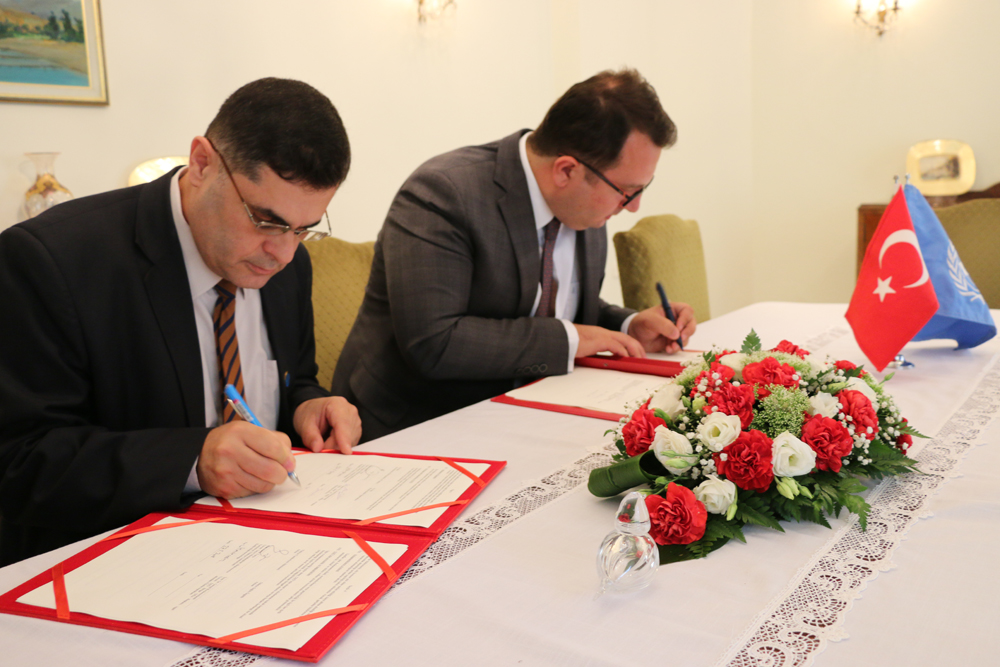 27 May, 2018 – With the aim of saving lives and drastically reducing the suffering of populations in Gaza, a US$1.2 million contribution from the Turkish Government to WHO was made official today. The fund will be used to provide essential drugs and disposables for trauma and emergency non-trauma cases across the Gaza Strip.
Since the mass demonstrations by Palestinians began in Gaza on 30 March 2018, over 100 people have been killed and over 13 000 people have been injured, according to the Ministry of Health. This current surge in humanitarian needs takes place against a backdrop of an extremely precarious humanitarian situation in the Gaza Strip and health system on the verge of collapse.
As of end of May 2018, 51% of essential drugs were at less than one month’s supply at the Central Drug Store in Gaza, including 47% of completely depleted items.
As constant shortages in essential lifesaving medical supplies add to the already burdened health system in Gaza, this timely funding provided by the Disaster and Emergency Management Presidency of the Prime Ministry of the Republic of Turkey (AFAD), will assist in procuring essential drugs and disposables needed by public hospitals, contributing to saving lives and reducing potential disability.
“It is a timely contribution, which will address the immediate needs of populations most affected by the recurring shortcomings of the health system in Gaza, thus giving communities a renewed sense of priority in emergency health care,” said Head of the WHO Gaza sub-office Dr Mahmoud Daher.
The Cooperation Agreement will provide targeted support to public hospitals. Over 150 000 patients will benefit with access to essential treatment through this funding.
“Funding provided to the World Health Organization is a sign of our determination to facilitate immediate support to Gaza medical staff working under exceptionally challenging circumstances to ensure the best possible emergency care to the substantial number of injured Palestinians overflowing hospitals at present,” said Erman Topcu, Charge d’affaires ad interim of the Republic of Turkey in Jerusalem.
”We will continue working with the State of Palestine and relevant international organizations with a view to contributing to efforts to ease the dire humanitarian situation on the ground, the root cause of which is the illegal closure of the occupied Gaza Strip”, Topcu concluded.
For additional information, please contact:
WHO truckload arrives at MoH Central Drugs Store in Gaza, May 2018
 24 May 2018 - Gaza, Over 930,000 medical consumables reached Gaza’s Central Drugs Store yesterday, May 22nd.
Procured from local suppliers and supplied to the MoH, elements include essential disposables such as latex gloves, sterile surgical blades, bandages, surgical face masks and chest tubes.
The Central Drugs Store in Gaza supplies all 14 MoH hospitals (2,234 beds) and 49 MoH primary healthcare clinics in Gaza. These health facilities provide 40% of Gazan’s primary healthcare covering approximately 600,000 people and 90% of all hospital care services.
As of 21st May, 47 % of essential drugs were completely depleted and 50% per cent were at less than one month’s supply at the Central Drug Store in Gaza.
Gaza: frontline health care innovation saves lives and reduces hospital load
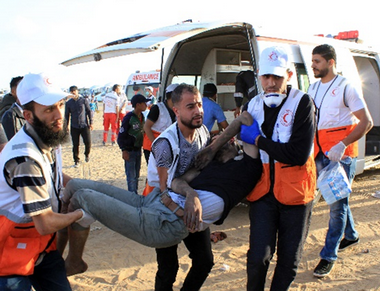 Patients are referred to the closest trauma stabilization point from the points of injury in northern Gaza. Photo: WHO18 May 2018 – During demonstrations in Gaza on 14 and 15 May, 62 Palestinians were killed, including one health worker, and 2768 injured, including 8 children. However, the toll could have been even higher without a recent emergency health care innovation.
Called ‘trauma stabilization points’, or ‘TSPs’, these large tent-like structures are located within minutes of the frontline and serve as the first point of care in the trauma-care pathway (from injury to pre-clinical trauma management, surgery and ultimate recovery). In a TSP, life- or limb-threatening cases are reanimated, stabilized, and then referred to hospitals for definitive further treatment. With these first crucial steps, TSP health workers can save additional lives in Gaza while taking some pressure off hospitals, which are being overwhelmed with injured patients.
One such patient who came through a TSP is Waleed. Waleed was shot in his left leg during last Friday’s demonstrations and immediately brought to the nearest TSP only 3 minutes away. There, doctors determined the severity of his injuries, stabilized his wounds, administered IV fluids and analgesics, and prepared him for hospital transfer. After surgery, he will have to rest for several weeks and use crutches but with the intervention at the TSP, Waleed managed to avoid permanent damage to his leg, and possibly an amputation.
Waleed is relieved: "I cannot afford to be on crutches [for long], while my home is destroyed. I must continue the chores at home and ensure my sister Amina’s reading classes. Who else will do it? My father was blinded in 2014 as a result of an explosion during the 2014 war and my mother died of cancer when I was 4 years old.”
In Gaza, the World Health Organization (WHO) has supported the Ministry of Health to upgrade the 5 TSPs close to the site of the largely peaceful demonstrations and enhance coordination with the additional 5 established by the Palestinian Red Crescent Society (PRCS). In addition, WHO provided medical supplies to Gaza including drugs, disposables and assistive devices for patients like Waleed. WHO also coordinates the Gaza Trauma Working Group, a coordination group which improves clinical standards, patient referral, and documentation of trauma patients. On 15 May, WHO also activated its global emergency medical teams (EMTs) network in order to more effectively respond to the humanitarian crisis.
Waleed is far from the only injured person. Since the start of the demonstrations on 30 March, over 12 000 people have been injured, including 3500 who have gunshot wounds. The influx of people with injuries has overwhelmed the healthcare system in Gaza, which was already in crisis before the demonstrations began; WHO reported in May that 40% of nearly 500 essential medicines were completely depleted in Gaza.
"Our surgeons are exhausted”, says Dr Medhat Abbas, director of the Dar Al Shifa hospital. “Our capacity has reached its limit. We cannot cope, even with surgeons and specialists, practitioners and volunteers.” Still, Dr. Abbas acknowledges that without the work of surgeons and nurses in the TSPs, hospital capacity and the quality of emergency care may have collapsed: “TSPs have greatly reduced the burden on hospitals; there is no question about it.”
In addition to TSPs and hospitals, specialist rehabilitation is a third key part of the trauma-care pathway. Dr Ahmad Shaheen, coordinator of the Al Awda hospital: “Many areas of Gaza have focused on the acute care elements of the trauma pathway. Yet, rehabilitation is critical.” With proper rehabilitation and help from specialists, Waleed and all other injured people in Gaza have a new hope for a full recovery and a healthy future.