

Sélectionnez votre langue
Coastal areas in Syria take the COVID-19 vaccination campaign to a new level
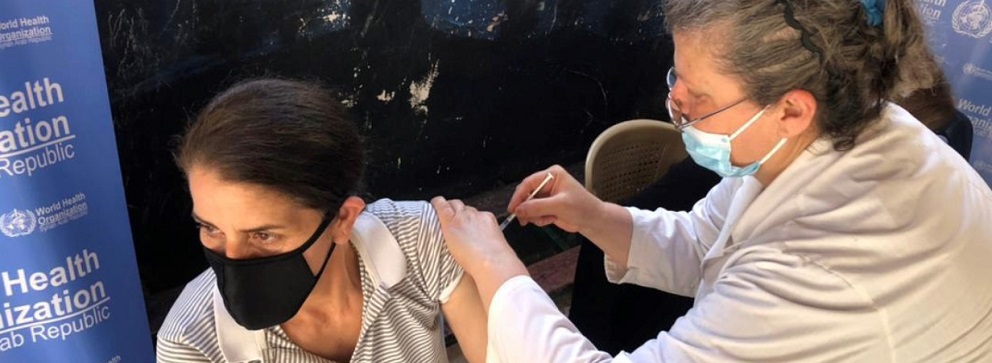
Damascus, 8 June 2022 – In a bid to increase the COVID-19 vaccination rates, Syria completed a 2-week intensified national campaign targeting over 2.5 million people across the country. Through more than 1000 fixed centres and 400 mobile teams, the campaign reached nearly every remote area in Syria to bring the vaccines closer to people.
In the coastal area, in Lattakia and Tartous governorates, WHO, together with 15 national and international community organizations scaled up their efforts by engaging community leaders, influencers, religious leaders, as well as 120 communication volunteers who accompanied vaccination teams to listen to communities, explain the benefits of vaccination and convince people about the importance of getting vaccinated.
“Everyone around the globe has been threatened by COVID-19, and the emergence of new variants continues to jeopardize the lives and livelihoods of millions. In Syria, people are well aware of the vaccines, however, low vaccination rates can be explained by challenges in vaccine accessibility and rapid spread of misinformation,” said Dr Hamza Hassan, Head of the WHO sub-office in Lattakia. “Making vaccines accessible to all communities and sharing accurate evidence-based information allowed us to increase the vaccination rates,” continued Dr Hassan.
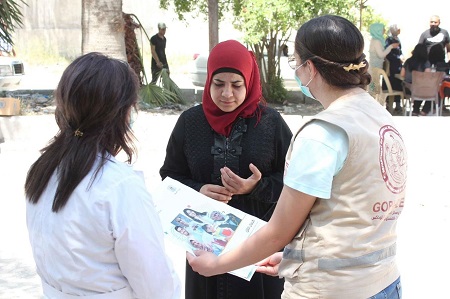
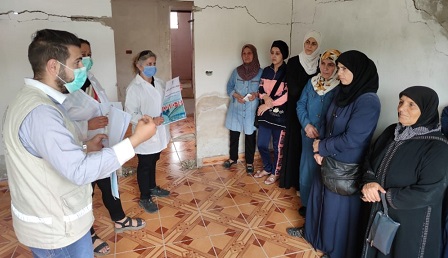
Before the campaign, WHO enhanced the communication skills of volunteers of nongovernmental organizations and international nongovernmental organizations to deliver adequate messages based on behavioural change strategies and est community practices. On a daily basis, volunteers reported on their visits to households, factories, shops, companies and other places and shared stories of those who decided to get their vaccines.
Because of these engaging important endeavours in the coastal areas and other parts of Syria, the number of vaccinated people has doubled during the campaign. While the average weekly coverage before the campaign was around 40 000 people across Syria, the national vaccination campaign saw the numbers go as high as 80 000 per week.
“COVID-19 has taken away one of my close family members. I know about the gravity of the disease from my personal experience, and I have decided to take a vaccine. I would like to see all those vulnerable people vaccinated as we cannot afford more losses and more tragedies,” said Ahmad, a 39-year-old businessman from Lattakia.
Syria’s programme of immunization has always been exemplary across the Region. Nevertheless, the late arrival of vaccine doses into Syria, novelty, as well as the short expiry date for some of the vaccines, played a major role in the growing perceptions against the benefits of vaccination.
While the current campaign could not reach the intended 2.5 million target, it has demonstrated promising practices such as stronger partnerships with local community organizations, expanded media campaign and SMS messaging, as well as increased involvement of local influencers and health care workers.
The Syrian Ministry of Health, in partnership with WHO and UNICEF, will conduct the next round of COVID-19 vaccination campaign in late June. All health sector partners and other stakeholders are invited to contribute to the campaign.
WHO issues situation report calling for urgent action to address malnutrition in northeast Syria
18 May 2022 – Seven hundred thousand more children face hunger in Syria due to the country’s continuously deteriorating economy, especially in northeast Syria. In the last 6 months, the total number of food-insecure children across the country has risen to more than 4.6 million. After more than 10 years of conflict and displacement, an unprecedented number of children in Syria are now battling soaring rates of malnutrition.
The World Health Organization and the Nutrition Sector continue to expand detection, as well as preventive and specialized inpatient nutrition services for children with acute malnutrition and ensure the availability of critical supplies.
Malnutrition refers to deficiencies, excesses or imbalances in a person’s intake of energy and/or nutrients. The term malnutrition covers two broad groups of conditions. One is ‘undernutrition’, which includes stunting (low height for age), wasting (low weight for height), underweight (low weight for age) and micronutrient deficiencies or insufficiencies (a lack of important vitamins and minerals). Malnutrition affects people in every country. Worldwide, some 159 million children are stunted and 50 million are wasted. Many families cannot afford or do not have access to nutritious foods like fresh fruits, vegetables, legumes, meat, and milk.
Over the past 11 years, northeast Syria has suffered enormously due to the ongoing crisis. The deterioration of health services, the economic crisis, and the decrease in purchasing power, coupled with the difficulty of accessing safe drinking-water have all led to an increase in malnutrition rates. As evidence shows, in 2022–2023 about 5.5 million people, including mothers and children aged 0–59 months in Syria will need direct nutrition assistance; half of them live in northeast Syria. Subsequent surveys have shown that the incidence of acute and chronic malnutrition is twice as much in northeast Syria as compared to the rest of the country.
WHO continues to confront the deteriorating nutritional situation in northeast Syria by providing a package of different nutritional service programmes. The main aim is to detect cases of malnutrition and ensure they get the appropriate management needed. WHO supports the management of malnutrition associated with complications in stabilization centres, in addition to fulfilling the need to prevent malnutrition through multiple programmes, such as infant and young child feeding counselling, as well as the Baby-Friendly Hospitals Initiative.
Addressing malnutrition is one of the key priorities for WHO in northeast Syria. The latest survey that was conducted in 2019 indicates that the rates of acute and chronic malnutrition cases in northeast Syria exceeded those recorded in other regions across the country. WHO expanded nutrition services in northeast Syria in 2021 to reach a large number of health facilities operating in the 3 governorates. Despite the challenges and the shortage of health care providers, WHO has covered large parts of northeast Syria, including hard-to-reach areas. However, more needs to be done to prevent or treat acute and chronic malnutrition in Syria.
Related link
COVAX supply update on COVID-19 vaccination in Syria, 10 May 2022
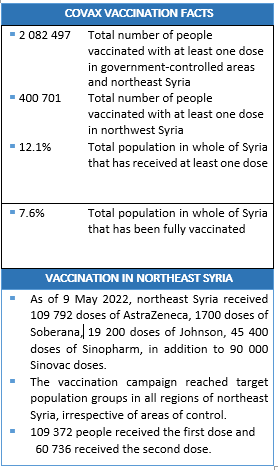 Summary
As of 9 May 2022, the total number of COVID-19 vaccines delivered to Syria through the COVAX Facility is 11 347 640 doses, in addition to 2 763 640 doses received through bilateral agreements. The available doses will enable Syria to reach about 45.4% of the population.
Between 23 March and 4 April 2022, 1 043 700 doses of AstraZeneca Covishield reached Syria via COVAX. So far, vaccines received from bilateral agreements represent 20% of the total vaccines received, and the remaining 80% were delivered through COVAX.
The vaccines are administered as part of the ongoing national vaccination campaign across the country.
Vaccination process
Vaccination activities continue across Syria at both fixed health facilities and through mobile medical teams in rural areas.
An increase of 44% in the number of administered doses was observed in April compared to March, due to the intensification of vaccination activities at mosques and shopping centres.
The Ministry of Health made vaccines available not only in designated health centres, but also in places where people visit the most. During the month of Ramadan, the implementation of vaccination during Tarawih prayers was carried out at 468 selected mosques in 6 governorates accompanied by workshops for religious leaders in different governorates. In addition, 13 churches, 2 malls and 2 parks were included in these activities.
Readiness for vaccines
Government and northeast Syria vaccination strategy as per the National Deployment and Vaccination Planto deliver vaccines
1037 fixed health facilities, including 43 hospitals and 994 PHC centres
361 mobile teams to cover rural and hard-to-reach areas
In total: 1398 vaccination teams are deployed (5499 health workers)
Northwest Syria
Increasing COVID-19 vaccination teams from 61 to 100 teams: 60 will work as outreach teams, while the other 40 teams will be located as fixed sites in the most populated areas, such as internally displaced persons camps and different cities in northwest Syria.
Priority groups
As per the National Deployment and Vaccination Plan, the vaccination priority groups include all adults over 18 years of age with special emphasis on health care workers, elderly, and people with comorbidities.
Challenges
The late arrival of vaccines makes it difficult for timely implementation of vaccination putting pressure on an already fragile health system. Overall vaccine hesitancy and the short expiry dates of some vaccine shipments create another challenge in achieving high vaccination rates.
Brussels VI Conference: "Supporting the future of Syria and the region": side event on health and the impact of the socio-economic crisis in Syria
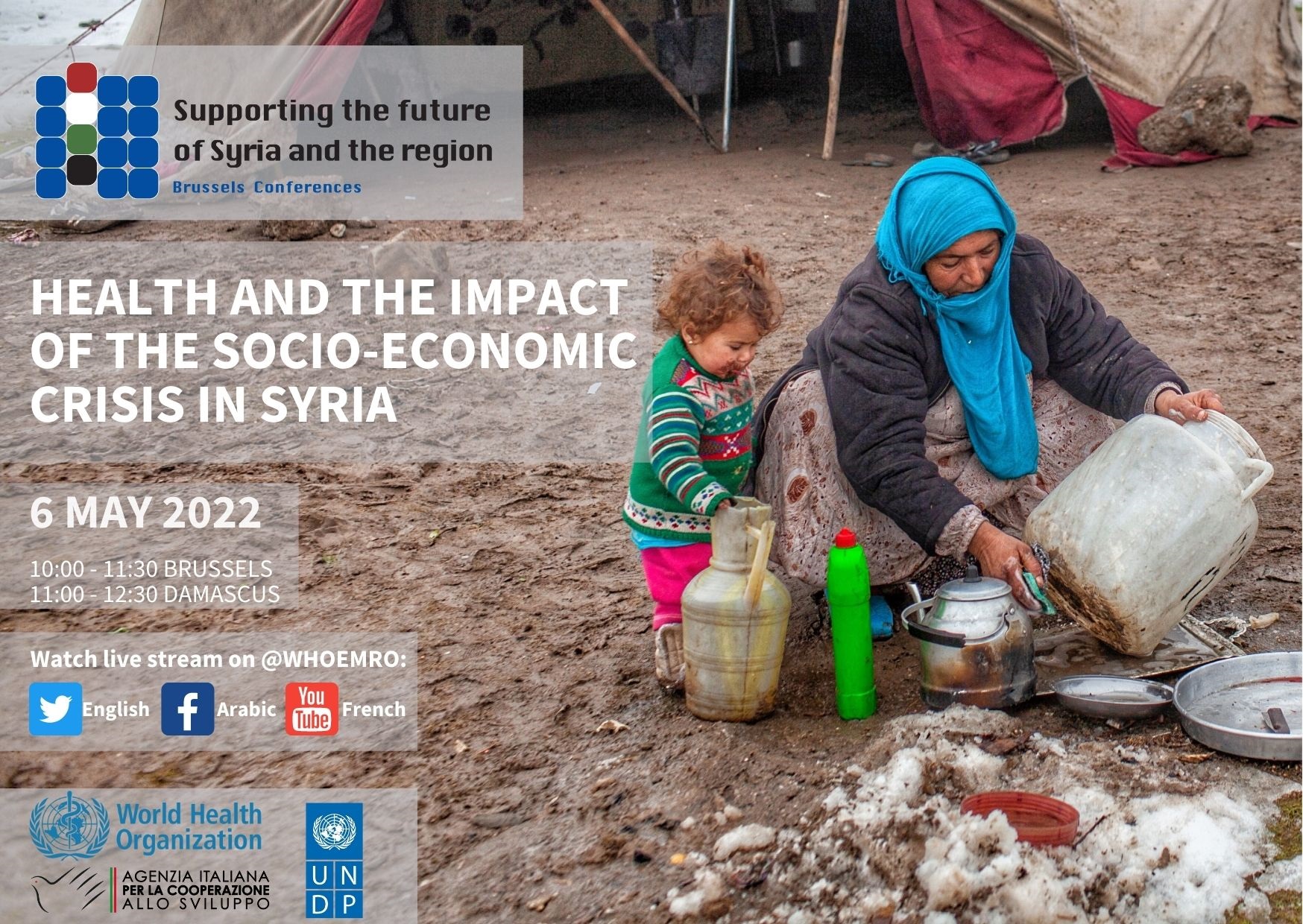
Join the important side event on health and the impact of the socio-economic crisis in Syria to be convened by WHO, in partnership with the Italian Agency for Development Cooperation and the United Nations Development Programme. The event will take place on 6 May, at 10 am Brussels time on the margins of the Brussels VI Conference on Syria.
Watch the event livestreamed on:
Twitter (English): www.twitter.com/WHOEMRO
Facebook (Arabic): www.facebook.com/WHOEMRO
YouTube (French): www.youtube.com/whoemr
Join this important panel discussion with Q&A that will focus on new multilateral partnerships and actions needed now to revitalize Syria’s severely disrupted health care system.
Related link
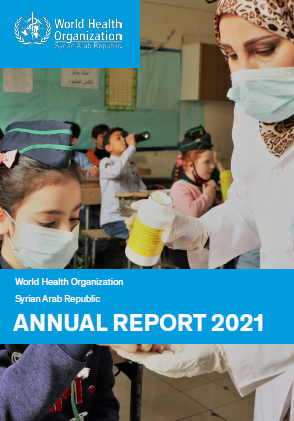 Syria annual report 2021