

Sélectionnez votre langue
Two years since world's largest outbreak of acute watery diarrhoea and cholera, Yemen witnessing another sharp increase in reported cases with number of deaths continuing to increase
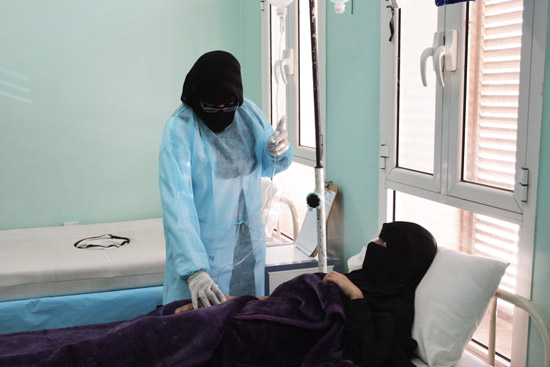 Photo: WHO/Sadeq Al-Wesabi
From Geert Cappelaere, UNICEF Regional Director in the Middle East and North Africa and Dr Ahmed Al Mandhari, WHO Regional Director for the Eastern Mediterranean
Muscat/Amman/Cairo, 26 March 2019 – “In Yemen, since the beginning of the year until 17 March, nearly 109 000 cases of severe acute watery diarrhoea and suspected cholera were reported with 190 total associated deaths since January. Nearly one third of the reported cases are children under the age of 5. This comes 2 years since Yemen witnessed the world's largest outbreak when more than 1 million cases were reported.
“We fear that the number of suspected cholera cases will continue to increase with the early arrival of the rainy season and as basic services, including lifesaving water systems and networks, have collapsed. The situation is exacerbated by the poor status of sewage disposal systems, the use of contaminated water for agriculture, unreliable electricity to store food and the displacement of families as they flee escalating violence, especially in Hudaydah and Tai’z.
“Our teams in Yemen are working day and night with a wide network of local partners to respond and stop the further spread and transmission of disease. Focusing on 147 priority districts, additional health, water, hygiene and sanitation supplies are being mobilized. Rapid response teams have been deployed. A total of 413 diarrhoea treatment centres and oral rehydration centres are operational in all 147 priority districts. Partners are repairing water and sanitation systems. In the past weeks, we scaled up chlorination activities to disinfect water in 95 priority districts and provided fuel and spare parts to keep going water supply and sanitation networks. A round of oral cholera vaccine campaign reached over 400 000 people in several districts. Meanwhile, community-based awareness-raising efforts reached 600 000 people in house-to-house campaigns since early 2019 to provide families with information on hygiene practices and improve the reporting of symptoms and seeking of treatment.
“UNICEF and WHO are committed to continue scaling up the response to assist immediately the people affected and to prevent the disease from spreading further. We are doing everything possible to avoid the 2017 scenario, including the timely use of proven effective measures, including oral cholera vaccination. However, we face several challenges, including the intensification of fighting, access restrictions and bureaucratic hurdles to bring lifesaving supplies and personnel to Yemen.
“UNICEF and WHO are calling for a lifting of all restrictions on our humanitarian operations to respond to the spread of the disease and other areas. Our humanitarian teams must have full access to reach every child, every woman, every man in need of medical and other humanitarian assistance.
“Above all, we jointly reiterate the calls for the fighting to end. It is time for the 4-year long war to come to an end. If not, Yemen will continue to be trapped in a web of disease, malice and sink deeper in endless humanitarian disasters, with the most vulnerable paying the highest price.
For further information, please contact:
Inas Hamam
Mobile: +2 01000 157 385
E-mail:
Tarik Jašarević
Mobile: +41 793 676 214
E-mail:
Statement on Yemen by Dr Ahmed Al-Mandhari, WHO Regional Director for the Eastern Mediterranean
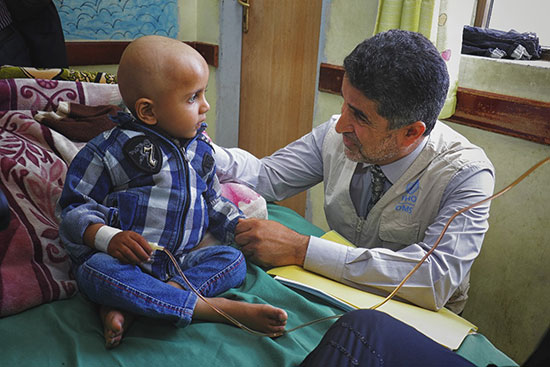 23 March 2019 - I have just returned from Yemen, where I witnessed firsthand the suffering, illness and death of innocent civilians caught up in this crisis.
In my visits to hospitals in Aden and Sana’a, I saw newborn babies and children, sometimes 2-3 to a bed, suffering from severe acute malnutrition, heart and renal failure, pneumonia and other life-threatening conditions. Doctors told me that some would not survive the week.
I met weak and frail kidney failure patients who receive dialysis sessions only once week, instead of the standard three, due to shortages in supplies. I witnessed cholera patients desperately clinging to life, fighting to survive a disease that is usually treatable under normal circumstances. There are patients with treatable forms of cancer who are dying needlessly, because they cannot afford the care, or it is simply not available.
In the Intensive Care Unit of Al-Thawra Hospital, a patient died before my eyes as doctors stood by helplessly, unable to save him. With more than half of all hospitals across the country not functional, and others barely operational due to shortages in medicines and supplies, many patients who can barely afford the cost of transport either die at home or reach health facilities too late.
I met many brave and heroic health staff, truly the backbone of the health system, who had not been paid in years yet were determined to keep working every day under incredibly difficult circumstances.
Amidst this massive suffering and despair, I saw signs of hope. I met Khadeeja, a little girl who was once severely malnourished and on the verge of death. Her parents travelled for hours to find a hospital that could treat her. She was admitted to a WHO-supported Therapeutic Feeding Centre, and weeks later, her condition improved. Many more months later, she is a happy, healthy, well-nourished girl.
We saved people like Ali, whose world fell apart last year when he learned that his eight children and wife tested positive for cholera. They received medical care in the diarrhoea treatment centre at Al-Sabeen Hospital jointly supported by WHO and UNICEF. They all survived, and Ali said that a new life was granted for him and his family.
Despite the unfolding tragedy in Yemen, stories like Ali’s and Khadeeja’s show that our work makes a difference. Last year, with 81% of required funding received as part of the 2018 Humanitarian Response Plan, WHO was able to successfully reach 13 million people, exceeding the target population of 10 million.
I call upon the international community to continue supporting our immediate lifesaving work in Yemen, while we also lay the foundation for investments in the health workforce and health system.
This year, WHO and health partners require US$ 627 million as part of the 2019 Humanitarian Response Plan for Yemen. This support will allow us to further improve access to primary, secondary and tertiary health care; ensure that hospitals in priority districts are able to respond to epidemics and outbreaks; and help restore the functionality of closed or damaged health facilities in high priority districts.
This year, humanitarian partners have recognized that meeting health needs is one of the top two priorities in Yemen, highlighting the urgency with which we need to act. The brave humanitarian aid staff working for our health partners in Yemen who have dedicated their lives to helping others must be allowed to continue uninterrupted.
As we continue to scale up our response to address the world’s worst humanitarian crisis I also call on all parties to the conflict to protect health staff and health facilities, and ensure safe and sustained access for humanitarian aid to enter the country. It is my sincere hope that the parties involved will come to a sustained peace settlement, which is the only sustainable answer to the humanitarian needs in Yemen.
The Minimum Service Package – a lifeline for the vulnerable in remote areas
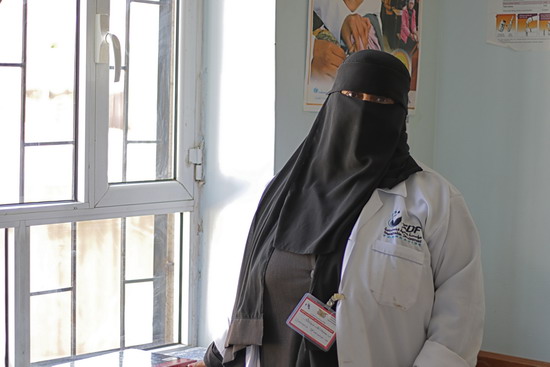 Safia Ahmed, has been working as a nurse for 20 years now. She currently works at Al Fawaris health centre supported by the Minimum Service Package. Due to the ongoing war in Yemen she has lost her her income.
19 February 2019 – With a health system on the brink of collapse, and ongoing conflict causing one of the largest humanitarian crises in the world, the health needs in Yemen are massive.
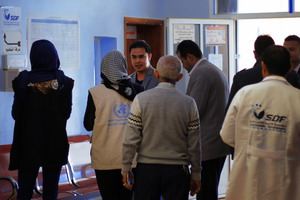 The MSP is a health delivery mechanism aiming at strengthening the access and availability of health care services therefore strengthening the health system in YemenThe Minimum Service Package (MSP) is a health delivery mechanism aimed at strengthening the access and availability of health care services therefore strengthening the health system in Yemen. Through the framework of the MSP, WHO in cooperation with health authorities and partners, is able to support the provision of primary health care services at the district level in 135 districts. Providing this access means that access to health care should not be an impediment, especially for vulnerable people in remote areas, where health facilities are either closed or lacking the needed supplies due to the ongoing war. Many people have to travel for hours to reach the closest facility putting them at risk of death.
Dr Hamid Al Hammadi, Director of Al Fawaris hospital, says that the support from WHO has enabled the health centre to provide primary health care for at least 10 000 people residing in the area who do not have access to health care nearby. “This project is critical and timely. Before the support the centre was functional for 5 hours a day only. Now we are able to operate 24 hours a day, 7 days a week,” he adds. The centre is now capable of providing maternal care, emergency care, laboratory tests and medical supplies.
Health workers are not forgotten
Since the beginning of the conflict 4 years ago, health workers in Yemen have struggled greatly to provide essential health care. Across the country, they work tirelessly without being paid and in turn cannot provide for and support their families. Providing incentives within the MSP ensures health workers are not forgotten.
Safia Ahmed works at Al Fawaris health centre supported by the MSP. She has been working as a nurse for 20 years now, and the ongoing war in Yemen has caused her to lose her income, like thousands of civil servants and pensioners who have not been paid salaries and bursaries for years due to the humanitarian situation.
“I now work here and thanks to the incentives paid by WHO, I am able to provide for my family. This support means a lot to us as health workers because it gives us a sense of purpose,” says Safia. Before this support, Safia would work 2 shifts for months on end without getting paid.
WHO expresses thanks to all donors and partners supporting the MSP in Yemen, including Italian Agency for Cooperation and Development, United Nations Central Emergency Response Fund and the Government of Kuwait. In 2019, WHO aims to make health services more accessible and available to 15 million people across Yemen.
Related links
Italian Agency for Development Cooperation
Despite civil unrest, almost half a million Yemenis treated for onchocerciasis
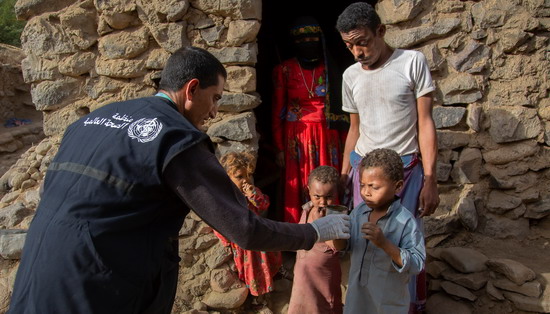 12 February 2019 | Geneva | Cairo | Sanaʽa – Defying logistical challenges and despite ongoing civil unrest and instability, health-care workers in Yemen have been able to distribute medicines through large-scale treatment of people at risk of onchocerciasis in 33 districts of the country’s 8 governorates [1].
The 3-day campaign on 28–31 January 2019 was led by Yemen’s Ministry of Health, the World Health Organization’s country office, with support of the Expanded Special Project for Neglected Tropical Disease (ESPEN) and the World Bank through the Emergency Health and Nutrition Project (EHNP).
“We mobilized 970 teams led by 225 team leaders and more than 1935 health workers to assist in the distribution of ivermectin tablets,” said the National Director of Neglected Tropical Diseases Programme, Yemen. “Preparatory works started in December last year and training workshops were decisive in achieving maximum compliance during the campaign.”
Out of a total of 528 420 people targeted in all 8 governorates, 474 027 people were reached and treated, representing 90% coverage.
A total of 1 177 524 ivermectin tablets from the Mectizan Donation Programme were used during this latest campaign.
Onchocerciasis in Yemen
Unlike Africa, Yemen there are no records of eye complications or blindness due to onchocerciasis.
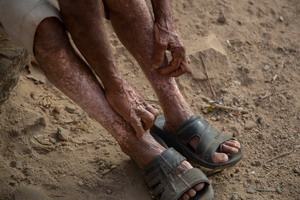 The disease mainly manifests in a localized form, mainly in lower legs in the form of ‘onchodermatisis’ also known as ‘reactive onchodermatitis’. Intense itching and skin irritation associated with severe manifestations leads to skin abrasion and other dermal infections.
The disease (locally known as ‘Sowda’ or ‘Sowdah’ referring to black pigementation) is endemic in 33 districts of the 8 governorates posing a risk to a total population of 3 million people.
Prevalence of onchocerciasis in Yemen is confined to the valleys running west of the Red Sea with over 60% clinical cases in the worst affected valleys. These areas abound with rapidly flowing water during the country's rainy seasons (usually between April and September) prompting fly breeding to take place. In Yemen, the vector for O.Volvulus is the blackfly, S. rasyani.
Prospects for elimination
Although Yemen started its onchocerciasis and lymphatic filariasis control programme as part of the National Leprosy Programme in 1992, targeting all people at risk of carrying microfilariae and susceptible to maintaining transmission even at a low level. The disease is under control and the national target is to achieve elimination as a public health issue as outlined in WHO’s Regional Office for the Eastern Mediterranean’s roadmap.
It is thanks to the technical support provided by the Regional Office and the dedicated work of local health workers and volunteers that treatment campaigns targeting everyone at risk are being sustained.
[1] Sana’a, Hajja, Ibb, Al-Mahweet, Dhamar, Raimah, Al-Hudaydah and Taiz