


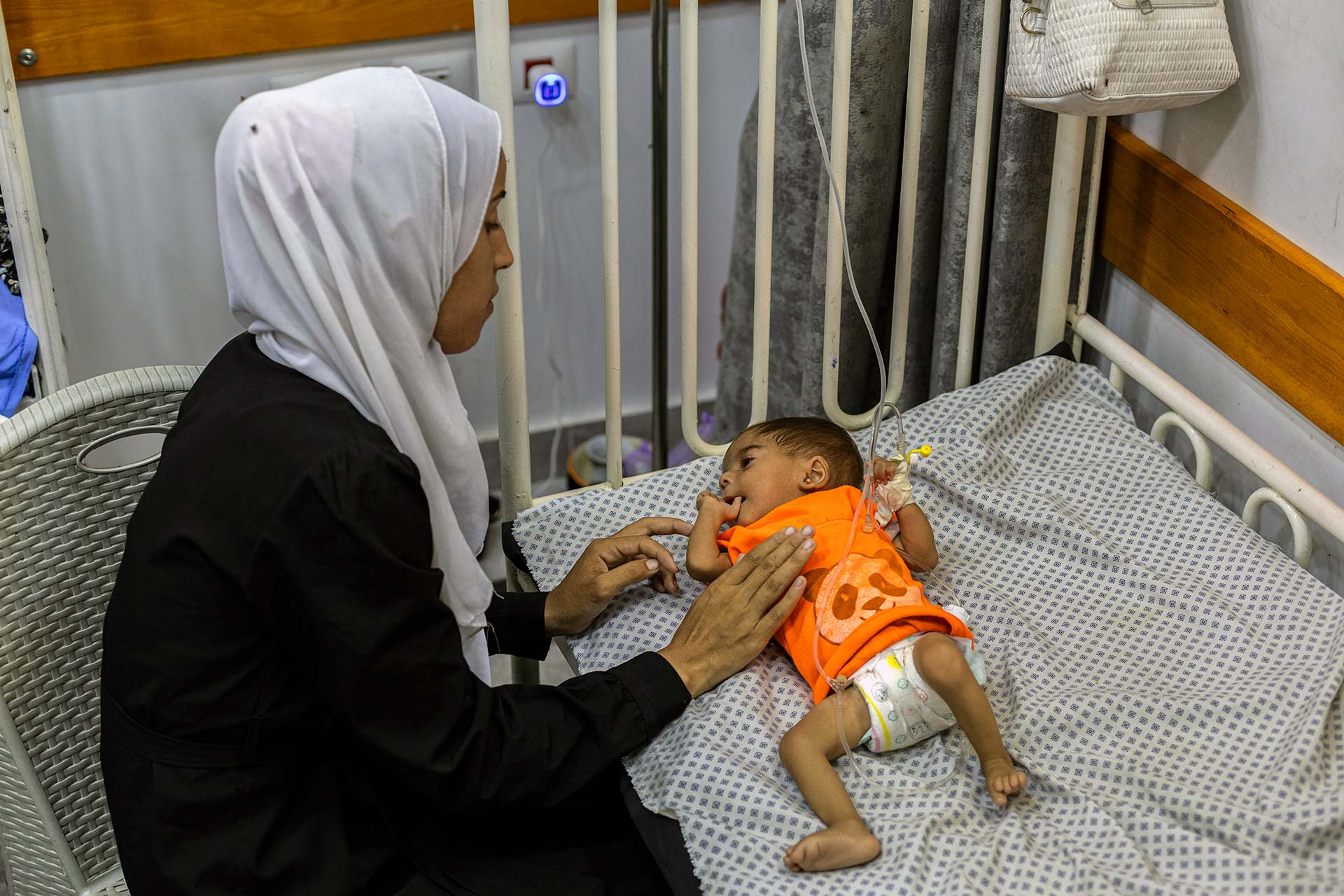
 A child with severe acute malnutrition (SAM) admitted to the inpatient SAM stabilization unit at Patient Friends Association Hospital. Photo credit: WHO
The malnutrition crisis in Gaza reached unmatched scale — at its peak, the entire population of approximately 2.2 million people faced acute food insecurity.
Before the conflict, malnutrition in Gaza was rare. By 2025, it had become one of the key health issues of the conflict. In this episode, Dr Dalia AbuJahel, WHO's Reproductive Health Officer, and Salwa Al-Tibi, Country Representative for emergency medical team Med-Global, discuss the scale of the malnutrition crisis in Gaza, how it unfolded, and what the response has looked like on the ground.
They speak to the human cost — including the story of two sisters, Jana and Joury, who died from severe acute malnutrition despite receiving care — and reflect on the broader impact on paediatric and maternal health, from rising rates of prematurity and low birth weight to overwhelmed neonatal units and shortages of essential supplies. They also look at what recovery will require, and why the situation, while stabilising, remains fragile.
Guests
Salwa Al-Tibi, Country Representative, Med-Global
Dalia AbuJahel, Reproductive Health Officer, WHO oPt
Transcript
Egmond Evers 00:05
Welcome back to The Frontline Shift, a podcast by WHO that looks at what it really takes to keep healthcare going in Gaza through coordination and deployment of emergency medical teams. I'm your host, Dr Egmond Evers Health Emergencies Team Lead for WHO in the occupied Palestinian territory.
Luca Pigozzi 00:21
And I'm Dr Luca Pigozzi, Acting in Charge of the WHO office in Gaza.
Egmond Evers 0:27
Children have paid a devastating price in the two years of conflict in Gaza, and we're not just talking about violence, displacement, disease and hunger have been equally devastating and often deadly.
Luca Pigozzi 0:37
In today's episode, we focus on how the conflict, restriction of aid and famine escalated malnutrition and also impacted the overall paediatric care in Gaza and the role of the emergency medical teams in supporting this.
Egmond Evers 0:51
We will also focus on the immense challenges of delivering healthcare for children during the conflict and what is needed to meet ongoing needs.
This is The Frontline Shift
Luca Pigozzi 1:03
With us today we have Salwa Al-Tibi speaking to us from Gaza. She's the Country Representative from Med-Global. Med-Global is an emergency medical team working in Gaza and deploying international teams since January 2024. We also have with us Dalia AbuJahel. She's the WHO reproductive health officer who was born and raised in Gaza.
Salwa Al-Tibi 1:27
Hello. Thank you so much for the invitation.
Dalia AbuJahel 1:31
Hello and thank you for the invitation.
Egmond Evers 1:34
Aid restriction has been a significant and persistent challenge in the conflict in Gaza, a complete blockade on the entry of all humanitarian aid, including food, medicines and other essential supplies, lasted between early March and mid May 2025. Just under three months. The restriction on entry of aid at scale has remained an issue throughout the conflict, although the availability of food in Gaza has improved since the ceasefire in October 2025.
Luca Pigozzi 1:59
One of the most alarming consequences of these aid restrictions in Gaza was the dramatic rise in malnutrition. Before the conflict, Gaza had enough food to feed its population, and malnutrition was really rare.
Egmond Evers 2:13
At that time, 0.8% of children under five years of age were acutely malnourished. But by February 2025 according to the United Nations IPC report, the figure was between 12 and 16% in the north of Gaza. In that area, the shortage of food was most severe given access restrictions for humanitarian staff and due to the intensity of ground operations.
Luca Pigozzi 2:35
Just to explain to our listeners, the IPC is a joint partnership of 21 organizations, including also us, including also WHO, who work together to determine the severity and extent of acute and chronic food insecurity and acute malnutrition situations according to internationally recognized standards.
Egmond Evers 2:54
It's no surprise that restriction on the entry of food eventually led to famine in parts of Gaza in late August 2025 one of the darkest chapters of this conflict. Butthe malnutrition situation was already dire much earlier in the year, even before famine was formally declared in parts of Gaza. Despite famine conditions ending by December, the damage had already been devastating, compounded by the destruction of the healthcare system.
Luca Pigozzi 3:19
Children and also adults died from the combined effects of malnutrition and diseases. Malnutrition weakened their bodies, making it harder to heal from injuries and fight off common communicable diseases like diarrhea and respiratory infections.
Egmond Evers 3:37
In turn, these infections increased the body's requirement for nutrition while reducing nutrient absorption, resulting in worsening malnutrition. With healthcare out of reach and access to clean water and sanitation severely limited illness and death increased.
Luca Pigozzi 3:53
Dalia, what has been the scale of the malnutrition crisis, and what is the situation as of now? How been the response delivered?
Dalia AbuJahel 4:02
As you mentioned, Luca, malnutrition was never reported in Gaza. The malnutrition crisis in Gaza has reached unmatched scale over the past years, particularly in 2025 when conditions in parts of the Gaza Strip, deteriorated into famine. So at its peak, and according to the IPC analysis, the entire population of approximately 2.2 million people living in Gaza faced acute food insecurity, with around 470,000 people in catastrophic hunger, IPC Phase Five, definitely, children have been disproportionately affected, with an estimated 71,000 children required the treatment from acute malnutrition, including around 14,000 children treated for severe acute malnutrition (SAM), and more than 1000 children were treated at SAM stabilization centers for severe acute malnutrition with complication, which is a life threatening condition with high morbidity and mortality. In some areas, acute malnutrition rates surged dramatically, with reports of up to one in five children affected from malnutrition, especially in Gaza Governorate, where famine was declared in August 2025. Malnutrition related deaths have also been reported in 2025, particularly among younger children. And the total number that has been verified by WHO, Minister of Health and Nutrition Cluster reached 421 of which 113 were children. Definitely, the crisis has been driven, as you mentioned, by the collapse of the food system, the severe restriction on the entry of humanitarian aid, the widespread displacement, destruction of the health services and poor WASH infrastructure, with lack of access of safe water as well as adequate nutrition. As of early 2026 the situation remains extremely serious, although the famine condition have been pushed back following relatively increased humanitarian access. However, according to the latest IPC analysis, an estimated 1.6 million people are expected to be facing high levels of acute food insecurity through mid April 2026, this includes approximately 101,000 children less than five years who are projected to be requiring treatment from malnutrition. Other vulnerable groups have emerged, including around 36,750 pregnant lactating women, 25,000 infants below six months, as well as 120,000 children aged 5 to 17 years. So while the immediate risk of famine have been reduced, still Gaza continues to face a larger scale, and we can say protracted malnutrition crisis, and a situation that will remain fragile unless there is a sustained humanitarian support that is secured. WHO worked in collaboration with the Minister of Health, Health Cluster and the Nutrition Cluster to respond to the malnutrition crisis in Gaza Strip, WHO focused on establishing severe acute malnutrition stabilization centers, which are centers that are dedicated for the inpatient treatment of severe acute malnutrition with complication. Since the start of the conflict, WHO supported the establishment of severe acute malnutrition stabilization centers all over the Gaza Strip. Ten stabilization centers were established in different governorates of Gaza Strip, out of which seven are remaining operational until now. The main challenge for establishing the stabilization center in Gaza was the lack of availability of enough space for integration of stabilization services in the inpatient facilities.
Egmond Evers 7:30
Dalia raises an important point, even as food access improved following the ceasefire and famine conditions were reduced in December 2025 a large number of people in Gaza are still expected to face acute food insecurity. This is because following the ceasefire, while markets improved with better flow of food deliveries, vulnerable families especially are unable to afford food. Nutrient rich foods, particularly proteins, remain scarce and expensive, and this is the reality for many people.
Luca Pigozzi 8:00
There have been so many devastating cases of lives lost due to hunger, something that was entirely preventable and manmade. Dalia, you have been working with the Ministry of Health to verify these cases. Are there any particular ones that come to mind?
Dalia Abu Jahel 8:17
As I mentioned, more than 113 children died from acute malnutrition, but there are two cases, actually they are two sisters, Jana and Joury, who tragically died from the severe acute malnutrition despite receiving care at the stabilization centers. Both sisters were admitted to the stabilization centers multiple times suffering from severe acute malnutrition, with complications mainly fever, diarrhoea, poor appetite, anaemia, dehydration and electrolyte imbalance. Despite each time they were admitted and received care at stabilization centers, they initially in the start showed improvement of their medical as well as a nutritional condition, but the recurrent admission to the SAM stabilization center and the fragility of their condition, and as you mentioned, the poor immunity that is attributed to the malnutrition situation, ultimately led to their death. Joury died first. She was only one and a half years suffering from the severe acute malnutrition with complication. Despite, as I mentioned, receiving the nutritional rehabilitation at two SAM stabilization centers, then Jana, after that, she died. Both of them were admitted more than three times to severe acute malnutrition stabilization centers and received adequate treatment. Both Jana and Joury were supposed to be receiving medevac and to be treated outside Gaza, but unfortunately, both of them died even before having the access for more advanced treatment outside Gaza.
Luca Pigozzi 9:45
Thank you. Dalia, very sad stories. Salwa, your team has been working on treating children with malnutrition. How young have the patients been? What is the caseload like now, and when did you start seeing a reduction in cases?
Salwa Al-Tibi 10:00
In the beginning, we were targeting from zero to five years old, but now we are targeting according to the needs. We are targeting the children from zero to 12 years old. And let me explain so far, the number of the children, is reduced. But last month, for example, at hospital, we received 25 cases with SAM with complications, and 11 of these children were below six months. And it's related to the mothers, because the mother, when she was pregnant, she was, you know, facing a malnutrition. What we are doing inside the stabilization center upon receiving the child and his or her caregiver at the hospital, the measurement are taking, including (MUAC) Mid-Upper Arm Circumference, weight and height based on the child health condition. If severe acute malnutrition is detected, the child will be transferred immediately to the inpatient department to begin the intensive treatment phase. In the same time, we are not working only with the children. We are supporting the caregivers. You know, we work closely with the mothers and caregivers by providing infant and younger child feeding, as I mentioned, awareness sessions to strengthening in nutrition practices and ensure sustainable improvement in the child health.
Luca Pigozzi 11:39
Thank you very much. Salwa, for your testimony. Dalia, could you tell us what are the long term impacts on children's health as a result of malnutrition?
Dalia Abu Jahel 11:50
Actually, the malnutrition situation in Gaza has moved from just not only being an acute emergency, but also is now evolving into a protracted crisis, and definitely it will have long term application for the affected populations, especially the children stunting and developmental delays due to prolonged malnutrition during the critical growth periods. The first 1000 days of any child's life is a very critical growth period which will be likely having an impact on the physical growth as well as the cognitive development, especially girls and adolescents who are facing high risk during the future pregnancies from poorer nutrition as well as health outcomes. Additionally, there will be likely long-term impact on the non communicable diseases risks, especially early life malnutrition increases the susceptibility for metabolic disorders, cardiovascular diseases and other non communicable diseases. Those children are under a very highly stressful condition which will be also affecting their mental health as well as psychosocial well-being, mentioning that the profound destruction, as well as the poor living condition, which will be like having very long term impact on the situation of those children, this actually raises and highlights the urgent needs for not only immediate lifesaving intervention, but as well as sustained investment in nutrition as well as, of course, health system recovery in order to prevent this last public health consequences on the children as well as the future generations.
Luca Pigozzi 13:22
Apart from malnutrition, overall paediatrics and maternal health care has suffered immensely in Gaza. Dalia, what have been some of the setbacks and what is being done to support in expanding services?
Dalia AbuJahel 13:36
Thank you, Luca, as Salwa mentioned, the fact that many admissions involve very young children, underscores that there's a very heightened vulnerability. Among these key challenges is the damage and the closure of health facilities, which has reduced the availability of essential services such as antenatal care service delivery, natal intensive care as well as paediatric treatment, which led to very high challenges in even establishing the stabilization centers, as I mentioned earlier. Additionally, there have been severe shortages of medicines, equipment supplies, which affected not only the quality but also the continuity of the care the healthcare workforce themselves, being Gazan suffering from the same hard living condition. They have been very heavily impacted, being displaced, overworked or unable to even to safely reach their workplaces, additionally, access barrier, including insecurity, transportation concern, population displacement, which have delayed care seeking, often resulting in more severe conditions even at the presentation. To address these setbacks, a lot of efforts are ongoing to restore and expand essential services, including supporting the rehabilitation and functionality of key health services, particularly maternity wards and neonatal units and paediatric departments. There also has been a large focus on larger scale provision of essential medicine equipment as well as supplies, additionally training of healthcare workers and supporting them in order to strengthen the service delivery. In parallel partners are working on expanding the service coverage, especially in areas where access has been better secured, and scaling up the stabilization centers for severe acute malnutrition, and strengthening the primary health care services and improving referral systems in order to ensure the continuity of care. There's also a continued emphasis on coordination as well as health system support to align intervention and prioritize the most affected areas. So a lot of important steps are being taken to expand services and sustained access to resources, as well as long-term investment are still needed and critical in order to fully restore and strengthen the paediatric and maternity healthcare in Gaza Strip.
Egmond Evers 15:45
Salwa, are there enough supplies coming into Gaza to support the care that's needed?
Salwa Al-Tibi 15:50
Still there is a gap. There is, you know, a shortage of medical supplies and disposables and equipment and other also, or let me call the spare parts for some of the equipment. There is a lot of the changes, also, that sometimes we face problems due to the closure of the crossings.
Luca Pigozzi 16:12
Thank you very much Salwa.
Egmond Evers 16:15
Dalia, what are some of the more common pediatric cases that we're seeing now in Gaza?
Dalia Abu Jahel 16:19
We are seeing a very high surge in prematurity in Gaza now. The increase rates of prematurity is reaching 11% of the live births now in Gaza, who are increasingly requiring admission to neonatal intensive care units for a long period, until they are recovering and able to be going with their mothers to the community. Additionally, low birth weight, which is attributed to the malnutrition during the pregnancy, is also surged high in some governorates during the famine crisis. It reached more than 15% of the live birth who are additionally requiring admission to the neonatal intensive care unit, as well as recurrent admission to the paediatric services later on. Additionally, congenital anomalies are being recorded among the newborns now in Gaza, which is also multifactorial, not all, related to only the malnutrition situation, but also to other genetic as well as predisposition, and later on, a lot of studies will be required to to investigate the causes of congenital anomalies. Additionally, children with inborn error of metabolism and metabolic disorders are increasingly requiring admission to the paediatric services. Those children in the past used to be referred outside Gaza for diagnosis of their condition as well as for specialized treatment. Now, they are recurrent admission, recurrently admitted to the pediatric services, as well as to the stabilization center, and unfortunately, they have high morbidity and mortality consequences of their condition with poor availability of the specific treatment now in the Gaza Strip. Additionally, as you know, the high rates of of communicable diseases and the outbreak of communicable diseases is also causing increasing admission of complication attributed to these communicable diseases, acute respiratory tract infection, acute diarrheal disorders, as well as bloody diarrhea, they are increasingly admitted to the paediatric services as leading to more than 100% occupancy rate and in the paediatric hospitals who are barely functioning with limited bed capacity, as well as limited staff working in these hospitals.
Luca Pigozzi 18:43
Dalia, what is needed to improve the paediatric and maternal health care services in Gaza?
Dalia Abu Jahel 18:48
Actually, everything is needed to improve the paediatric and maternal health care services in Gaza, but some of the several critical priorities that are needed to be addressed is: first and foremost, is sustained and unhindered humanitarian access. Without reliable access, it will not be possible to ensure continuity of essential services, timely referrals, or the consistent delivery of care for women and the children. WHO is working tirelessly on securing the entry of supplies as well as medication and equipment in Gaza. Second, there is a need for large scale provision of medicine and supplies and equipment. This includes everything from essential drugs consumable to neonatal and obstetric equipment required for safe deliveries in newborn care and paediatric treatment. Third and the most important, is rebuilding and strengthening the health care workforce, not only addressing shortages, but also supporting the training and retaining the skilled health worker who have been operating under extreme pressure. WHO, throughout the past year and this year, is trying to work on a package of sexual reproductive, maternal, newborn and child healthcare capacity building topics, in order to improve the quality of the healthcare provided to the paediatric as well as to the maternity cases admitted to the hospitals, as well as at primary health care level. Finally, there must be a long term investment in the health system in Gaza, restoring and rehabilitating the healthcare facilities and strengthening the primary healthcare and ensuring the integration of maternity, newborn and child health services. Much more focus needs to be for restoring these services in order to ensure that we have timely as well as availability of services for these vulnerable groups in the Gaza Strip.
Egmond Evers 20:32
The stories we've heard today of children like Jana and Joury and of health workers treating children under impossible conditions, these are not just numbers, not just statistics, they're the lived reality of an entire generation.
Luca Pigozzi 20:46
Access to health services, medical supplies and a sustained commitment to rebuilding, this is what Gaza needs now. Thank you Salwa. Thank you Dalia, for your time and hard work dedication in this emergency response.
Egmond Evers 21:00
And to every health worker and humanitarian who has refused to give up on Gaza, thank you. This has been The Frontline Shift. These are your hosts, Luca and Egmond, signing off.
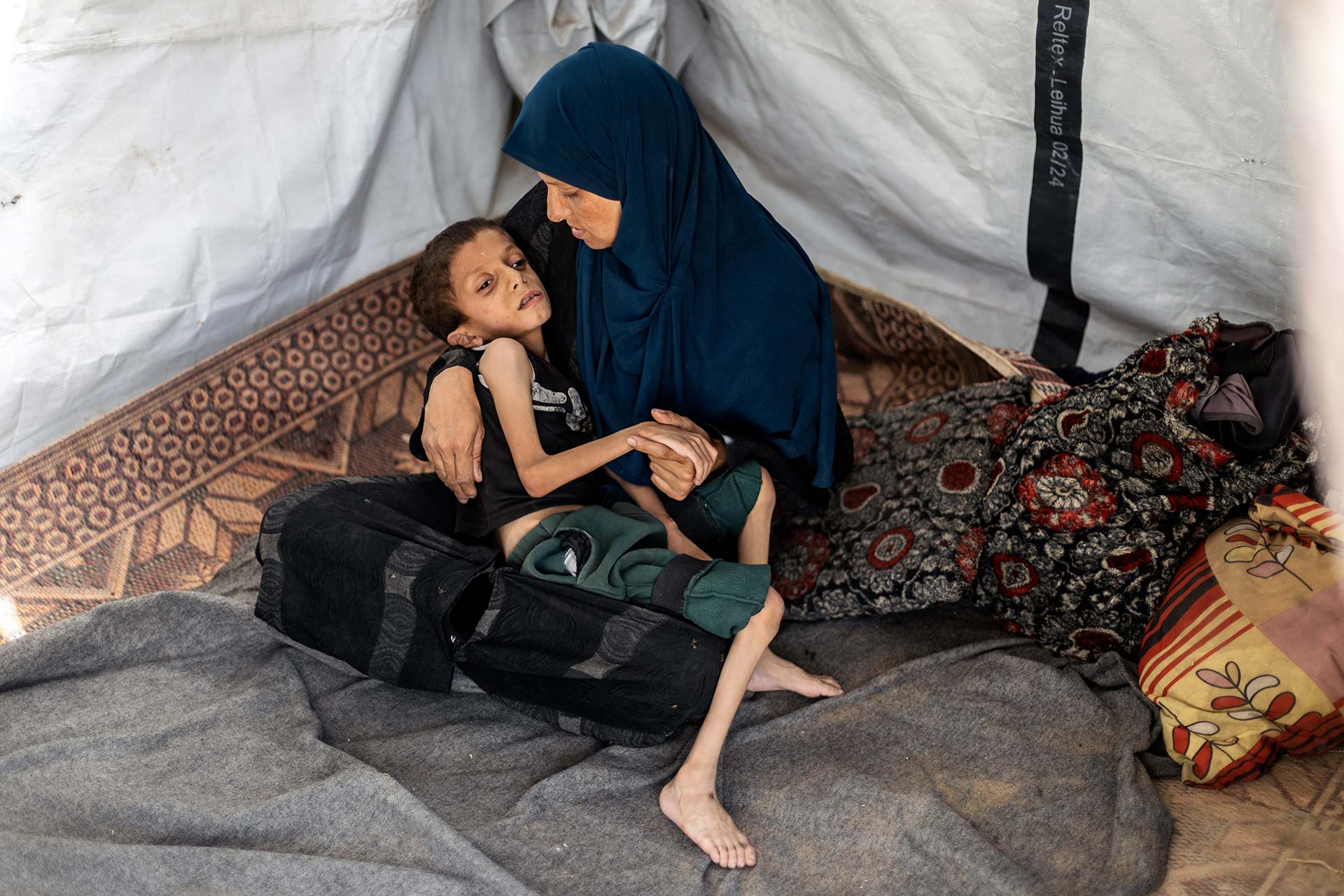 A child suffering from malnutrition sets in a tent with his mother. Photo credit: WHO
