

Sélectionnez votre langue
Health partners recommit to integrated approach to address health emergencies in Somalia with a focus on polio
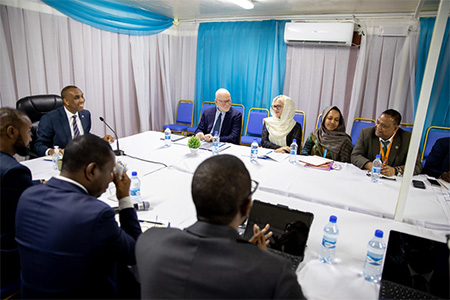 H.E the Prime Minister of Somalia, Mr. Hamza Abdi Barre chairs a high-level consultative meeting with BMGF, WHO and UNICEF on 12 October 2023. Photo credit: WHO Somalia/I.Taxta19 October 2023, Mogadishu, Somalia – High-level political support to stop poliomyelitis, boost immunity to other vaccine-preventable diseases and strengthen health systems in Somalia has been renewed and reinforced. This follows a series of meetings between the Prime Minister of the Federal Government of Somalia, His Excellency Mr Hamza Abdi Barre; representatives of the World Health Organization (WHO), United Nations Children’s Fund (UNICEF) and United Nations Population Fund (UNFPA); and a delegation from the Bill & Melinda Gates Foundation led by Dr Chris Elias, President of the Global Development Division. Ms Etleva Kadilli, UNICEF Regional Director for Eastern and Southern Africa, also joined the discussions.
Dr Chris Elias, who is also Chair of the Global Polio Eradication Initiative (GPEI) Polio Oversight Board, and polio team members took part in a half-day technical consultation with the Federal Ministry of Health. The aim was to review progress, assess barriers and determine how to advance the march towards a polio-free world.
Under the leadership of President Hassan Sheikh Mohamud of Somalia, the Prime Minister remains strongly committed to efforts that protect Somalia’s children from outbreaks of polio, measles and other vaccine-preventable diseases and that ensure increased outreach across the country to vaccinate mothers and zero-dose children under the Expanded Programme on Immunization.
While extending appreciation for the work and commitment of the Bill & Melinda Gates Foundation, WHO, UNICEF and UNFPA in strengthening immunization, the Prime Minister called upon the Foundation and the health partners “to extend support beyond polio eradication, especially in the area of finding durable solutions to break the cycle of chronic humanitarian emergencies and resulting food crisis.” H.E. Mr Hamza Abdi Barre further urged the organizations to extend their support in the areas of “climate change adaptation, food security and human capital development.” He added: “Such a comprehensive approach will strengthen health systems in a way that improves health and well-being of Somalis.”
Somalia is facing one of the world’s longest running outbreaks of circulating vaccine-derived poliovirus type 2. Since the outbreak began in 2017, the virus has paralysed 32 children in the country and spread to Ethiopia and Kenya. Ending this outbreak is a priority for Somalia and its partners, including GPEI, the core partners of which include WHO, UNICEF, the Bill & Melinda Gates Foundation, Rotary International and Gavi, the Vaccine Alliance.
“I would like to congratulate the Government of Somalia and our partners for the progress towards stopping polio, commitment to introducing pneumococcal and rotavirus vaccines, and continued commitment to control cholera,” said Dr Chris Elias. “The Polio Oversight Board looks forward to continued high-level government leadership to end polio and emphasizes the importance of taking an integrated, whole-of-government approach to address climate-induced health emergencies, including polio outbreaks.”
Both WHO and UNICEF reiterated their commitment to stand shoulder to shoulder with the Government of Somalia and their fellow GPEI partners, and to deliver on-the-ground programmatic support that will yield results.
“Over the past year, my team and I have been part of the implementation of the Somalia Emergency Action Plan (SEAP) and we have seen what is possible when a critical review of programming is followed by renewed collaboration and support from all stakeholders,” said Dr Mamunur Rahman Malik, WHO Representative to Somalia. “We’re now implementing SEAP II, and I am confident that our efforts, led by the Government of Somalia and dedicated health workers at all levels, will deliver real improvements in health outcomes for Somalia’s children.”
“So far this year, the Government, WHO, UNICEF and partners have reached an estimated 4 million children with at least 2 doses of the polio vaccine in an effort to eradicate poliomyelitis from Somalia,” said Ms Wafaa Saeed, UNICEF Representative in Somalia. “With the El Niño effect increasing the rains and severe flooding, disease outbreak is imminent. Getting children vaccinated is the surest way to protect them from life-threatening and debilitating childhood diseases. Vaccines are safe, effective and free. We are thankful for this partnership and the support from donors that enables us to aim to reach every child.”
Media contacts
Fouzia Bano, Communications Officer, WHO Somalia
Email:
Lisa Hill, Communications Specialist, UNICEF Somalia
Mobile: +25 26 13 64 26 23
Email:
Related links
Somalia observes World Mental Health Day under the slogan “Our minds, our rights”
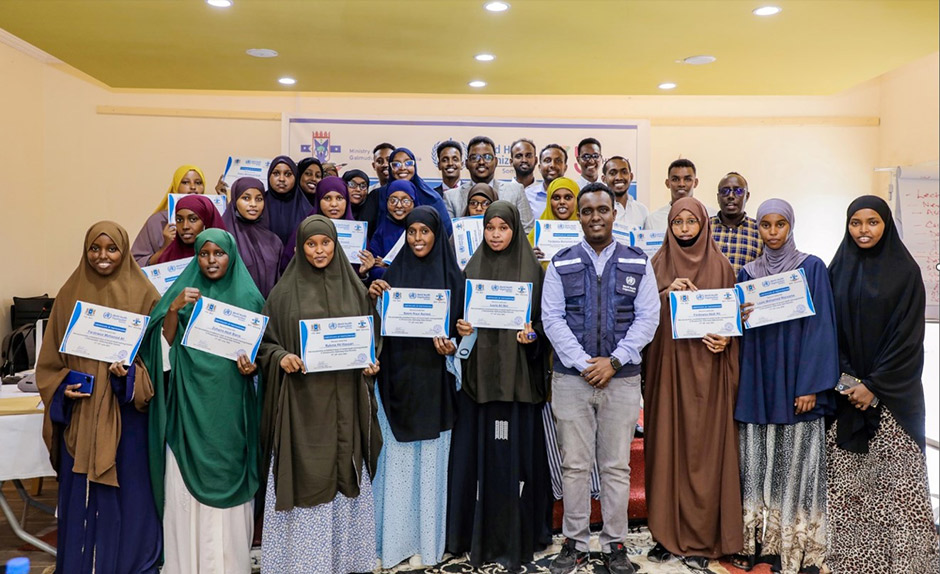 A group of health professionals trained on mental health and psychosocial support in Dhusamareb, Galmudug State. Photo credit: WHO Somalia/A. Mohamud
10 October 2023, Mogadishu, Somalia – The World Health Organization (WHO) Somalia Country Office is supporting the Federal Ministry of Health and Human Services to observe the World Mental Health Day 2023. This year’s theme- w “Mental health is a universal human right” is a stark reminder that in a country frequently affected by conflict and crisis and having a high burden of mental health disorder, everyone, everywhere suffering from mental health illness has the right to seek and receive quality mental health care. Multiple events are being run in parallel in Mogadishu and in capital cities of Somalia’s federal member states under the slogan “Our minds, our rights”.
WHO estimates that 10% of people worldwide experience mental health issues. This figure may rise to as much as 20% in countries that are prone to war and conflict, such as Somalia, where violence has infiltrated every aspect of society. Mental health conditions also affect a growing number of adolescents and young people. In one of the recent studies carried out jointly by WHO, the Somali National University and the Federal Ministry of Health amongst 713 people (age range between 25 to 56 years) and conducted in three districts, it was found out that the prevalence of mental disorders was high (76.9%) as well as substance use disorders (50.6%). This shows that the young people in suffer from higher burden of mental health illness than was previously estimated.
WHO advocates for mental health as a basic human right for all by promoting the idea that everyone, whoever and wherever they are, has the right to the highest attainable standard of mental health. This includes the right to be protected from mental health risks; the right to available, accessible, acceptable and good quality care; and the right to liberty, independence and inclusion in the community.
WHO continues to support the Federal Ministry of Health and Human Services and local partners to ensure that mental health is valued, promoted and protected, and that urgent action is taken so that everyone can exercise their human rights and access the quality mental health care they need. This includes efforts to strengthen an integrated, multisectoral response through evidence-based and achievable plans that promote the identification, prevention, treatment and rehabilitation of mental and neurological disorders, with respect for human rights and social protection. This approach aligns with both Somalia’s Essential Package of Health Services (EPHS) 2020 and WHO’s Mental Health Gap Action Programme.
“Only an estimated 5% of people with mental disorders contact psychiatric professionals owing to cultural stigma associated with mental illness in Somalia. Therefore, much more work is needed to understand the overall burden of mental disorders in the country and make basic, good quality mental health care widely available,” observed the Dr Mahmud, Director of Hudur Hospital.
In June and July 2023, WHO supported the Federal Ministry of Health and Human Services to train 50 health professionals in the regional hospitals of Hudur, South West State, and Dhusamareb, Galmudug State. It also helped the state ministries to develop an operational referral system for tertiary health care facilities, which will connect communities with the available mental health and psychosocial support services (MHPSS). By August, the newly trained workforce had begun to administer services at their respective health facilities, thus expanding the network of mental health care in the 2 regions.
“The training was a crucial part of integrating mental health into primary health care and is beneficial for health professionals, but a lot still needs to be done to raise awareness among local communities to help reduce the stigma associated with mental illness. Fewer people are being chained, but even now, very few people opt to consult the available practitioners owing to societal pressures. We need to address this hesitation, especially among the younger generation,” summarized Dr Saed of Dhusamareb Hospital, who attended the WHO-administered training on MHPSS.
WHO-supported trainings are helping to expand and enrich the network of MHPSS professionals in Somalia. In the longer term, the plan is to establish institutional training up to the level of a psychology degree course. WHO continues to work with its partners to mobilize the necessary resources to realize this long-term plan.
For more information, please contact:
Fouzia Bano
Communications Officer,
WHO Somalia Country
OfficeEmail:
Related links:
Somalia launches US$ 11.4 million project to strengthen emergency care services at regional hospitals
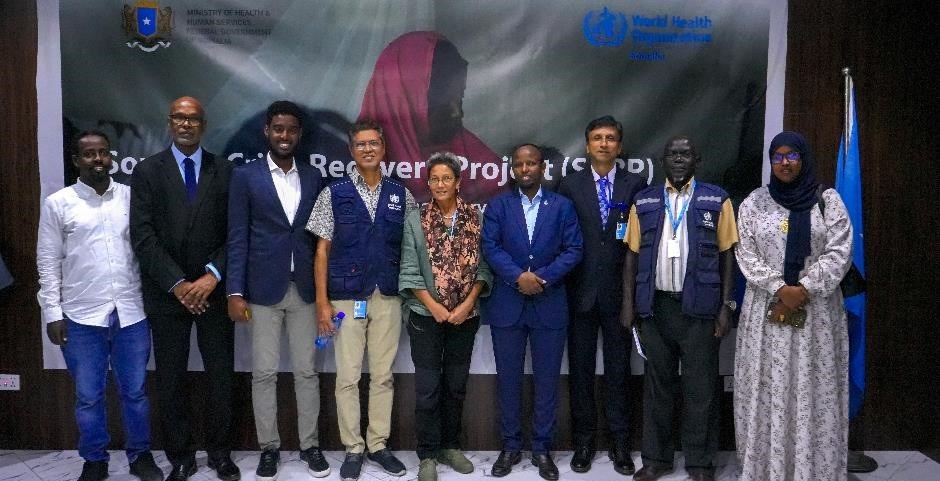 Participants at the project launch, Mogadishu, Somalia, 9 September 2023. Photo credit: WHO Somalia/I. Taxta
29 September 2023, Mogadishu, Somalia – The Federal Government of Somalia, through its Federal Ministry of Health and Human Services, has launched a new project that aims to strengthen the medical emergency services at federal and state referral hospitals. Critical care capacities will be a particular focus.The US$ 11.4 million project is funded by the World Bank under the Somalia Crisis Recovery Project (SCRP). The World Health Organization (WHO) will support the delivery of the ‘Strengthening the Medical Emergency Services at Federal and State Referral Hospitals’ project.
This collaborative initiative comes as the country’s health system grapples with high levels of communicable and noncommunicable diseases, as well as injuries and disabilities caused by ongoing conflict and widespread use of improvised explosive devices.
“We have started important work to strengthen Somalia’s emergency health care through the Somalia Crisis Recovery Project,” said Abdi Tawane, Co-Project Manager of SCRP, who is based in the Project Implementation Unit of the Federal Ministry of Finance. “By upgrading facilities, training staff and coordinating health services, we are building sustainable capacity to respond to health crises and serve citizens across the country. This targeted support will have a significant impact on Somalia’s health care system both now and in the future.”
Following the official launch, representatives of WHO, the Project Implementation Unit of the Federal Ministry of Finance, the Federal Ministry of Health and Human Services, and Federal Member States met to discuss the project implementation in detail.
Strengthening of critical care
The new project aims to get emergency, critical and operative care services up and running in 8 hospitals across the country. The selected facilities can then properly function as regional referral hospitals, delivering emergency and critical care services. This is part of the Government’s vision for delivering integrated health services as set out in the Essential Package for Health Services (EPHS 2020) for Somalia.
The project also seeks to strengthen the referral mechanisms between primary health care and higher levels of health care in the country for critical care support. This will establish a model integrated health care delivery system that can be replicated to meet every person’s health needs across the life course.
“This crucial component of the Somalia Crisis Recovery Project builds on the strong partnership between the Ministry of Health and Human Services, Ministry of Finance, the World Bank and WHO in Somalia,” said Dr Ali Hadji Adan Abubakar, Minister of Health and Human Services. “Somalia made great strides during the COVID-19 pandemic to strengthen national capacity to prepare for, respond to and recover from public health crises, with the support of partners like WHO and the World Bank. More action is needed to meet the immediate needs of the population and strengthen surveillance and laboratory systems to detect and respond to emerging public health threats.”
“Close collaboration among all partners and open reporting to our Project Implementation Unit will be vital to demonstrate governance and maximize outcomes for Somali citizens. With transparency and shared commitment, I’m hopeful this project will save many lives while also sustaining public trust in our institutions,” said Saleiman Sheik Umar, Director-General of the Ministry of Finance.
Dr Mamunur Rahman Malik, WHO Representative and Head of Mission to Somalia, recognized the commitment of the federal and state health ministries. “Using a health system approach, this project will underscore the need for greater investment in emergency and critical care services across Somalia, as highlighted in the recent resolution WHA76.2,” said Dr Malik. “Improving integrated emergency, critical and operative care services as a continuum of care is an important ingredient for achieving universal health coverage. Improving these services will also enable the country to be better prepared for and ready to manage critical care patients in any future pandemics and promote the enjoyment of health as a human right.”
About the Somalia Crisis Recovery Project
SCRP is a holistic project that supports recovery from past disasters while enhancing resilience to future shocks. SCRP recognizes how important it is to bolster Somalia’s health system as it responds to climate- and conflict-related crises.
For component 3 of SCRP, the Project Implementation Unit is working closely with the Ministry of Health and Human Services to pilot approaches for building resilience in the health sector. Emergency telehealth networks are being set up to ensure that remote populations can access care during disasters. Disease early warning systems are being upgraded to predict outbreaks, and community health workers are being trained in first aid and trauma response.
Innovative capacity-building of this nature will help Somalia’s health system to withstand future climate shocks. In this way, SCRP aims to lay the groundwork for more resilient health care nationwide and to support the basic right to health for all in Somalia in this challenging context.
For more information, please contact:
Somalia Crisis Recovery Project
Abdi Tawane
Co-Project Manager of SCRP, Project Implementation Unit, Ministry of Finance
Email:
Ministry of Health and Human Services
Bile Abdi
Communications Officer, Ministry of Health and Human Services
Email:
WHO
Kyle DeFreitas
External Relations Officer, WHO Somalia Country Office
Email:
Fouzia Bano
Communications Officer, WHO Somalia Country Office
Email:
USAID support leads to 47% of eligible Somalis being vaccinated against COVID-19
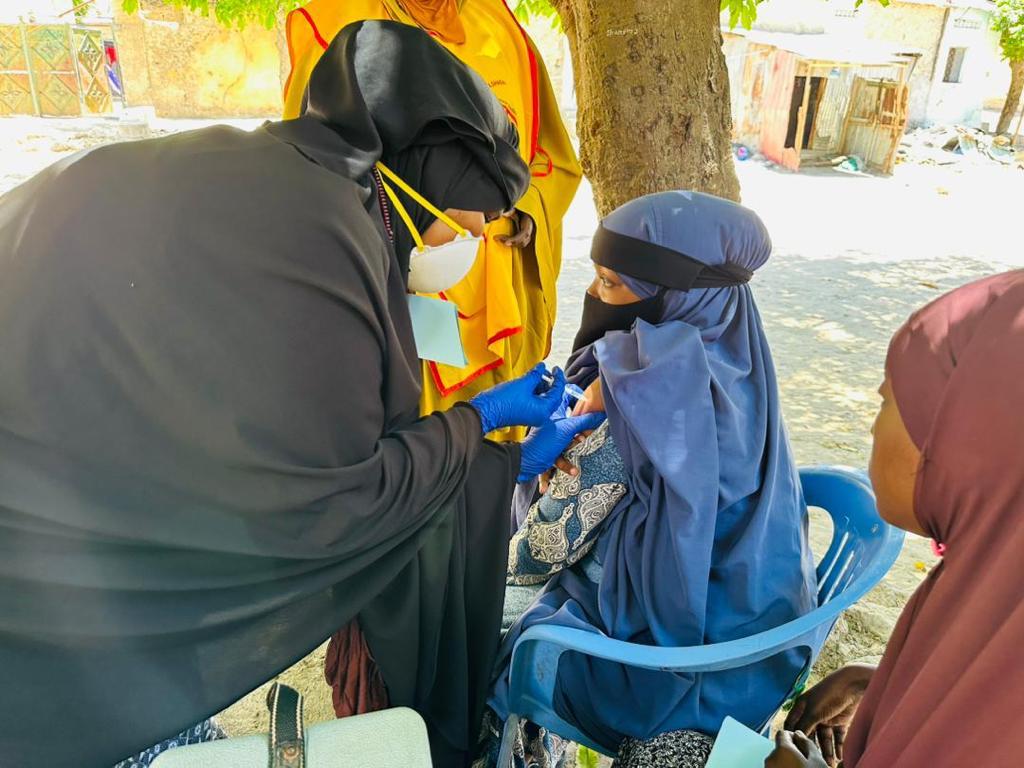
USAID’s support contributed to fully vaccinating 47% of eligible Somalis with the COVID-19 primary series vaccines. Credit: WHO/Somalia
Mogadishu, 9 September 2023 – Nearly 47% of the eligible Somali population (1) are now fully vaccinated against COVID-19, thanks to the successful collaboration between the World Health Organization (WHO), Federal Government of Somalia and the United States Agency for International Development (USAID) under the COVID-19 response in Somalia project. This project was implemented from July 2022 to July 2023, by the Somali Federal and state-level ministries of health with the technical support of WHO and USAID and aimed to strengthen health care systems and train community health care workers as part of an integrated vaccination campaign for COVID-19 and other vaccinations covered under the Expanded Programme on Immunization (2). By the end of June 2023, Somalia had administered a total of 10 527 700 doses of COVID-19 vaccines (64.4 doses of primary series COVID-19 vaccines per 100 people) — one of the highest vaccination rates in Africa (3).
“Considering the fragility of our health system, achieving such a high rate of the primary COVID-19 vaccination series in Somalia is no small accomplishment,” said Dr Mukhtar Abdi Shube, the Head of Vaccines and Immunization Programme at the Federal Ministry of Health. “It puts Somalia on par with the more stable and advanced countries in Africa and elsewhere. The project helped address existing gaps in our immunization services and infrastructure, such as coordination, surveillance, shortage of vaccinators, and an operational response to COVID-19,” he added.
The COVID-19 response project worked with the Somali Federal and state ministries of health to ensure that the most vulnerable and hard-to-reach populations would be reached with the COVID-19 vaccination campaign. Under this project, nearly 2000 community health workers were trained and deployed in 71 high-priority districts, including 31 drought-affected districts. The community health workers made house-to-house visits in marginalized settings, conducted case detection and contact tracing for COVID-19, and identified people, especially female household members, who needed to be vaccinated and refered them to nearby outreach teams set up at community centres for COVID-19 vaccination. In addition, more than 85% of the vaccinators for the community outreach teams deployed by the COVID-19 response project were women. This gender focus helped increase the vaccination rate for women from 19% (at the start of 2022) to 44% (in July 2023). The COVID-19 response project also helped fully vaccinate 57% of the nearly 3 million internally displaced persons (IDPs) in Somalia and 21% of its nomadic populations.
“This collaboration between WHO and USAID not only contained transmission of COVID-19 in Somalia, but improved coverage for other critical vaccinations,” said Ted Lawrence, USAID Somalia’s acting Mission Director. “By focusing on community-based initiatives, this project helped build a more resilient health system that is better prepared for future health emergencies.” The stronger immunization system also enabled Somalia to roll out supplementary immunization targeting children who had never received critical childhood vaccinations. This contributed to over 84 600 zero-dose children being identified and receiving their first dose of vaccines (BCG, diphtheria-tetanus-pertussis and polio vaccine).
For additional information, please contact:
Kyle DeFreitas
WHO External Relations Officer
Fouzia Bano
WHO Communications Officer
Sila Kimanzi
USAID Somalia Maternal, Child Health, Nutrition and Family Planning Specialist
Danielle Botti
USAID Somalia Development Outreach and Communications Specialist
Keisha Herbert
USAID Somalia Program Office Deputy Director
Related links
1. People at least 18 years old and with no disqualifying health conditions were eligible for COVID-19 vaccines in Somalia.
2. Routine vaccination includes tuberculosis, polio, diphtheria, pertussis, tetanus, Hib pneumonia and meningitis, measles, hepatitis B and pneumococcal pneumonia.
3. In addition to fully vaccinating nearly 47% of the eligible population, through this project an additional 11% of the population received at least one dose of a COVID-19 vaccination series, and 28 000 people received booster doses of a COVID-19 vaccination.