


اختر لغتك

The heroic efforts of Yemen’s healthcare workers: selflessly serving to advance health for all
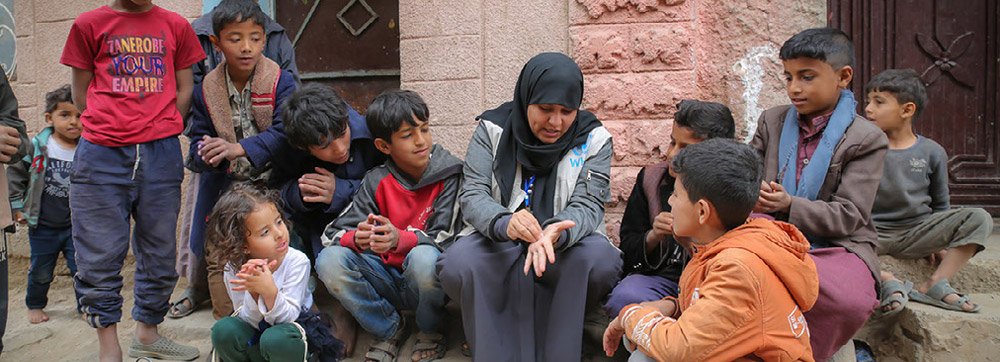
9 March 2023 – As Yemeni women face extreme hardships linked to prolonged conflict, many are serving selflessly, under enormous pressures, at badly overstretched health facilities where millions of children and families depend on them for hope, healing and survival.
According to the UN’s Yemen Humanitarian Needs Overview 2023 (HNO), severe health threats and limited access to health services pose greatest risks to children and women who are highly vulnerable to malnutrition and preventable diseases.
In 2021, Yemen ranked 155th of 156 countries on the World Economic Forum’s Global Gender Gap Index. Subject to restricted movements, high exposure to gender-based violence (GBV), and other major challenges, women as well as girls with disabilities are among most-marginalized Yemenis who are also least reachable by healthcare and humanitarian workers.
For Yemen’s children, the path to a polio diagnosis starts with a remarkable road trip
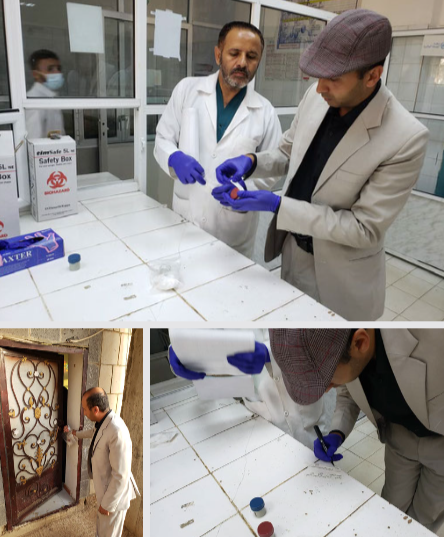 Dr Mohammed Sharafulddin, AFPl surveillance coordinator in Al Mahaweet governorate, receiving and handling a stool sample.2 March 2023 – Stopping any polio outbreak starts with vaccine procurement, transport by airplanes and trucks, distribution involving complex logistics, and eventually the oral administration of the vaccine by drops in the mouths of every eligible child.
However, there is another, lesser known but equally important process that must also take place to halt transmission of the poliovirus. It begins with a humble thumb sized stool sample taken from a child with acute flaccid paralysis (AFP), then delivered to the nearest laboratory that can test the sample specifically for poliovirus.
But nowhere in Yemen is there any such laboratory. So the long and arduous journey of any stool sample from a Yemeni child to receiving laboratory can take up to several days – following an easterly route, to the neighbouring country of Oman.
An explanation of how stool samples are transported over such a distance starts with why: monitoring children under 15 years of age for signs of AFP, which is the most common sign of poliovirus infection. The Global Polio Eradication Initiative has set a benchmark of at least three AFP cases per 100 000 children under 15 years of age, a standard that Yemen has consistently met, thanks to the effectiveness of its surveillance system. This achievement is all the more remarkable considering that Yemen is entering its ninth year of internal conflict, with resulting population displacements, widespread food and fuel shortages, and a devastated health system (in which only 46%of hospitals and health facilities are only partially functioning or completely out of service).
Yemen’s health crisis: WHO calls for increased funding to save millions of Yemenis
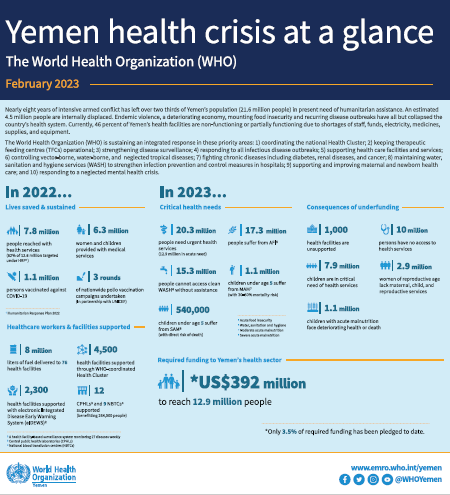 Read the infographicSana’a, Yemen, 26 February 2023 – Ahead of tomorrow’s High-Level Pledging Event for the Humanitarian Crisis in Yemen, the World Health Organization (WHO) together with its Health Cluster partners in Yemen is appealing for US$ 392 million to reach 12.9 million people with essential health assistance in 2023.
“Yemen requires urgent and robust support from international donors and other partners to effectively avert the potential collapse of its health system,” said Dr Adham Abdel Moneim, WHO Representative in Yemen. “New funding to the amount of US$ 392 million is required by Yemen’s health sector to ensure that overstretched health facilities can continue providing even most basic services to 12.9 million of the most vulnerable people.”
In 2022, international funding pledges enabled WHO and 44 Health Cluster partners (including 4 other UN agencies, 39 international and local NGOs, and Yemen’s Ministry of Public Health and Population) to deliver medical equipment, supplies, training and other support to hospitals and health facilities that provided a wide range of vital and often lifesaving services to nearly 7.8 million Yemenis. Nevertheless, this level of funding fell far short of addressing identified and urgent health needs of some 12.6 million persons, effectively limiting assistance to only 7.8 million of them.
Increased funding urgently needed
To date in 2023, funds pledged to the WHO-led Health Cluster equals only 3.5% of the US$ 392 million required to provide even most basic services to the 12.9 million most vulnerable Yemenis targeted by this year’s United Nations Humanitarian Response Plan (HRP) for Yemen,” said Dr Adham Abdel Moneim. “They include up to 540 000 children under the age of 5 who are otherwise facing severe acute malnutrition, with direct risk of death.”
“Unless and until this massive funding gap is reversed, we will not be able to sustain our health emergency interventions in Yemen. We therefore call upon donors to continue to support our efforts to provide essential and lifesaving health services to the Yemeni people,” Dr Adham Abdel Moneim said.
Yemen requires continuing strong support from the international donor community to deliver a minimum health service package that prioritizes access to primary health care services by vulnerable population groups, especially in remote and conflict-affected districts of Yemen where these services are most needed.
This minimum service package entails health interventions and continuum of services prioritized at each level of care – from prevention and diagnosis to treatment and rehabilitation – in order to:
maintain even low levels of immunization coverage against recurring and fast-spreading outbreaks of communicable diseases, including COVID-19, measles, diphtheria and the vaccine-derived poliovirus type 2 (cVDPV2);
sustain and strengthen local capacities to detect, assess, and contain vector-borne and waterborne diseases, including malaria, dengue fever, and cholera;
ensure adequate nutrition surveillance and continuation of life-saving medical and nutrition care for Yemeni infants and children, especially those suffering from severe acute malnutrition with medical complications;
continue deliveries of essential fuel, oxygen, medicines, and water, sanitation and hygiene for services (WASH) for infection prevention and control to functioning/targeted health facilities country-wide; and
prevent the potential collapse of Yemen’s health system, which will otherwise be unable to reach some 39.5% of the population.
“Tomorrow’s high-level pledging event for the humanitarian crisis in Yemen comes at a crucial moment to show the world’s commitment to assisting millions of Yemenis who are in distress and suffering from diseases, malnutrition, and trauma,” Dr Adham Abdel Moneim added.
Underfunding of the Health Cluster in Yemen in 2023 (serving 4812 health facilities, 276 hospitals and specialized centres, 1199 health centres, and 3337 health units) will result in:
Up to 1000 unsupported health facilities;
10 million persons, including 7.9 million children, without needed access to health services;
1.1 million children with acute malnutrition facing deteriorating health or death; and
2.9 million women of reproductive age lacking maternal, child, and reproductive services.
Note to the editors
Worsening health situation and WHO’s response across Yemen
Nearly 9 years of conflict has left over two thirds of Yemen’s population (21.6 million people) in present need of humanitarian assistance. An estimated 4.5 million people are internally displaced. Endemic violence, a deteriorating economy, mounting food insecurity and recurring disease outbreaks have all but collapsed the country’s health system. Across Yemen currently, 46% of all health facilities are only partially functioning or completely out of service due to shortages of staff, funds, electricity, medicines, supplies, and equipment.
In 2022, the World Health Organization (WHO) provided life-saving medical and healthcare services to 12.6 million Yemenis – 62% of last year’s Humanitarian Response Plan (HRP).
The World Health Organization (WHO) is sustaining an integrated response in these priority areas: 1) coordinating the national Health Cluster; 2) keeping therapeutic feeding centres (TFCs) operational; 3) strengthening disease surveillance; 4) responding to all infectious disease outbreaks; 5) supporting health care facilities and services; 6) controlling vector-borne, water-borne, and neglected tropical diseases; 7) fighting chronic diseases including diabetes, renal diseases, and cancer; 8) maintaining water, sanitation and hygiene services (WASH) to strengthening infection prevention and control measures in hospitals; 9) supporting and improving maternal and newborn health care; and 10) responding to a neglected mental health crisis.
WHO follows an integrated and sustainable health approach focused on ensuring continuous access to health for all vulnerable people, while also strengthening the capacities and efficiencies of the national health system and Ministry of Public Health and Population in Yemen with sustainable solutions.
These solutions include but are not limited to the rehabilitation of health facilities; the establishment of units and laboratories that the Yemeni health system lacks; the establishment of a disease outbreak surveillance system, a health information management system, and much more.
For further information, contact:
Tarik Jasarevic
Media Relations
World Health Organization
Mobile: +41 793 676 214
Tel: +41 22 791 5099
e-mail:
Kevin Cook
Senior Communications Advisor
WHO-Yemen Country Office
Mobile: 01-727-377-0871
e-mail:
Strength from suffering
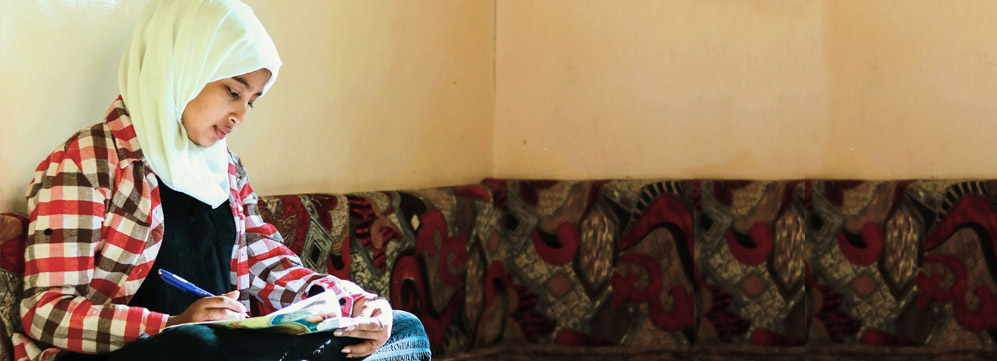
Heroism on the frontlines of Yemen’s fight against genetic blood disorders
12 February 2023– Rehab Fuad has survived deep poverty, chronic anemia and fatigue since being diagnosed with an inherited blood disorder – and all before reaching her first birthday.
But Rehab’s suffering has made her a much stronger person today. Highly resilient and resolutely focused on achieving her dreams, she is determined to live every day with as much purpose and positivity as she can.
Thalassemia is the disease that has caused Rehab to experience an exhaustingly difficult lifetime of weakness, fatigue, accelerated pulse, and other physical and emotional duress. The disease deprives her reduced red blood count of oxygen, and she also suffers from hemochromatosis, or iron overload, that can cause serious organ damage and potentially death.
