


16 March 2026, Aden, Yemen – Amid one of the world’s most complex humanitarian crises, Yemen has reinforced its national immunization system and successfully interrupted variant poliovirus type 2 (cVDPV2) transmission in the south.
Between 2024 and 2025, the World Health Organization (WHO), with financial support from Gavi, the Vaccine Alliance; the Global Polio Eradication Initiative (GPEI) and the King Salman Humanitarian Aid and Relief Centre (KSrelief), delivered comprehensive technical and operational assistance to the Ministry of Public Health and Population. This support strengthened the Expanded Programme on Immunization (EPI) and the national Polio programme.
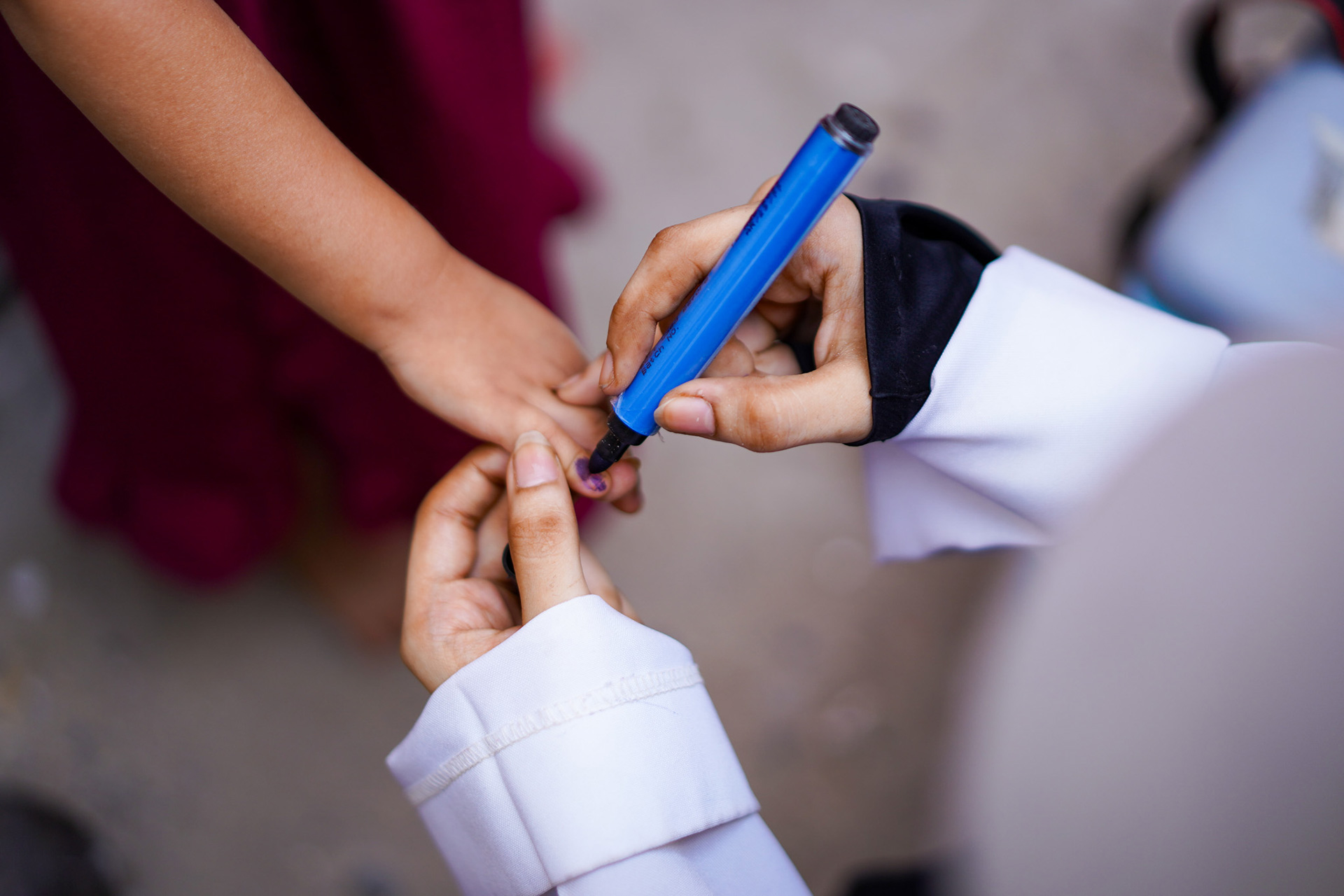 A health worker marks a child’s finger during a community vaccination campaign
A total of 18,832 immunization staff were trained to enhance routine services and 800 polio and vaccine-preventable diseases personnel trained to improve surveillance, outbreak investigation and sample management capacities. Laboratories in Aden, Sana’a and Taiz received nearly US$ 1 million in essential supplies to improve sample storage and testing, and laboratory workforce capacities were strengthened with continuous training.
Faced with the threat of cVDPV2 transmission, the response was swift and coordinated. WHO supported the rollout of novel oral polio vaccine type 2 (nOPV2), training over 9000 vaccinators and deploying more than 7,000 vaccination teams. Two nationwide vaccination rounds in 2024 achieved 100% coverage. They were followed by 2 additional 100% coverage rounds in 2025, protecting millions of children and expanding access to vitamin A supplementation.
 Community health volunteer Ahlam Ahmed visits households to support vaccination efforts
“When the outbreak began, we knew we could not afford delays. We went door to door, sometimes walking for hours to reach children in remote villages and displacement sites. Every child vaccinated meant one more family protected and brought us one step closer to stopping the virus,” said community health volunteer Ahlam Ahmed.
Reaching those previously unreached was central to the success of the initiative. During 9 integrated outreach rounds across 12 southern governorates, 7620 health workers travelled to remote valleys, mountain settlements and displacement sites.
These efforts reached 542,183 children under 5, including 119,702 zero-dose children. More than 222,120 pentavalent doses and 184 063 measles vaccines were administered, helping close long-standing immunity gaps.
In northern Yemen, outreach services resumed for the first time in more than 3 years. In 2025, 2.2 million measles-rubella vaccinations were delivered alongside integrated child, maternal and nutrition consultation services.
Behind these statistics are families whose confidence in health services is being rebuilt.
“For months, we lived in fear of disease spreading among our children. When the vaccination teams arrived, I did not hesitate. I made sure my children were vaccinated immediately. Protecting them is my responsibility. I encourage every parent to vaccinate their children. Every dose brings us closer to a healthier, safer future for all,” said Abdullah Raged.
These successes have been made possible by the unwavering commitment of national health authorities and the support of WHO’s donors and partners whose investments enabled workforce training, surveillance strengthening, laboratory improvements, extensive outreach campaigns and the rapid deployment of lifesaving vaccines.
The work must continue. In a health landscape shaped by conflict, displacement and system fragility, millions of children remain vulnerable to vaccine‑preventable diseases. Sustained and flexible donor support is essential to maintain immunization coverage, close remaining immunity gaps, sustain robust surveillance and ensure every child receives lifesaving vaccines.
With continued partnership and solidarity, Yemen can secure a polio‑free future for its children.
