


11 February 2026, Damascus, Syrian Arab Republic – Damascus, 10 February 2026 – The Ministry of Health, in collaboration with the Ministry of Higher Education and Scientific Research and with technical support from the World Health Organization (WHO), has launched a three–day national workshop aimed at strengthening governance and leadership in health professions education in Syria.
 Participants and partners gather at the opening of the national workshop on strengthening governance and leadership in medical and health sciences education. Photo credit: WHO
Bringing together senior academic leaders, policymakers and health educators from across the country, the workshop focuses on improving how medical and health professions education is governed, planned and delivered–at a time when Syria’s health system continues to recover from years of strain, workforce shortages and the migration of skilled professionals.
 H.E. Dr. Musab Al-Ali, Minister of Health, delivers opening remarks at the national workshop. Photo credit: WHO
Opening the workshop, H.E. Dr. Musab Al–Ali, Minister of Health, underscored the direct link between the quality of medical education and the quality-of-care people receive. He stressed that rebuilding the health system depends not only on restoring services, but on investing in the people who deliver them–and the institutions responsible for their training.
“The healthcare sector has faced difficult circumstances in recent years, creating clear challenges for the educational institutions responsible for training medical and healthcare professionals,” said Dr. Al–Ali. “Today, we face a reality that demands sincere commitment and coordinated, collective action from all of us to strengthen leadership and governance within healthcare education structures, because the future of healthcare is inextricably linked to the quality of medical education.”
Dr. Al–Ali noted that the workshop is designed as a practical step forward, combining policy–oriented discussions with applied tools to support decision–making, quality standards and institutional leadership–tailored to Syria’s current realities.
 H.E. Dr. Marwan Al-Halabi, Minister of Higher Education and Scientific Research, addresses participants at the national workshop. Photo credit: WHO
That emphasis on systems and long–term reform was echoed by H.E. Dr. Marwan Al–Halabi, Minister of Higher Education and Scientific Research, who framed the workshop as a strategic national investment rather than a stand–alone training activity.
“Governance and leadership in health professions education are not procedural concepts; they are a philosophy of work and a system of values,” said Dr. Al–Halabi. “Repositioning medical education at the heart of the national health system is essential for reform, quality assurance and sustainable impact.”
He highlighted the importance of stronger coordination between universities, training institutions and the health sector to ensure that education outcomes respond to population health needs, support workforce retention and translate knowledge into safer, higher–quality care. Clear roles, integrated planning and accountable leadership, he added, are critical to transforming institutions from isolated entities into a coherent, functioning system.
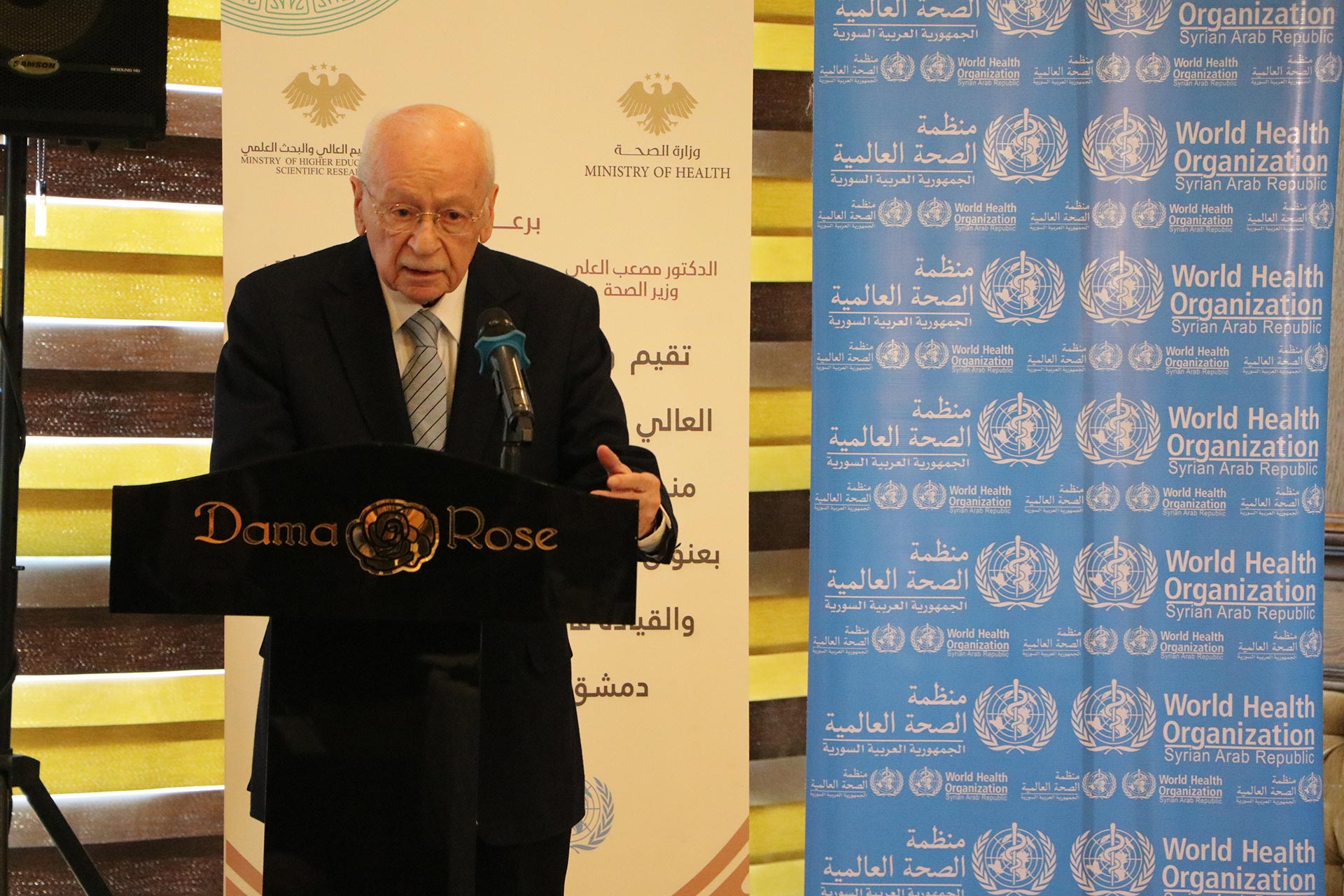 Professor Dr. Mohammed Iyad Al‑Shatti speaks during the national workshop. Photo credit: WHO
The workshop also builds on decades of academic experience within Syria. Professor Dr. Mohammed Iyad Al–Shatti reflected on earlier efforts to modernize medical education and the enduring relevance of governance principles. “As early as the 1980s, we were already discussing quality standards, transparency, fairness and effective financing in education,” he said. “What matters today is thinking holistically–how the Ministries of Health and Higher Education work together, and how leadership and governance shape the entire health system, not just individual institutions.”
Addressing participants online, Dr. Asmus Hammerich, Acting WHO Representative to Syria, reaffirmed WHO’s role as a technical partner supporting nationally led reform efforts. “Syria’s health system is at a pivotal moment of recovery and reform,” said Dr. Hammerich. “Strengthening health professions education is one of the most effective ways to rebuild confidence in health services, sustain quality standards and move towards universal health coverage. WHO is here to support the institutions leading this work–under the stewardship of the Ministry of Health and in close coordination with the Ministry of Higher Education–by helping translate shared priorities into practical, implementable steps.”
He highlighted the workshop’s action–oriented design, which combines systems thinking, strategic planning, and quality improvement with a focus on accreditation and leadership development. He also emphasized the importance of inclusive approaches that support women’s leadership, enable participation of people with disabilities, and ensure education pathways serve communities in underserved areas.
Running from 10 to 12 February 2026, the workshop includes interactive lectures, group simulations, and strategic planning exercises. Participants include deans and vice–deans of medical and health sciences, faculties and training institutes, representatives of national health boards, and senior officials from the Ministries of Health and Higher Education.
By the end of the three days, participants are expected to develop concrete institutional action plans and strengthen coordination between education and service delivery–contributing to a more resilient health workforce and more responsive health services for people across Syria.
