


18 February 2026, Idlib, Syrian Arab Republic - In the Ariha sector of Idlib governorate, ambulance crews operate in constant readiness. When a call comes in - whether for a road traffic accident, a fracture, a cardiac emergency or a critical transfer between hospitals - the response must be immediate.
 Saleh Khalouf prepares to transport a patient inside a newly delivered ambulance in Idlib, strengthening emergency response and patient safety across the governorate. Photo credit: WHO
“There is no routine day for us,” says Musaab Abdulwahab Al-Yaqoub, 33, who has worked in the Central Referral and Ambulance System since 2018. “During our shifts, we are on alert 24 hours a day. We respond to road accidents, falls, fractures and critical cases. At any moment, the phone can ring.”
For years, emergency teams worked with ageing ambulances that had long passed their intended lifespan. The vehicles had endured heavy use, repeated strain and constant mechanical issues. “Our ambulances were very old,” Musaab explains. “They had been exposed to many problems, and maintenance was a continuous challenge.”
Some of the models dated back to the 1990s. “Today we are operating 2025 models,” says Saleh Khalouf, 35, who has served in the system for four years. “The difference is clear.”
That difference goes beyond appearance. In emergency medicine, timing is critical. “We call them the ‘golden minutes,’” Musaab says. “The faster we reach the patient, the more stable their condition can be.” Older vehicles sometimes slowed response times or created uncertainty during long-distance calls to remote villages. Crews had to contend with uneven roads, potholes and damaged infrastructure - all of which affected transport conditions.
 Nurse Qais Ibrahim Zureiq monitors a patient’s vital signs inside a newly delivered ambulance, helping ensure safer and more stable emergency transport. Photo credit: WHO
“For patients with fractures or trauma, the road itself can cause pain,” explains Qais Ibrahim Zureiq, a nurse who has worked in the system for five years. “The older ambulances were not comfortable. Patients would complain during transport, especially on damaged roads.” Smoother transport reduces additional suffering during already critical moments.
Beyond equipment, staffing remains a pressing challenge. Across Syria, an estimated 50–70% of health care workers have left the country over the years of conflict, placing sustained pressure on those who remain. In many ambulances, responses are carried out by only a driver and one medical professional, rather than a full team of paramedics and a physician.
“We need more staff,” Qais explains. “Sometimes there are only two of us in the ambulance. Ideally, there should be four or five.”
Strengthening and retaining the existing health workforce - and encouraging Syrian health professionals to return - remains a priority for the Ministry of Health as part of ongoing recovery efforts.
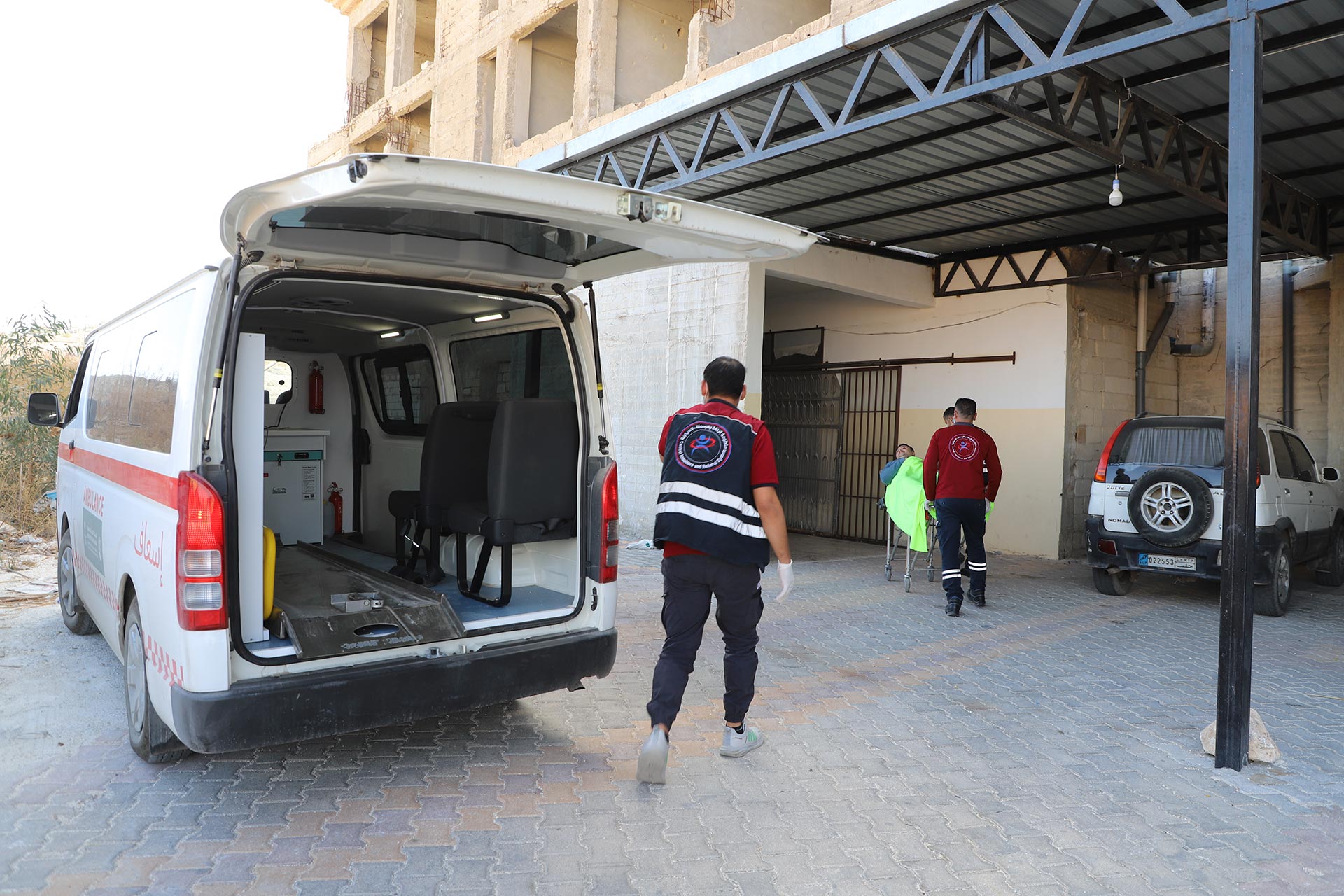 Musaab Abdulwahab Al-Yaqoub responds to an emergency call in Idlib, transferring a patient from a newly delivered ambulance to a health facility under the Central Referral and Ambulance System. Photo credit: WHO
With support from KSrelief, WHO has delivered 10 new ambulances to strengthen emergency response services across Syria, supporting frontline teams operating under sustained pressure. The newer vehicles are more reliable, require less maintenance and provide greater stability on the road, helping reduce delays and improve patient transport conditions.
Despite the demands, the crews remain driven by a strong humanitarian commitment. “When you help stabilize a critical patient and deliver them safely to hospital, you feel that you achieved something meaningful that day,” Qais says. “It gives you satisfaction.”
For Musaab, the motivation has remained constant. “We started this work to help people,” he says. “That is what keeps us continuing.”
For Saleh, the arrival of the new ambulances carries another meaning. “It means that people see us,” he says. “They understand our situation and they want to support us. That matters.”
In emergency response, every minute counts. In Idlib, those minutes are now being protected - one call at a time.
