


 Polio vaccinator Zeenat administers polio drops during the first national campaign of 2026 in Rawalpindi, Pakistan. Photo credit: Hamid Inam/WHO Pakistan
11 February 2026, Islamabad – “We climb mountains and walk through the snow for hours with great difficulty. There is also a risk of snow falling on us from the mountains. Yet we do not give up. We reach our assigned area to vaccinate all children and protect them from polio,” says Rabia, a polio worker from Upper Chitral, Khyber Pakhtunkhwa.
Rabia is one of the 400,000 polio frontline workers trained and mobilized by the World Health Organization (WHO), in partnership with Pakistan’s Polio Eradication Initiative, who went door-to-door during the first national polio vaccination campaign of 2026 (2–8 February). Their goal: to bring the life-saving polio vaccine to 45 million children.
Over the past 3 decades, thanks to hundreds of thousands of polio workers and the unwavering commitment of the Government of Pakistan and partners, Pakistan has reduced polio cases by 99.8% – from an estimated 20,000 in the early 1990s to 31 cases in 2025. Experts agree: ending wild polio in Pakistan and worldwide is within reach, but only if all partners intensify the response, particularly in the remaining two endemic countries: Pakistan and Afghanistan.
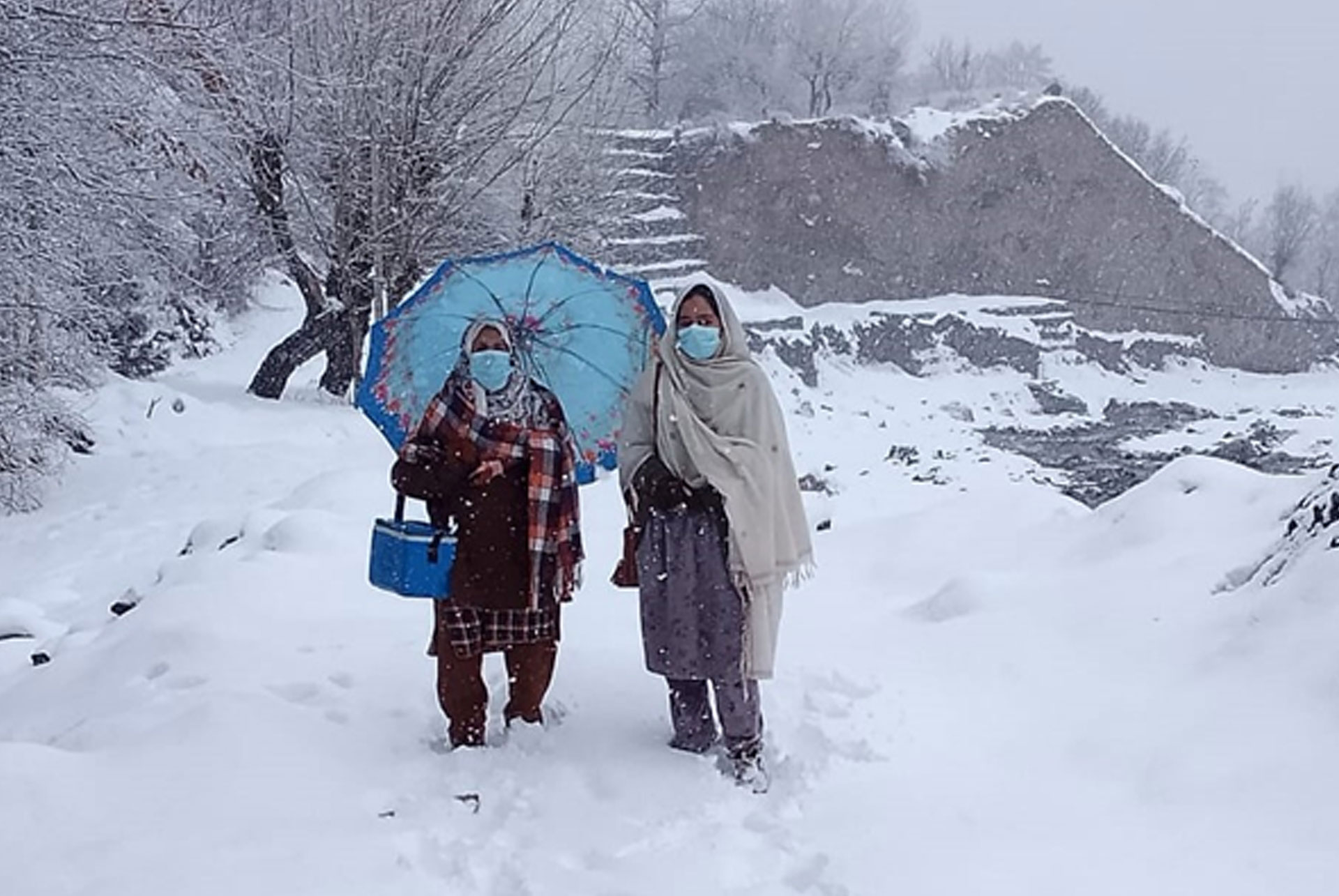 Polio worker Rabia (right) in Upper Chitral during the national campaign conducted in Pakistan from 2-8 February 2026. Photo credit: WHO Pakistan
The WHO-prequalified polio vaccines are safe and effective and have been used in 195 countries to fight polio and shield millions of children from a disease that has no cure and can cause lifelong paralysis or death.
During the recent February campaign, Rabia climbed steep mountains in remote areas to visit 146 houses and vaccinate 85 children.
Like Rabia, Momina is part of a 2-member polio team in Booni, Upper Chitral. “I thank Allah that I have gotten this opportunity to serve and I am trying my best to eradicate polio in my country,” she says.
About 400 kilometres away, Zeenat was deployed in the Khayaban-e-Sir Syed area, Rawalpindi. She spent her days walking for hours, traversing narrow alleys and climbing multiple floors of buildings to visit 242 houses and administer 2 drops of the oral polio vaccine to every child.
“I am a mother too and I have also gotten my own children vaccinated for polio. Thank God, they are healthy and protected now,” she says. “This disease has no cure. I want all parents in the country to vaccinate their children with polio drops so they don’t fall prey to paralysis.”
 A WHO staff member and a vaccinator mark children’s fingers after administering polio drops in Rawalpindi, Pakistan, during the first 2026 national polio campaign (2-8 February). Photo credit: Hamid Inam/WHO Pakistan.
A science-based polio operation to fight a global threat
As a founding partner of the Global Polio Eradication Initiative (GPEI), WHO provides technical and operational assistance to Pakistan’s Polio Eradication Initiative, launched in 1994. In this role, WHO supports Pakistan and partners in leading key components of the largest polio operation in the world. This includes science- and evidence-based vaccination campaigns, training and deployment of polio workers, outbreak response, poliovirus surveillance and monitoring and evaluation of vaccination drives. In 2024–25, WHO polio operations in Pakistan were supported by the generous contributions of Pakistan, United Arab Emirates, United Kingdom of Great Britain and Northern Ireland, France, Canada, Kingdom of Saudi Arabia, Germany, United States of America, the Gates Foundation and Rotary International.
Carrying hope, two polio drops at a time
“The vaccine is very important for children in Pakistan because polio can infect children and paralyze them. This is why we go house-to-house to vaccinate them so that no child is paralyzed,” says Neelum, a polio worker from Rawalpindi.
Rabia, Momina, Zeenat, and Neelum’s dedication is a testament to the work of hundreds of thousands of polio workers who make their way across the country to keep families and communities safe from the global health threat of polio. On every street corner, on every snowy slope, in every remote desert, and at every river crossing – two drops at a time – they carry the hope of a healthier, polio-free future for all.
Written by: Suzanna Masih
Edited by: Dr José Ignacio Martín Galán
