


 Vaccination teams accompanied by WHO personnel during the HPV vaccination campaign against cervical cancer conducted by Pakistan in September 2025. Photo credit: Ayesha Javed/ WHO Pakistan.
6 January 2026, Islamabad, Pakistan – Riffat, Saira, Shaheen, and Naheed are 4 of the 49 000 health workers trained with support from the World Health Organization (WHO) who implemented Pakistan's first-ever human papillomavirus (HPV) vaccination campaign to prevent cervical cancer in 2025, protecting over 9.6 million girls aged 9–14 years.
As we mark cervical cancer awareness month, we celebrate their stories and their crucial contributions to the fight against a preventable disease that every year affects over 5000 women in Pakistan – killing 3200 of them (64%).
By battling a disinformation storm to protect millions of girls and their future families, these frontline workers achieved a historic milestone in the nation’s public health journey. They became the heroes paving the way towards ending cervical cancer for millions of women.
Riffat Naz: the planner who rewrote the plan
 Riffat Naz, UCMO using the community map to discuss with her team members the number of girls to be vaccinated in each area and school. Photo credit: Ayesha Javed/ WHO Pakistan
"Every single girl on our list is a daughter, a sister, a future leader. Our planning must be flawless to protect every one of them,” sayd Riffat Naz, a Union Council Medical Officer (UCMO) in Islamabad before the campaign began. Her team spent months conducting meticulous microplanning, creating maps and data sheets for a campaign largely focused on schools.
However, reality quickly tested these plans. Riffat’s teams faced unexpected reluctance from school administrations and a high number of parents who, influenced by online misinformation, refused to provide consent. When school-based coverage remained significantly low, Riffat had to change the approach. Her new strategy focused on reaching girls outside the classroom, redeploying teams to reassure parents at their doorstep and covering out-of-school girls in communities and nomadic settlements. “Our initial plans were challenged daily, but with the support of government authorities we were able to adapt”.
Saira Hassan: the social mobilizer on the frontline of misinformation
 Saira responds to mothers' questions during a community engagement session. Photo credit: WHO Pakistan
As the campaign shifted from schools to households, the role of social mobilizers like Saira Hassan became even more critical. Her task was to counter misinformation circulating online by answering questions from parents and providing science-based facts to show that the WHO-prequalified vaccine is safe, life-saving, and effective, and has been successfully used in 150 countries – including Muslim countries – to protect girls from cervical cancer.
“When I speak to a mother, I tell her this vaccine is safe and free, and is for the health of her daughter,” says Saira. With 7 years of experience, she used the trust built in her community to patiently counter the myths. This personal commitment was mirrored by staff at WHO, who vaccinated their own daughters and shared these moments on social media, creating a powerful, unified front against misinformation.
Shaheen Akhter and Naheed Akhter: a team reassuring parents amidst doubt
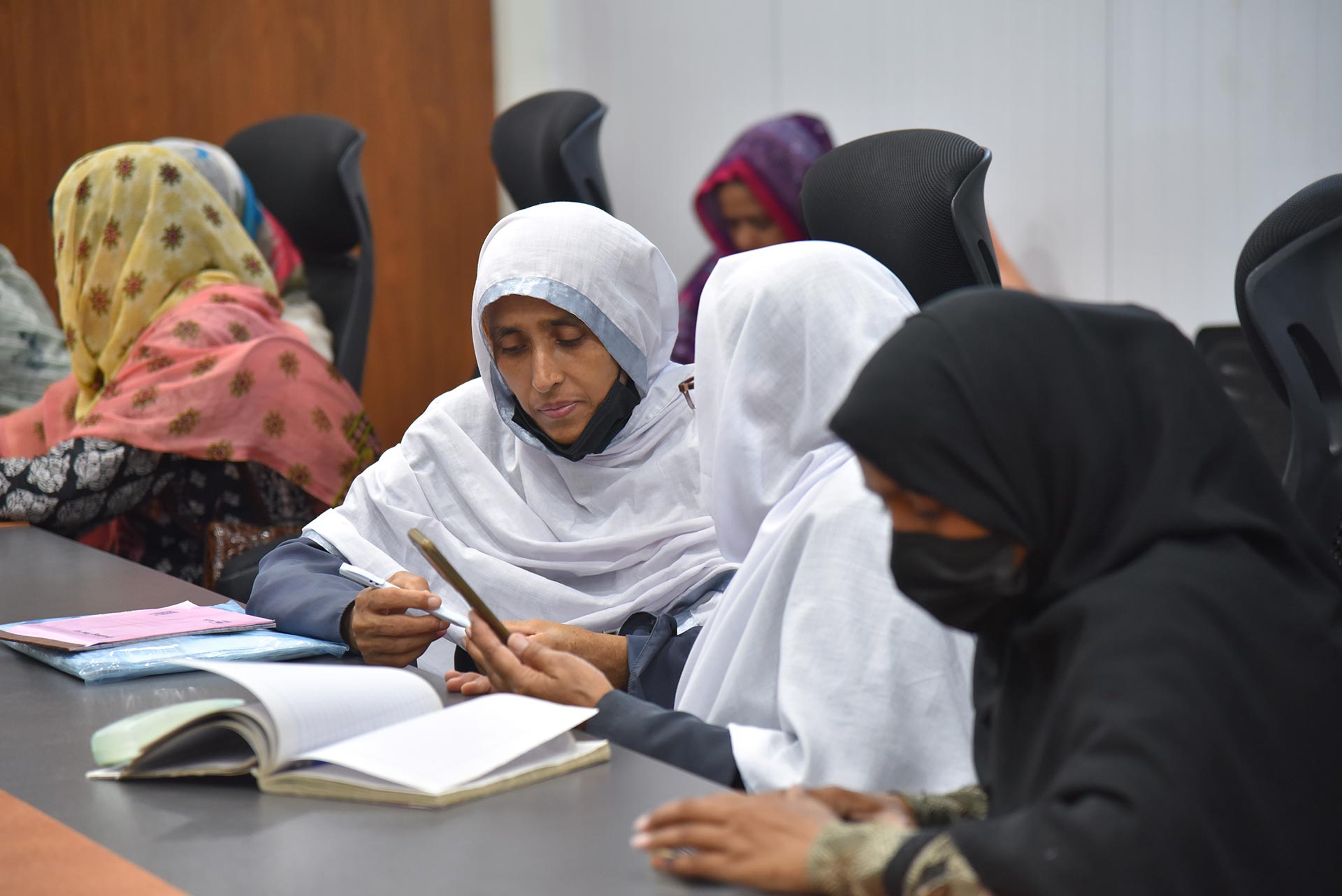 Health workers Naheed and Shaheen during a training facilitated by WHO Pakistan. Photo credit: Hamid Inam/WHO Pakistan.
For vaccinator Shaheen Akhter, being part of this historic first campaign was an honor. The intensive training supported by WHO had prepared her for the job. But the real test came in the field, where she and her team assistant, Naheed Akhter, faced parents filled with fear and doubt.
While Shaheen focused on the vaccine, Naheed provided reassurance to parents and girls. “My job is to make sure everyone feels safe and cared for. A kind word and a smile can make all the difference,” Naheed says. Her reassuring presence was vital in calming anxious families. “I see my own daughters in the faces of these young girls,” she says.
A new conversation, a ray of hope
Together, Riffat, Saira, Shaheen, and Naheed represent the thousands of health workers who made the first vaccination campaign in Pakistan to prevent cervical cancer possible. While the 66% coverage rate achieved indicates that there is still work to be done, a ray of hope has emerged from the challenges. The campaign’s frontline workers have ignited a nationwide conversation on ending the public health threat of cervical cancer for millions of girls.
Written by: Ayesha Javed
Edited by: José Ignacio Martín Galán
