


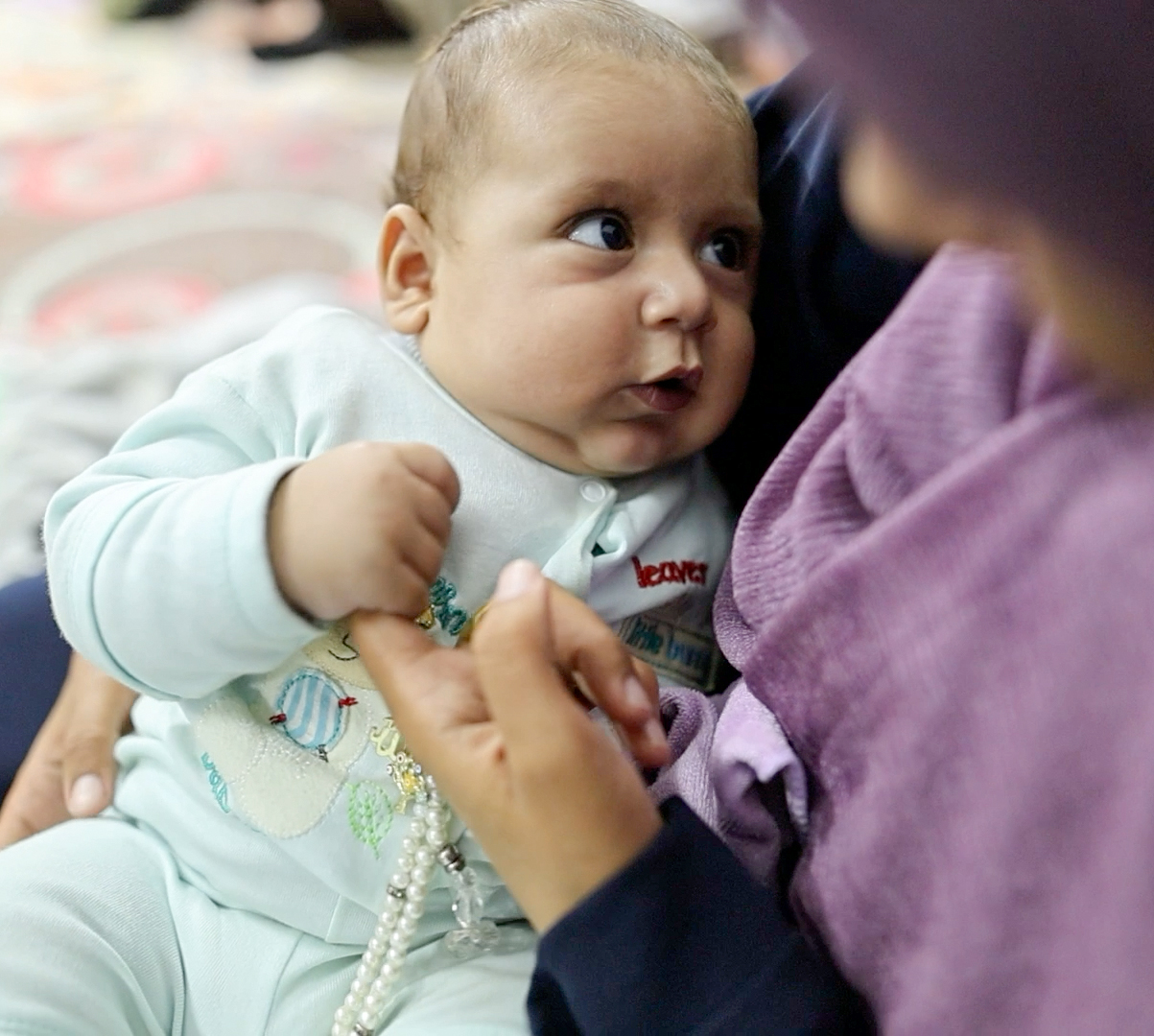
Five-month-old Qusai was born in the Gaza Strip during the recent conflict, and from his first days of life, his health was fragile.
“I knew something was wrong almost immediately,” his mother, Ayesha*, says. “Every breath felt heavy. I watched his chest rise and fall and wondered how such a tiny body could be carrying so much.”
Just one week after his birth, a doctor noticed a wheezing sound in Qusai’s chest. Further examinations at Nasser Hospital confirmed multiple serious congenital heart conditions, including a hole in his heart and a blockage in the pulmonary artery. Doctors explained that he would need complex open-heart surgery — care that was not available in the Gaza Strip.
Ayesha’s pregnancy with Qusai had already been marked by fear and uncertainty. Reaching a hospital for her caesarean section was difficult amidst bombardment and lack of safe access to health facilities. She worried about the availability of adequate health care and whether her baby would survive the birth. After surgery, she returned to a tent with fresh stitches, limited nutrition and little protection from the cold.
As Qusai grew, his condition worsened. He struggled to breathe, and his lips and limbs often turned blue from lack of oxygen. Feeding became difficult, and he could not tolerate pollution or cold air.
“I watched my baby fight for every breath,” Ayesha says. “That kind of fear stays with you.”
In October 2025, with WHO’s support, Qusai was evacuated to Ireland, where he is now receiving specialized cardiac care. For the first time, he is beginning to recover and experience moments of childhood.
Qusai is one of many patients evacuated with the support of WHO, European Union and Member States. Since October 2023, more than 10 700 patients have been evacuated from Gaza for specialized treatment in over 30 countries.
Qusai is one of over 10 700 patients WHO has supported to evacuate from the Gaza Strip for specialized treatment in over 30 countries. Two years of conflict have severely degraded Gaza's health system. Currently, only half of all hospitals are partially functional, and specialized medical care is largely unavailable, leaving 18 500 people, including 4000 children, without access to lifesaving treatment. With the ceasefire improving access and security, it is critical that WHO is supported to rapidly scale up health care in Gaza. This includes rehabilitating damaged health facilities, increased medical supplies, and expanding services to reduce the need for medical evacuation. Achieving this will require expedited clearance procedures and the removal of access restrictions on the entry of essential medical supplies and equipment.
In parallel, WHO calls for the urgent reopening of the medical referral route to the West Bank, including East Jerusalem, which remains the most time and cost-effective pathway for patients to access specialized care. In the interim, WHO urges more countries to demonstrate solidarity by accepting patients from Gaza, to save lives and reduce preventable morbidity and loss of life.
