


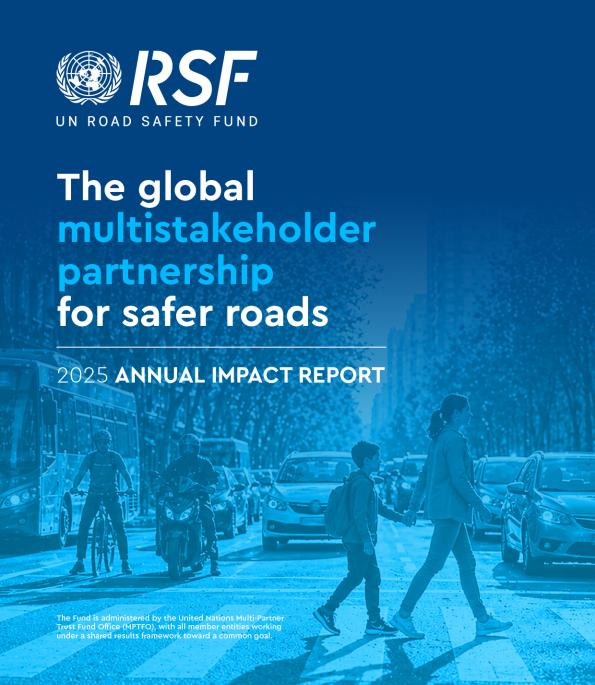
10 May 2026, Cairo, Egypt – On Monday 4 May 2026, the United Nations Road Safety Fund (UNRSF) released its 2025 Annual Impact Report. The Report showcases UNRSF-supported initiatives covering 58 countries and 88 municipalities. Delivered measurable results are presented across 5 critical pathways to impact: addressing high-risk factors; safer vehicles; strengthened national road safety systems; safer and greener streets, and emergency care systems.
One of the initiatives – a WHO-coordinated project implemented by the Islamic Republic of Iran, Oman, Pakistan, Saudi Arabia, Tunisia and Yemen, in collaboration with partners including the United Nations Development Programme (UNDP), the United Nations Economic Commission for Europe (UNECE), Africa Transport Policy Programme, World Bank group (SSATP), the Asian Development Bank (ADB) and the African Road Safety Observatory (ARSO) – aims to strengthen motorcycle safety across the Eastern Mediterranean Region. It started in November 2025 and will continue until March 2027.
The Global status report on road safety 2023 contained alarming statistics on the increase in deaths involving powered 2/3 wheelers in the Eastern Mediterranean Region. The increase, from 14% to 17% of all road traffic deaths between 2010 and 2021, underlines the urgent need for enhanced road safety measures, including the adoption of laws and standards aligned with UN legal instruments.
The current project aims to strengthen motorcycle safety systems through harmonized helmet standards and cross-country coordination, in alignment with global best practices.
A multi-country platform was established to enable legislative alignment across the 6 participating countries, supported by national readiness assessments that provide a baseline for strengthening helmet standards and laws. A crash data improvement strategy has also been developed in line with the best global practices.
By combining international technical expertise with strong national ownership, the initiative is elevating motorcycle helmet safety to a coordinated regional policy priority and building the systems needed for effective implementation and enforcement.
As countries continue to collaborate, the project offers a scalable model for improving road safety, protecting riders and saving lives across the Eastern Mediterranean Region..
