


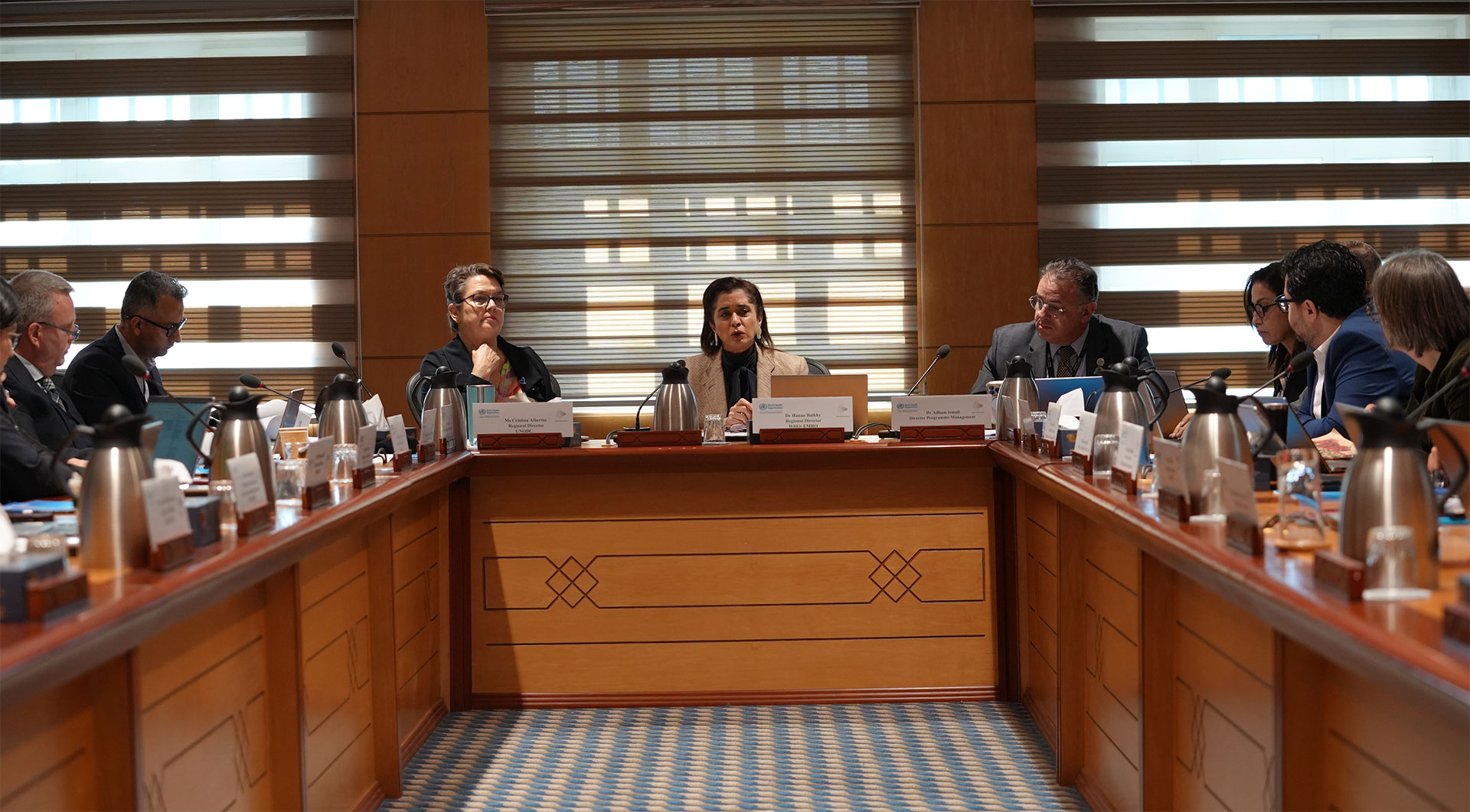
 Dr Hanan Balkhy addressing participants in the Regional Health Alliance’s meeting to accelerate equitable access to medical products across the Region. Photo credit: WHO/Mahmoud Essa
3 December 2025, Cairo, Egypt – Today, the Regional Health Alliance (RHA) concluded its meeting on strengthening regulatory systems, enhancing local production and improving the procurement and supply chain of medical products through collaboration and partnership. The meeting ended with a strong commitment to accelerate equitable access to medical products across the World Health Organization (WHO) Eastern Mediterranean Region.
Hosted by the WHO Regional Office for the Eastern Mediterranean in Cairo, the hybrid meeting brought together senior representatives from WHO, including from country offices in Egypt, Iraq, Jordan, Lebanon, Morocco, Pakistan and Tunisia, and from the United Nations Children’s Fund (UNICEF), the United Nations Industrial Development Organization (UNIDO), the United Nations Office on Drugs and Crime (UNODC), the United Nations Population Fund (UNFPA), the United Nations Development Programme (UNDP) and the World Bank.
Participants emphasized that equitable access to safe, effective and affordable medical products is a public health imperative. Discussions highlighted the need for harmonized regulatory frameworks, investment in local manufacturing and innovative procurement strategies to build resilient supply chains.
Agencies also explored mechanisms to combat substandard and falsified products and promote fair pricing models, generics and technology transfer.
“Although our region accounts for less than 10% of the world's population, we accounted for more than half of WHO's global procurement in 2024 and 2025. If this is indicative of anything, it is two things: the magnitude of our needs, and the need to strengthen our systems to become more resilient and self-reliant,” said Dr Hanan Balkhy, WHO Regional Director for the Eastern Mediterranean
“Therefore, our main initiative on expanding equitable access to medical products focuses on three main pillars: efficient procurement and supply chains, strong regulatory systems, and strong local production capacity.”
Access to safe, effective and affordable medical products is a pressing public health challenge in the Eastern Mediterranean Region where countries face significant barriers, including reliance on imports, vulnerability to global supply disruptions and fragmented regulatory frameworks. By promoting harmonized regulations, combating substandard and falsified products and leveraging generics and fair pricing models the Region can improve affordability and accessibility, especially for underserved populations and those in emergency settings.
In an era of constrained resources, participants underscored the importance of doing more with less through strategic alignment and partnership.
Ensuring access to safe, effective and affordable medical products requires a comprehensive approach built on 3 pillars:
- Strengthening regulatory systems to ensure quality and safety.
- Enhancing local production through technology transfer and investment in regional manufacturing.
- Improving procurement and supply chain resilience to guarantee timely availability of essential products.
The meeting’s key outcomes aligned with these pillars.
Joint action plans
Agencies agreed to develop resourced country support workplans for 2025–2026, focused on strengthening regulatory systems, enhancing local production and improving procurement and supply chains.
Resource mobilization
A joint resource mobilization plan will be designed to sustain progress and optimize limited resources.
Collaboration framework
Priority areas for interagency collaboration were identified to accelerate implementation of the Regional flagship initiative on expanding equitable access to medical products endorsed by the WHO Regional Committee in 2024.
RHA’s collective efforts will focus on 13 priority countries – Egypt, Iraq, Iran, Jordan, Lebanon, Morocco, Oman, Pakistan, Sudan, Syria, Saudi Arabia, Tunisia, UAE– over the next 2 years. By pooling expertise and resources, the Alliance aims to expand equitable access to essential medical products, reduce disease burden and contribute to economic growth in line with the Sustainable Development Goals.
About RHA
The Regional Health Alliance (RHA), a cooperative UN platform comprising 18 regional agencies, continues to play a pivotal role in advancing health priorities across the WHO Eastern Mediterranean Region. Established in 2019, RHA fosters interagency coordination to accelerate progress toward health-related Sustainable Development Goals (SDGs). In an era of constrained resources, collaboration and strategic alignment are essential to “do more with less” and deliver equitable, sustainable health outcomes.
