


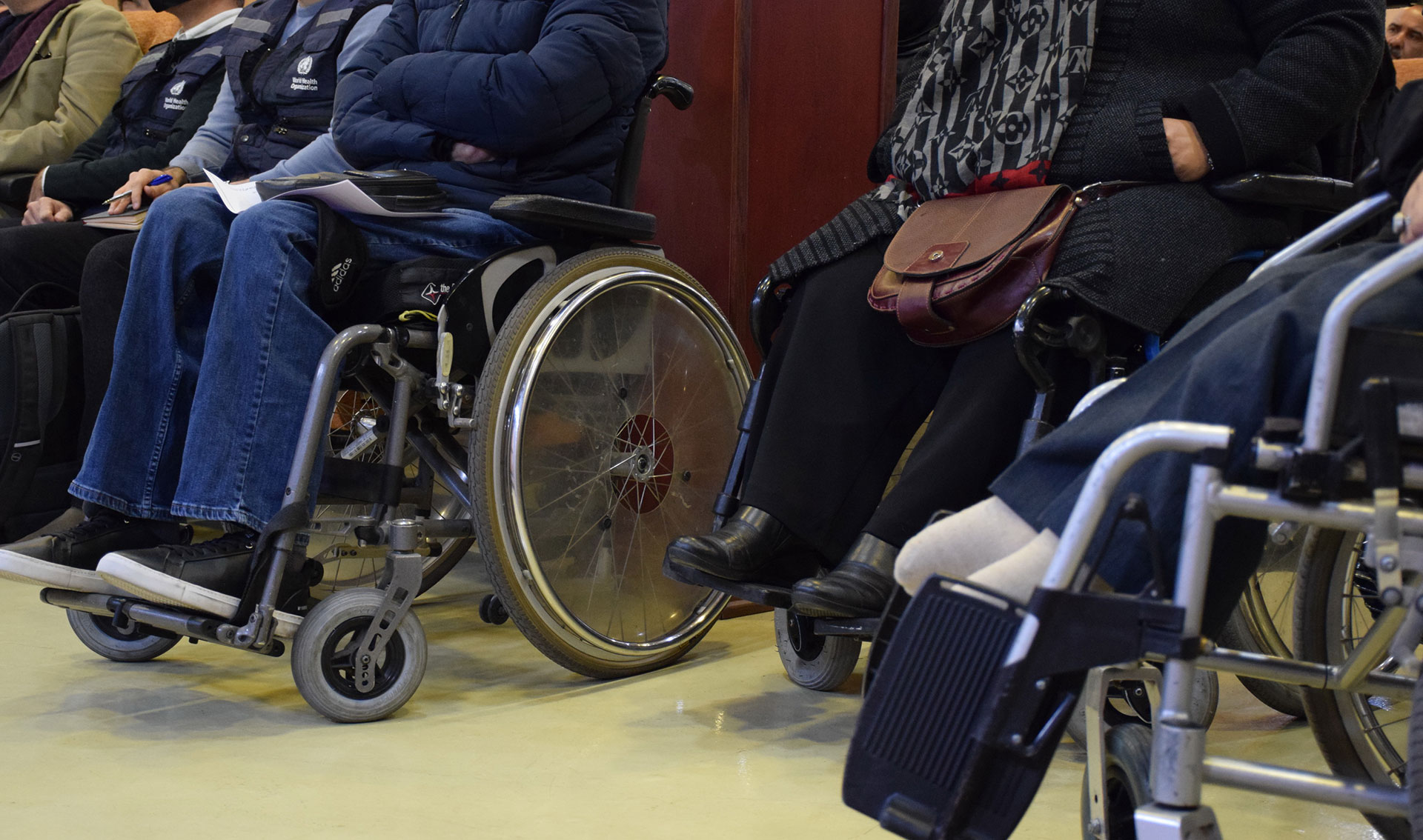
 WHO distributes assistive technology tools to older people and people living with disabilities in cooperation with local NGO, Islamic Republic of Iran. Photo credit: WHO
2 December 2025, Cairo, Egypt – The International Day of Persons with Disabilities (IDPD) promotes the dignity, rights and well-being of persons with disabilities and raises awareness about the benefits of their inclusion in all aspects of political, social, economic and cultural life. Since United Nations General Assembly resolution 47/3 was adopted in 1992, proclaiming 3 December as IDPD, the Day has served as a global reminder of the importance of ensuring that persons with disabilities are fully included and empowered.
The year’s IDPD theme – Fostering disability-inclusive societies for advancing social progress – underscores the need to strengthen inclusion to advance human development across all sectors. It builds on the outcomes of the Second World Summit or Social Development held in Doha, Qatar, on 4–6 November 2025, when Member States reaffirmed their commitment to promote equity, justice and full participation for persons with disabilities.
This is in line with related global commitments. Article 25 of the United Nations Convention on the Rights of Persons with Disabilities (UNCRPD) recognizes the right to “the highest attainable standard of health without discrimination on the basis of disability”. Article 26 provides for “habilitation and rehabilitation” services, including assistive technologies.
 This is in line with related global commitments. Article 25 of the United Nations Convention on the Rights of Persons with Disabilities (UNCRPD) recognizes the right to “the highest attainable standard of health without discrimination on the basis of disability”. Article 26 provides for “habilitation and rehabilitation” services, including assistive technologies.
In 2021, the World Health Assembly endorsed resolution WHA74.8 which calls on Member States to make the health sector more disability inclusive, involve persons with disabilities in decision-making and the design of programmes and to take measures to ensure access to health services for persons with disabilities, particularly during health emergencies.
The 2022 Global report on health equity for persons with disabilities showed that despite country efforts, persons with disabilities continue to face barriers in accessing health care, experience health disparities that can shorten life expectancy by up to 20 years, are disproportionately affected by chronic health conditions and face stigma and discrimination in society and within health care systems.
In the Eastern Mediterranean Region, 21 out of 22 countries and territories have ratified UNCRPD and there is growing self-advocacy and government commitment to realize the rights of persons with disabilities – an estimated 14.7% of the population, a figure likely to increase on the back of global trends that include an increase in noncommunicable diseases, ageing populations and the disproportionate impact of wars, conflict, forcible displacement and natural disasters.
In 2022, a regional report, based on a rapid assessment of disability inclusion during the COVID-19 health response, concluded that inclusion needed strengthening and offered a basis for further assessments to inform the development of health systems with disability inclusion at their core.
Recognizing the need for a deeper understanding of disability inclusion across the Region, WHO developed a situation analysis of disability inclusive health systems, in collaboration with Member States and the Global Disability Innovation Hub (GDI Hub) of University College London (UCL). The situation analysis, which will soon be published, builds on the recommendations of the Global report on health equity for persons with disabilities and aims to provide a foundation for countries to draw on when taking steps to improve disability inclusion and, ultimately, the lives of persons with disabilities.
Achieving equitable access to health services – drawing on global frameworks such as the WHO Policy on Disability, the United Nations Disability Inclusion Strategy, WHA74.8 and the UNCRPD – is central to WHO’s mandate. Multiple endeavours are already in place to advocate for, and provide practical guidance towards health equity for persons with disabilities. The Global report details 10 entry points and 40 disability-inclusive actions to advance equity across the health sector. Recommendations focus on ensuring that persons with disabilities can exercise their right to health, achieve the highest possible level of wellness and actively participate in decisions that impact their lives.
 Achieving equitable access to health services – drawing on global frameworks such as the WHO Policy on Disability, the United Nations Disability Inclusion Strategy, WHA74.8 and the UNCRPD – is central to WHO’s mandate. Multiple endeavours are already in place to advocate for, and provide practical guidance towards health equity for persons with disabilities. The Global report details 10 entry points and 40 disability-inclusive actions to advance equity across the health sector. Recommendations focus on ensuring that persons with disabilities can exercise their right to health, achieve the highest possible level of wellness and actively participate in decisions that impact their lives.
To support the efforts of ministries of health and partners to implement these recommendations, WHO produced Health equity for persons with disabilities: guide for action (or the Disability inclusion guide for action) in 2024. The document provides practical guidance on processes that ministries of health should lead in order to better integrate disability inclusion into health systems governance and planning and monitoring processes in line with the strategic operational plan for the Eastern Mediterranean Region 2025–2028 which foregrounds disability inclusion in all WHO programmatic areas and at all health system levels.
The WHO Disability Health Equity Network, a stakeholder network supporting the WHO Disability Health Equity Initiative, was also launched this year, bringing together stakeholders from governments, civil society, academia and international organizations to work in support of inclusive health systems.
On the occasion of International Day of Persons with Disabilities 2025, WHO calls on governments, stakeholders, persons with disabilities, civil society organizations and communities to intensify collective efforts to erase barriers that prevent persons with disabilities from accessing health services and meeting their health needs with care, dignity and respect.
WHO reaffirms its commitment to advance and realize the right of persons with disabilities to the highest attainable standard of health, leaving no one behind.
Useful links
Disability-inclusion in COVID-19 health responses in the Eastern Mediterranean Region
Global report on health equity for persons with disabilities:
Full report: Global report on health equity for persons with disabilities
Executive summary:
Global report on health equity for persons with disabilities: Executive summary: English | Arabic
Health equity for persons with disabilities: guide for action
Inaugural meeting of the WHO Disability Health Equity Network
Resolution WHA74.8 “The highest attainable standard of health for persons with disabilities”:
English | Arabic | French
