

Sélectionnez votre langue
Polio outbreak in Saada governorate
6 September 2020 – Fourteen cases of vaccine-derived poliovirus type 1 (cVDPV1) have been detected in several districts in Saada governorate, in the north-west of Yemen.
The cases – children aged from 8 to 156 months – had onset of paralysis ranging from 31 January to 18 June 2020, with one other case from June 2019 also confirmed retrospectively.
The 14 cases are clustered in an area with very low routine immunization levels that has been inaccessible to the polio programme since late 2018 for various reasons, including the restrictions due to the current COVID-19 pandemic, and has been a source of growing concern for those reasons.
Health authorities in Yemen, supported by the polio programme staff, and the regional teams of WHO and UNICEF, are working hard to mount an outbreak response rapidly.
Contacts of affected children are being traced, and every effort is being made to ensure more children have access to essential immunization.
Vaccination is the only way to protect children from polio, and the oral polio vaccine (OPV) is the best know tool for that. It is the tool used by the WHO’s polio programme to eradicate polio and protect populations from type 1 polioviruses, in Yemen and worldwide.
Note on the vaccine-derived poliovirus
Vaccine-derived poliovirus type 1 is a strain of poliovirus that emerges and paralyses children in communities where not enough children have received OPV. The term “vaccine-derived poliovirus” can be misleading: while the vaccine-derived strains can cause outbreaks of polio, these outbreaks are stopped by achieving high vaccination coverage by the same vaccines. For this reason, an outbreak of VDPV acts as an urgent warning signal that immunity levels in that area are dangerously low.
Fighting for the rights of renal failure patients in Yemen
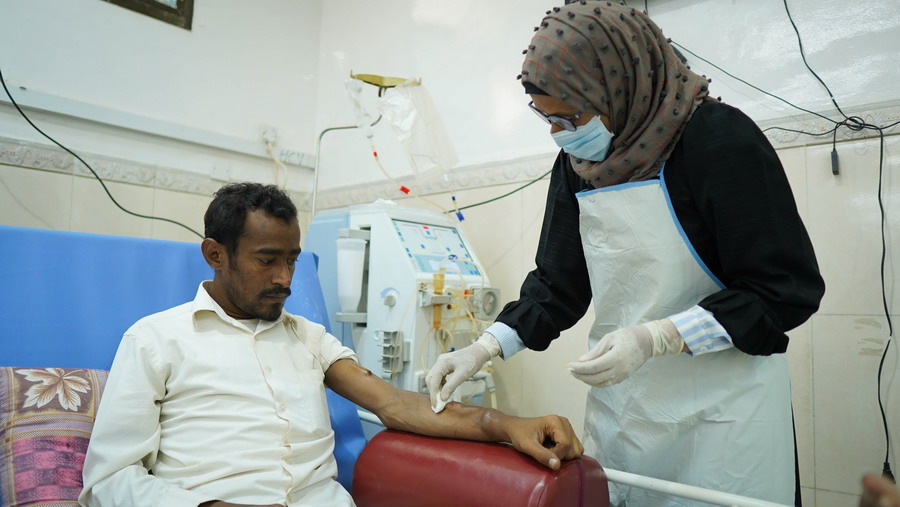 Osama, 28, receives treatment in Al Sadqqah Hospital in Aden
31 August 2020 – Over 5 years of hostilities in Yemen have resulted in a massive setback to an already weak health care system and led to a dramatic collapse of health care services provided to the population. More than 17.9 million people out of the total population of 30 million require health care services in 2020, while only half of the health facilities are fully functioning.
The dialysis centre also face a severe shortfall of essential supplies such as medication and fuel to run hospital equipment, as well as a lack of funds to pay health care workers regularly.
Dheya has been working as a nurse in Al Sadqqah Hospital's dialysis centre in Aden for the last 6 years. She has witnessed the torment of kidney failure patients, and the decreasing capacity of the hospital to treat the patients properly.
"Without dialysis consumables and supplies, the suffering of these patients is unbearable. But because of the lack of medical supplies, we often had no other choices than to reduce the duration or the frequency of the dialysis sessions,” said Dheya.
"Limited access to dialysis sessions and treatment put the lives of these vulnerable patients at higher risk, not to mention the suffering they go and their families through because of the lack of treatment," said Dr Abdulwahab Al-Nehmi, Noncommunicable Disease Officer at the WHO country office in Yemen.
A partnership between WHO, KSrelief and the Government of Kuwait has helped support patients suffering from renal failure in Yemen through the provision of access to healthcare. Between September 2019 and May 2020, up to 110 340 dialysis sessions were delivered to more than 4300 patients with chronic kidney failure.
KSrelief has covered up to 80% of the total cost of the dialysis sessions in all 21 centres across the country. WHO has provided up to US$ 24 million worth in supplies to cover the life-saving treatment needs of patients living with chronic, life-threatening conditions (cancer, kidney failure and noncommunicable diseases, including diabetes).
Osama is 28 years old. He is one of the patients receiving dialysis treatment at Al-Sadaqa hospital. "Being a dialysis patient is very challenging. Receiving treatment is also a challenge, but those dialysis sessions have made a positive difference in my life. I am gradually feeling better, and I can feel that my health is improving," he said.
"As a health worker, witnessing my patients' health condition stabilize and improve through treatment is what gives me the energy to continue my mission despite the hardship," says Dheya.
Despite the long-standing efforts of WHO and partners in coordination with health authorities, significant gaps remain due to funding shortages to the humanitarian response in Yemen under the throes of the collapse of public institutions. Continued support is still needed to save the lives of the most vulnerable, including renal failure patients.
WHO and Italy, frontrunners in the fight against malnutrition in Yemen
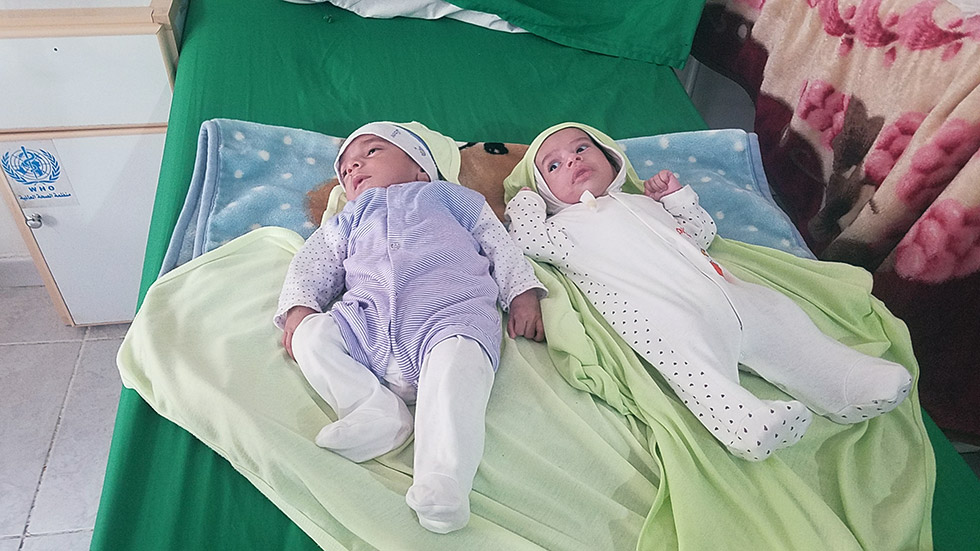 Ahmed and Qaed, 2-month-old twins from Ibb, suffered from severe acute malnutrition. They were admitted at a WHO-supported therapeutic feeding centre in Sana'a. Their condition improved after one week of treatment.
30 July 2020 – The life of children in Yemen is marked by poverty, hunger and disease. In 2020, 2 million Yemeni children suffer from acute malnutrition, including nearly 320 000 from who suffer severe acute malnutrition, of whom up to 10% may end up with severe medical complications with a 90% chance of death, if not treated.
Ahmed and Qaed, 2-month-old twins from Ibb, suffered from severe acute malnutrition. They were admitted to a WHO-supported therapeutic feeding centre in Sana'a.
"Ahmed and Qaed got sick and could not be appropriately fed, which resulted in a severe loss of weight. We had to travel to Sana'a from Ibb where there was no therapeutic feeding centre," said Hana'a, the twins' mother.
Like hundreds of thousands of Yemeni families, Ahmed and Qaed's parents have been struggling to keep their children safe from the war, starvation and disease, as a result of the ongoing crisis.
"My husband graduated from university. Yet, his efforts to find a job have been in vain. Because we couldn't afford to live by ourselves in Sana'a, we had to go back to the village to live with his family. We can barely cover the cost of food, and we couldn't afford the cost of treatment for my husband who had an accident resulting in a spinal disc herniation," said Hana'a.
Half of the population in Yemen is unemployed due to a devastated civil and social infrastructure. The situation is aggravated by disease outbreaks, including cholera, dengue and malaria, which remain major public health problems in Yemen. And recently, COVID-19, which is spreading rapidly across the country.
"Immune systems are compromised by malnutrition, especially in the case of children, leaving them vulnerable to infectious diseases, including COVID-19," said Salah Alshaoof, a nutrition and health professional at the WHO-supported therapeutic feeding centre.
"We work to provide life-saving management to these children and support their caregivers with meals, counselling and provision of admission kits," he added.
In addition to having severe wasting, Ahmed had a hernia. He needed to stay longer in the feeding centre until he recovered. He was then referred for further medical and surgical management. WHO provided the family with therapeutic milk and medicine, financial support for transportation fees and covered the cost of clinical and laboratory investigations.
It took the twins one week to show signs of improvement. "I was advised to attend counselling sessions about breastfeeding and hygiene, as the twins are still in the exclusive breastfeeding period, and I have to learn proper infant feeding practice. I hope that will help me take care of my children better," said Hana'a.
Entisar was brought to Al Sadakah hospital in Aden. The feeble child was suffering from severe acute malnutrition with watery diarrhoea symptoms. The 3-year-old girl is from a low-income family in the Taizz governorate who flew to Aden because of the fighting. Her mother has been psychologically traumatized by the conflict and is no longer able to care for her children, including Entisar.
Hundreds of thousands of Yemenis have developed mental health problems as a result of psychological and physical stress due to large-scale insecurity, displacement and food insecurity.
"I'm the one taking care of my sister and my other siblings," said the 14-year-old sister of Entisar.
WHO procures and distributes child-friendly and gender-responsive admission kits to preserve the mothers' dignity and reduce the financial burden on families during a child's stay at the therapuetic feeding centre.
“Health – understood as a right and as a condition and opportunity for development – continues to be a priority intervention issue for Italian Cooperation, integrated with gender equality and with the rights of minors and of people with disabilities,” said Emilio Ciarlo, Head of Institutional Relations and Communication of the Italian Agency for Development Cooperation.
Thanks to the generous contributions of the Government of Italy and other donors, WHO has provided support to Yemen's 90 therapeutic feeding centres, including 37, which have been recently established. Between 2019 and June 2020, 17 831 children were treated for severe acute malnutrition in WHO-supported centres.
"Thanks to partnerships like this one, the death rate of severely acutely malnourished children under 5 has decreased from 3.6% in 2017 to 2.1% as of June 2020,"said Dr Ferima Coulibaly Zerbo, Nutrition team lead, at the WHO country office in Yemen.
WHO and UNICEF confirm that polio vaccines are safe and have not expired
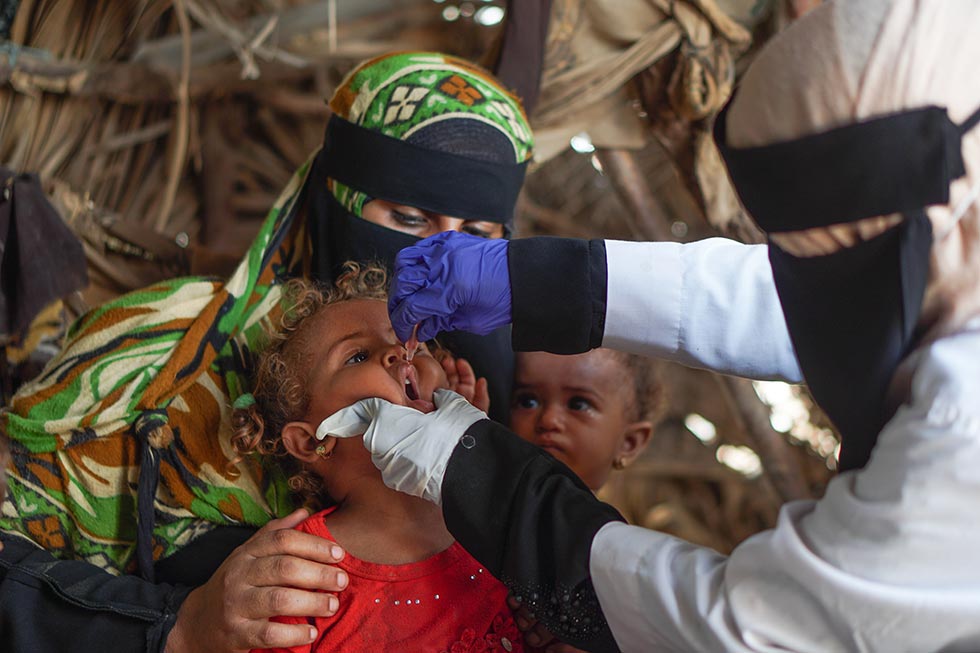
29 July 2020 – A lifesaving vaccination campaign is ongoing in 13 governorates in Yemen. Children are being provided with the polio vaccine and vitamin A micronutrient supplements to help protect them from preventable disease. Strict COVID-19 prevention measures are being practised in the interests of public health.
WHO and UNICEF confirm that the vaccines are safe for use. These vaccines have not expired and, as with our vaccine cold chains globally, have been stored safely.