

Sélectionnez votre langue
Responding to Yemen's unseen mental health crisis

12 June 2022 - Mohamed (not his real name) is a 35-year-old patient at the Al Amal hospital in Sana’a – one of only four hospitals in Yemen providing care to persons with mental disorders.
Mohamed (not his real name) is a 35-year-old patient at the Al Amal hospital in Sana’a – one of only four hospitals in Yemen providing care to persons with mental disorders.
A father of four, Mohamed is isolated from his wife and children. He thinks about them constantly.
“They have nothing to eat,” he says, eyes welled with tears. “All I am worried about is my children going hungry, while I must stay here for my treatment. I miss them. They have no one to support them.”
Outside the hospital walls, Mohamed faces social stigma and shame, because of widespread misinformation, ignorance, and discriminatory attitudes about mental illness in Yemen.
Fighting COVID-19 and strengthening the backbone of pandemic preparedness and response
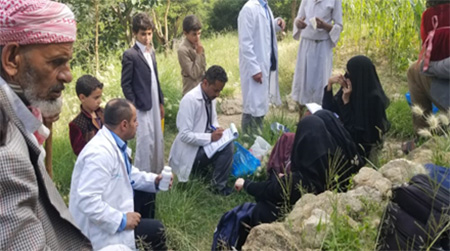 Sana’a, 2 June 2022 – Every country needs a strong health workforce to monitor and respond quickly to any increase in cases of infectious diseases. The world saw this clearly during the COVID-19 pandemic and it is a key lesson to take forward.
WHO and World Bank partnership on eIDEWS and rapid response teams
In Yemen, every year, cases of cholera, dengue, diphtheria, malaria, measles, and other diseases are reported. To support the authorities to rapidly detect and respond to these threats, WHO and the World Bank have worked together in partnership since 2017 through the Emergency Health and Nutrition Project (EHNP).
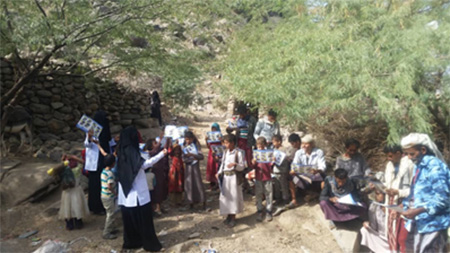 The WHO Representative to Yemen, Dr Adham Rashad Ismail Abdel-Moneim shared an example of the project’s success: “When the EHNP started there were around 1000 surveillance sites across 306 districts in Yemen. One year later the number of sites had doubled and expanded to all 333 districts in the country. By 2020, there were 2378 sites all regularly reporting via eIDEWS”.
The EHNP also enabled significant upgrading of Yemen’s electronic Integrated Disease Early Warning System (eIDEWS). The platform is now completely digital and standardizes line lists, investigation forms and response forms as well as summarizing key information into visual dashboards.
Responding to the world’s largest cholera outbreak
During the largest cholera outbreak the world had ever seen, in Yemen in 2016–2017, rapid response teams (RRTs) were established in every district with the World Bank’s support. They were equipped with mobile phones and tablets to report through eIDEWS so that data from the field could be made available to decision-makers. The 333 RRTs were made up of five members: a doctor or medical assistant, health educator, surveillance officer, laboratory officer and district health officer. They were supported and supervised by 23 governorate teams and two central teams in Sana’a and Aden.
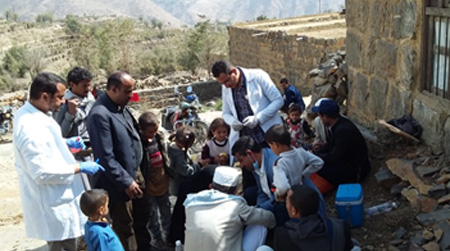 The RRTs played a critical role in containing the cholera outbreak and their value as first responders to infectious disease alerts was soon realized. Over time the remit of the RRTs expanded to cover more than 20 infectious diseases. Through the EHNP, almost 1800 RRT team members and 3000 surveillance officers have undergone training to build their skills and knowledge in disease surveillance and response. They are now an integral part of Yemen’s health system.
Tackling challenges together: COVID-19
When COVID-19 struck in 2020, the RRT model was used to quickly establish 670 COVID-19 teams. These two-person teams were deployed within 24 hours to investigate any alerts about suspected COVID-19 cases. They worked closely with the 333 RRTs who continued to monitor and respond to the myriad of infectious diseases in Yemen. This two-pronged approach of routine and COVID-19 specific RRTs enabled the surveillance system to be sustained even while COVID-19 dominated global attention.
The World Bank played a pivotal role by partnering with WHO on the Yemen COVID-19 Response Project (YCRP) in April 2020. The Bank was the first donor to support the COVID-19 response in Yemen, providing $27 million to WHO. These funds were crucial in activating the COVID-19 RRTs, establishing 48 isolation units across the country, dramatically scaling-up PCR testing to 18 laboratories, and procuring lifesaving supplies and equipment. In July 2021, the Bank again showed its leadership in pandemic response, providing an additional $20 million for Yemen to rollout the COVID-19 vaccines and reinforce health system capacities towards building back better.
Looking to the future: investing in human capital
Now as the focus on COVID-19 fades, Yemen is responding to outbreaks of polio, measles, and pertussis serving as constant reminders of the need to invest in routine immunization and preparedness and response. Eight years of conflict have taken a disastrous toll on the country, but by staying engaged the World Bank’s support to WHO has prevented the collapse of Yemen’s health system. Through the new Emergency Human Capital Project (EHCP), which is the successor to the EHNP, WHO and the World Bank are investing in building institutional and individual capacities.
Launching the intermediate Field Epidemiology Training Program (FETP)
One key activity of the EHCP, which builds on investments in eIDEWS, RRTs and the COVID-19 response, is a year-long intermediate Field Epidemiology Training Program (FETP).
FETP is renowned globally for building national epidemiological capacities. More than 80% of graduates continue to work in their home countries in leadership positions. In Sana’a, for example, the Director of Disease Surveillance and Response is a former FETP graduate.
This month 40 candidate health workers were selected from among hundreds across Yemen to compete for 25 places in the intermediate FETP course. They will build skills in public health data management and outbreak response, and they will do on-the-job field projects towards strengthening surveillance systems, all while continuing with their day jobs. At the launch of the course, the FETP Coordinator, Dr Yasser Ahmed Abdrehim Ghaleb stressed to the participants “in future, Yemen will count on you to rapidly investigate and respond to outbreaks.”
Yemen’s top AFP surveillance officer on what the indicators tell us
With cVDPV1 and cVDPV2 outbreaks unfolding against the backdrop of a major humanitarian crisis, polio surveillance has never been tougher – or more important
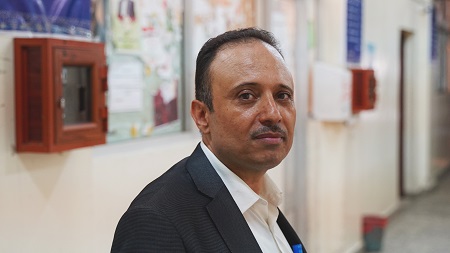 Dr Mutahar Ahmed, national surveillance coordinatorAt his office in Sana’a, Yemen, Dr Mutahar Ahmed stands before a wall-sized map of his country and feels the weight of the world on his shoulders.
“The situation here in Yemen is very complex, and the problems we face are quite immense,” said Dr Ahmed.
As Yemen’s national surveillance coordinator, Dr Ahmed leads the country’s acute flaccid paralysis (AFP) surveillance efforts, the primary means of tracking poliovirus transmission. With an explosive outbreak of circulating vaccine-derived poliovirus type 2 having paralysed 115 children and counting, and with swathes of the country’s infrastructure – from roads to hospitals – decimated by conflict, you’d be forgiven for thinking that his and his team’s efforts to surveil for poliovirus were falling short or otherwise compromised. But you’d be wrong.
In Yemen, despite a long-running conflict and complex humanitarian disaster that has significantly impacted health care, AFP surveillance indicators tell a promising story of a functioning system where case detection, sample collection and laboratory analysis – the steps that enable us to detect poliovirus so we can respond to it – are, in fact, on track.
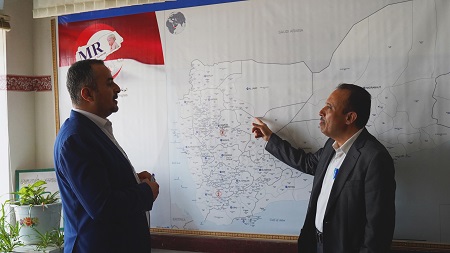 Dr Mutahar Ahmed reviewing the location of AFP cases with Dr Khaled Al-Moayad, Director of Disease Control and Surveillance in Sanaa, YemenSurveillance data allows the polio programme to identify new AFP cases and to test those cases to determine whether polio infection is the cause. In this way, a robust and wide-reaching AFP surveillance system enables health workers to detect the presence and circulation of poliovirus.
“In addition to our work building the engagement and knowledge of pediatricians and clinicians, we are reaching the community and community-based health care providers including traditional healers. We also appeal to families for their support in reporting cases. The more aware they are of the symptoms of paralysis in a child, the quicker our surveillance coordinators can collect the stool sample for analysis,” said Dr Ahmed.
Early detection of symptoms such as AFP is a crucial step in the chain of polio surveillance. If a case of paralysis is not reported within the first 14 days of the onset of symptoms, the reliability of testing the sample in the laboratory reduces significantly. In Yemen, the AFP surveillance system in high-risk districts is supported by volunteers trained in community-based surveillance. In 2021, 82% of AFP cases were detected early, within the first seven days of the onset of paralysis, which is above the global target of 80%.
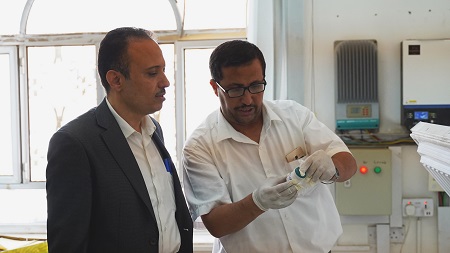 Dr Mutahar Ahmed L inspecting samples with Dr Abdullah Yahya, assistant national coordinator for AFP surveillance
Once a case is detected and stool samples are collected, it’s vital to make sure the samples reach the laboratory in good condition.
“Two stool samples are required from each child showing symptoms of paralysis. Both samples need to be collected within the first 14 days, 24 hours apart. They need to be correctly labelled, and their temperature needs to be maintained at between 2 and 8 degrees. Otherwise, they are not adequate samples,” said Dr Ahmed.
In 2021, 921 AFP cases were detected. Of these cases, 87.84% had adequate specimens collected, which is above the global target of 80% (Polio bulletin, issue no. 1227, week 14).
Along with stool adequacy, another key performance indicator for surveillance is the non-polio AFP rate. This refers to the detection of diseases, other than polio, that can cause AFP. Yemen’s non-polio AFP rate is 5.96 per 100 000 children aged below 15 years in 2021, significantly higher than the global standard of 3 per 100 000 for polio outbreak countries like Yemen (Polio bulletin, issue no. 1227, week 14). This accomplishment points to the sensitivity of Yemen’s surveillance system due to the relentless efforts and commitment of the surveillance personnel working with Dr Ahmed.
Due to electricity shortages, maintaining the cold chain (keeping vaccines cold) and reverse cold chain (keeping stool samples cold) poses a significant challenge for the programme. To overcome this and further increase the efficiency and sensitivity of the surveillance system to detect polioviruses as quickly as possible, solar power panels have been installed in health facilities at the central and governorate levels to support the storage and transfer of stool samples. One indicator of the impact of this change is Yemen's non-polio enterovirus rate, which tells us what percent of stool samples tested negative for poliovirus, but were in such condition that they could still test positive for enteroviruses. In 2021, that rate was 20% above the global target of 10%.
Because Yemen does not have a poliovirus laboratory in-country for testing, samples are first collected at the central level in Sana’a and then sent by road to Muscat, Oman. The journey can take up to 7 days, barring any obstacles or emergencies.
“Working in this role is a challenge, but what I particularly enjoy is how we are able to turn these challenges into opportunities for the AFP surveillance programme. The AFP indicators for the last year show us how far we have come in our journey,” said Dr Ahmed.
He explained why these indicators are so critical to the polio programme.
“The fact that our indicators are above the minimum global standards shows that the surveillance system is functioning, sensitive and responsive, despite the critical humanitarian situation. The data from our surveillance work has helped us identify the outbreak of circulating vaccine-derived polioviruses type-1 and type-2. The situation is quite fragile, but we are committed to addressing these challenges, and we will continue to do so.”
WHO has supported Yemen to establish an environmental surveillance system to supplement its AFP surveillance system and support early detection of polioviruses and more timely responses.
Building a specialized cadre of doctors and nurses to save lives in Yemen
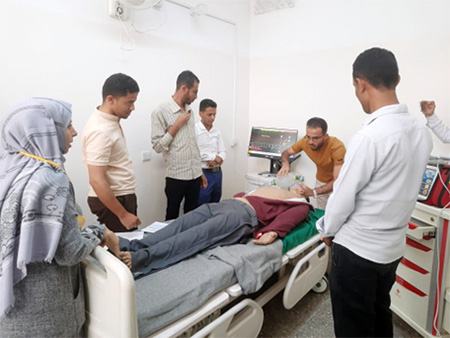 Aden, 22 June 2022 – Providing critical care in Yemen is a challenging task. Doctors and nurses with the skills and knowledge needed to save lives are often pulled to the private sector and abroad because of better salaries and working conditions.
During the COVID-19 pandemic, short-term intensive care and critical care trainings have filled an important gap in strengthening case management capacities. The WHO Representative to Yemen, Dr Adham Rashad Ismail Abdel Moneim explains “with support from partners, including the World Bank, WHO and the Ministry of Public Health and Population (MoPHP) trained more than 2000 health workers in case management. These short-term trainings were designed based on needs and country capacities”.
Now, WHO and MoPHP are looking towards a future beyond the COVID-19 pandemic, and towards lasting improvements in critical care capacities. With the World Bank’s support via the Yemen COVID-19 Response Project (YCRP), a longer-term training is being rolled out to quickly build a cadre of competent nurses and physicians working in government hospital intensive care units (ICUs) in Yemen. This training will contribute to ensuring the health system is equipped with sufficient critical care capacity for future emergencies.
After consultation with the MoPHP, University of Aden Faculty of Nursing and Medicine, and senior health professionals, a curriculum for a certificate course in critical care was developed. The 9-week course includes didactic, university-based laboratory simulations and practical clinical attachments in ICUs, delivered in partnership with Oman Medical Specialty Board. Course modules are being delivered in a variety of locations: theory at conference venues in Aden, laboratory simulations at the University of Aden Faculty of Medicine & Nursing Skills Laboratory, and practical classes in ICUs in government and private hospitals in Aden. The course also incorporates online training by WHO and the European Society of Intensive Care Medicine.
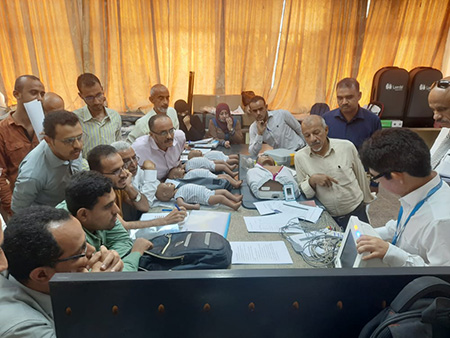 Participants who pass the course will receive a certificate in the Fundamentals of Critical Care Support (FCCS) from the Faculty of Medicine at the University of Aden. To ensure a return on investment, participants will be bonded to work in public sector hospitals for two years.
Forty-eight health workers are taking part in the inaugural course – 24 physicians and 24 nurses from all southern governorates in Yemen. They were selected via a competitive process, including an interview and written test, and all the participants are currently working in government hospital ICUs.
Implementation of this course is possible because of strong teamwork and close collaboration with the University of Aden, MoPHP, numerous hospitals in Aden, the World Bank and WHO. In the rollout, work is ongoing with the authorities to improve the didactic, simulation, and clinical sessions to enhance the experience for the students.
By contributing towards producing a cadre of critical care experts, this course is part of bridging the humanitarian-development nexus. It is both enhancing emergency preparedness and response capacities in Yemen, as well as strengthening critical care capacities within the heath system.