

Sélectionnez votre langue
WHO concerned about access to health services for displaced people in southern Syria
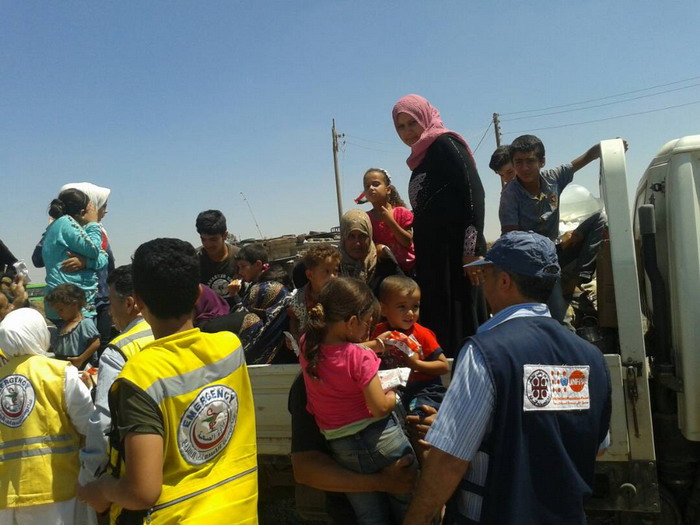 Photo: United Nations Population Fund12 July, 2018 – The World Health Organization (WHO) today called for the protection of health facilities and increased access to southern Syria, where the recent hostilities have left over 210 000 people displaced and in need of urgent health services. Up to 160 000 displaced Syrians currently seeking safety in Quneitra are inaccessible to health partners, raising concerns for their health.
“People in Dar’a and Quneitra are waiting for the humanitarian community to reach them with urgently needed aid and we cannot let them down. Access must be granted,” said Dr Michel Thieren, WHO’s Regional Emergencies Director. “We call on all parties to open the door to people in southern Syria and allow the safe delivery of medicines and medical items they need, and to grant severely injured patients safe passage to hospitals outside the area that can save their lives.”
WHO delivers over 17 tons of life-saving medicines and medical equipment to the newly accessible city of Douma
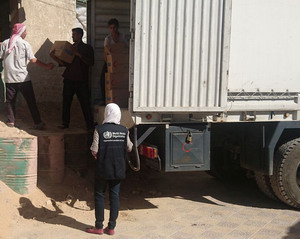 A WHO shipment reaches Douma in east Ghouta and is offloaded7 July 2018 – On 1 July 2018, the World Health Organization (WHO) delivered over 17 tons of life-saving medicines and medical equipment to the newly accessible city of Douma in eastern Ghouta in Rural Damascus.
The WHO supplies, dispatched as part of an inter-agency humanitarian convoy, are sufficient for more than 26 000 treatments for ill and wounded patients, and will be distributed to health care facilities supported by the Directorate of Health and the Syrian Arab Red Crescent. They include essential and chronic disease medicines, nutritional supplements, trauma and burn kits, mobile and fixed X-ray and ultrasound machines, laboratory supplies and operating theatre and surgical equipment.
WHO health supplies reach southern Syria as needs grow amid increased fighting
28 June 2018, Amman, Jordan -- Opposition-controlled areas in southern Syria are witnessing a dramatic increase in violence that has led to high levels of insecurity and the displacement of tens of thousands of people. Over 80% of the estimated 525 000 people living in these areas are expected to need humanitarian assistance as a result of the fighting. This includes up to 50 000 people who have displaced over the past two weeks.
On 27 June, WHO’s office in Damascus dispatched over 27 tons of medical supplies to respond to urgent humanitarian health needs in southern Syria. Items include operating tables, intravenous fluids, antibiotics and trauma supplies, burn medications and emergency health kits. The supplies are sufficient to provide 135 000 treatments. Further supplies have been prepositioned to respond to the rapidly evolving situation.
Health care facilities in southern Syria can also draw on regular cross-border stocks delivered by WHO and health partners in Amman. Current stocks are enough to treat up to 300 000 people for three months. WHO and its partners in Amman plan to pre-position another 51 tons of emergency supplies in warehouses throughout the area, ready for dispatch to health care facilities in southern Syria as and when needed.
Al Moadamya primary health care centre in rural Damascus, Syria, reopens with WHO support
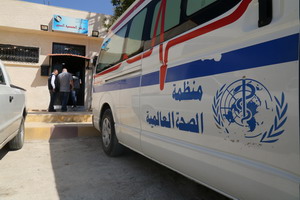 14 June, 2018, Damascus, Syria – With support from the World Health Organization (WHO), Al Moadamya primary health care centre in rural Damascus, Syria, has reopened after extensive rehabilitation made possible by a generous donation from the United Kingdom’s Department for International Development (DFID).
The centre serves more than 3800 people in the area, including almost 1800 people displaced from other parts of Rural Damascus. Services provided by its 19-strong team of doctors, nurses and midwives include vaccinations, maternal, newborn and child health, mental health, trauma care, nutrition, and treatment for communicable and noncommunicable diseases.
“I am extremely grateful to WHO for supporting the rehabilitation of this centre,” said Umm Ahmad, a resident of Al Moadamya. “I suffer from severe asthma, and being able to obtain health care in my own community has made all the difference in helping me manage this life-threatening disease.”
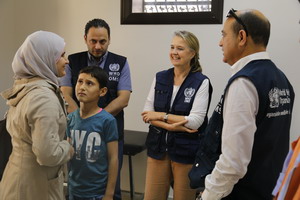 “WHO recognizes the vital importance of ensuring that people throughout Syria, especially the most vulnerable, have ready access to live-saving health care,” said Elizabeth Hoff, WHO Representative in Syria. “WHO’s support of this centre is part of our ongoing work to help rehabilitate facilities that are damaged, and support health facilities across the country with medicines, equipment and supplies,” Hoff added.
WHO has also donated an ambulance to Al Moadamya, which was besieged for more than 3 years until October 2016. The only available ambulance in the town provides emergency services and transports patients to nearby hospitals.
Related link
United Kingdom’s Department for International Development (DFID)