

Sélectionnez votre langue
EU support to medical supply chains keeps hospitals and clinics running in Syria
 Majd Qolghasi, Warehouse Officer with Hand in Hand for Aid and Development, checks EU-funded medical supplies at the WHO-managed warehouse in Sarmada, Idlib. Photo credit: WHO16 September 2025, Idlib, Syrian Arab Republic – In a warehouse in Sarmada, boxes of medicines and surgical kits are stacked neatly on pallets, ready to be dispatched to health facilities across Syria. For Majd Qolghasi, Warehouse Officer with Hand in Hand for Aid and Development, the health partner managing WHO’s warehouse in Idlib, each shipment represents more than supplies – it is a lifeline for patients.
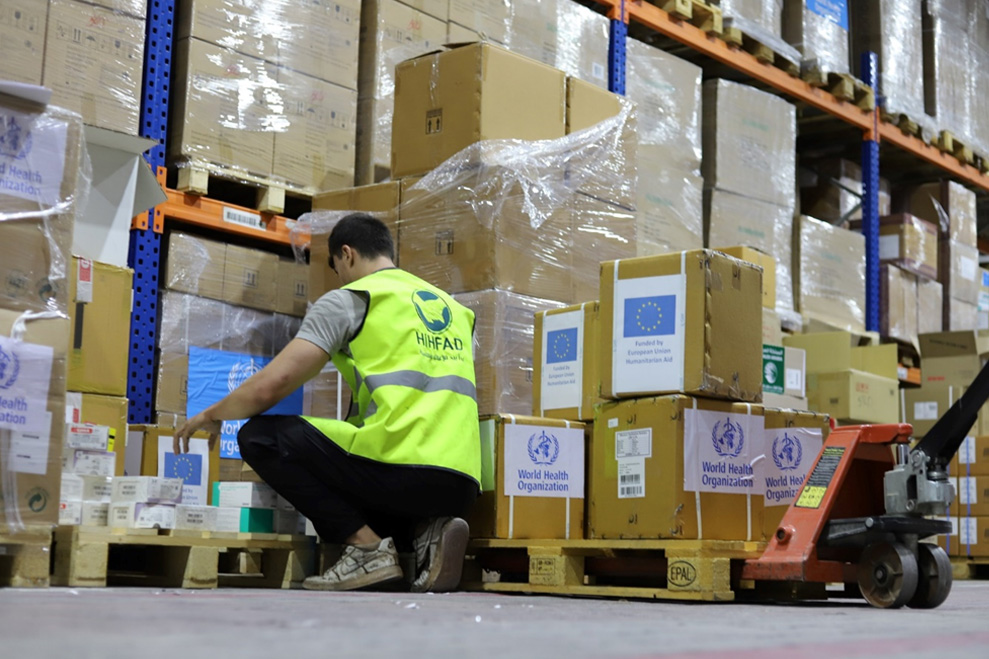 Warehouse staff organize EU-funded medical supplies at WHO’s warehouse in Sarmada, Idlib, before dispatch to health facilities. Photo credit: WHO “This shipment comes in response to the growing needs of the health sector,” says Majd. “It will significantly support hospitals and health centres by strengthening their capacity to provide medical services to patients – especially under the difficult circumstances the sector is facing, with limited resources and funding.”
The most recent consignment, delivered with support from the European Union (EU) through its Civil Protection and Humanitarian Aid Operations (ECHO), included essential medicines, medical consumables and surgical supplies. Distribution is carried out through a carefully planned system in coordination with the local Health Directorate under the leadership of the Ministry of Health, ensuring that health partners operating in Idlib and Aleppo can serve the people most in need.
Air bridge to Syria’s health facilities
This is not the first time EU support has sustained Syria’s fragile supply chain. In December 2024, more than 50 tonnes of EU-funded medicines and supplies were flown to Türkiye through the EU Humanitarian Air Bridge and transported by WHO to overstretched health facilities in Idlib and Aleppo. The delivery arrived at a pivotal moment as the country entered a transitional phase, helping facilities restock amid persistent needs.
Meeting emergencies head-on
From routine care to crisis response, timely supplies are vital to keep Syria’s health system functioning.
“These shipments help ensure the continuity of life-saving services for both chronic conditions and emergencies,” Majd explains. “Hospitals, health centres and mobile medical units are better supported, easing the pressure on facilities and enabling medical teams to provide immediate and continuous care.”
 EU-funded medical supplies are loaded for delivery from WHO’s warehouse in Idlib to hospitals and clinics. Photo credit: WHO Following the recent blasts in Idlib in July this year, WHO responded within 24 hours in coordination with the Health Directorate and partners – delivering 24 trauma kits to support emergency medical care. Each kit includes essential drugs, anaesthesia supplies, transfusion materials, dressing sets and surgical tools – enough to support more than 200 surgical procedures.
Majd recalls the impact clearly: “We had the trauma kits ready in the warehouse. When the blasts happened, the needs were identified by health authorities and partners, and we were able to send them immediately. That speed saved lives.”
This was also evident during the devastating wildfires in Lattakia earlier this summer. WHO delivered eight Trauma and Emergency Surgery Kits for burn care from its Idlib warehouse. Four kits were provided to Lattakia’s National and University Hospitals to treat people with severe burns, while another four were pre-positioned as contingency stock for future needs. Each kit contained supplies to manage 50 burn cases – helping health workers save lives when every minute counts.
Strengthening emergency response and continuity of care
Since 2011, Syria’s health system has been tested by conflict, economic crisis and multiple emergencies. EU support has been a cornerstone in strengthening resilience.
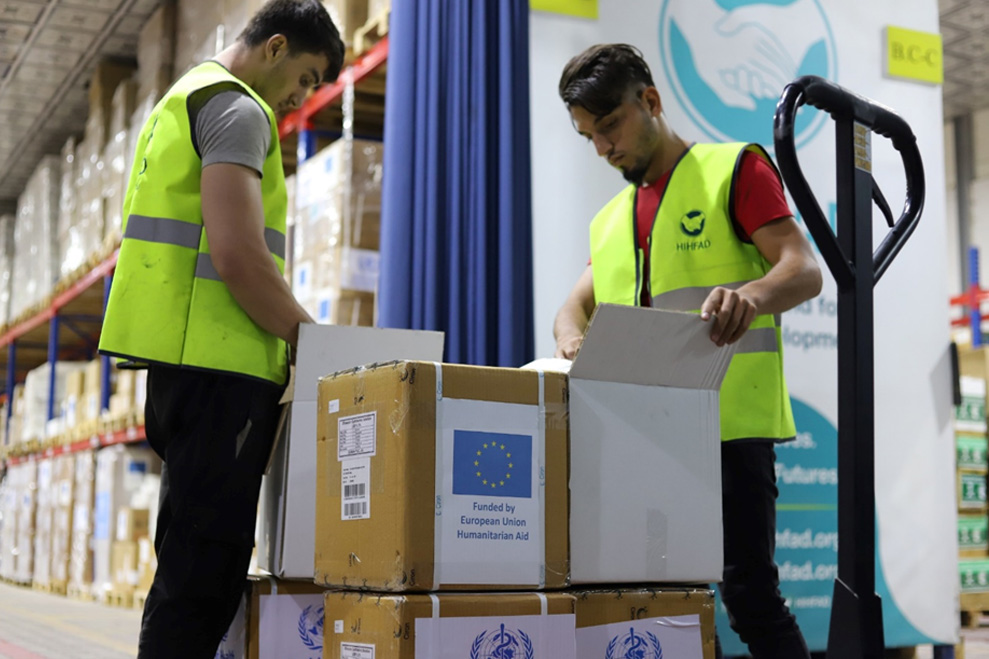 Health partner staff prepare EU-funded medical consignments at WHO’s warehouse in Sarmada ensuring medicines and supplies reach facilities on time. Photo credit: WHO Since last year, the European Union (EU), through its Civil Protection and Humanitarian Aid Operations (ECHO) has provided around €10.4 million to WHO across Syria, supporting ambulances, referral systems, essential medicines, primary health care, trauma services and more. Of this, over €4.1 million has gone towards medical procurement, ensuring essential medicines and supplies reached over 1 million people in need.
A new EU commitment of €22 million will sustain life-saving and life-sustaining health services for more than 6.5 million people into next year – keeping hospitals, clinics, referral pathways and medical supply chains running as the country begins its transition to recovery and rebuilding, while still maintaining critical humanitarian services.
“For us, every box in this warehouse means hope,” says Majd. “Thanks to the EU’s support, we can move quickly when emergencies happen and keep services running for the people who depend on them. That is what makes the difference.”
Paramedics in Aleppo keep hope alive through EU-supported referral system
 Tarek Al-Sheikh helps load a patient into the ambulance for urgent referral to hospital in northern Aleppo. Photo credit: WHO15 September 2025, Aleppo, Syrian Arab Republic – “I leave home early every morning to start my shift in the ambulance. Some days I wait for hours until a call arrives. Other days I respond immediately to emergencies – a child struggling to breathe, a mother in labour, or a patient who needs to be transferred urgently to another hospital,” says Tarek Al-Sheikh, a paramedic with the Syrian Relief and Development (SRD) team at Afrin National Hospital in Aleppo, northern Syria.
Tarek has been serving his community for more than 4 years. For him, this work is more than a job – it is a lifeline for families who otherwise would not be able to reach the care they need.
“The importance of this work is that it is purely humanitarian. Our people in the north need these services, which reach many people who otherwise would not be able to access care,” Tarek says.
Referral systems as lifelines
The referral system Tarek is part of is designed to save lives by moving patients quickly and safely across Idlib and Aleppo. Operating in areas where over 4 million people remain in need of health assistance – including 2 million living in camps – and with more returning to Syria, the need is immense. Since 2024, more than 1.2 million Syrians have returned to the country, while internal returns continue, with 1.7 million internally displaced returnees recorded since December 2024.
Against this backdrop, referral pathways help ensure that emergencies do not become tragedies. Tarek recalls one case that captures both the challenges and the impact of this work.
“We were at Bab Al Hawa Hospital, transferring a newborn from the incubator unit to Rajou Hospital in Afrin. When we arrived, we found two newborn twins, only 2 hours old, who urgently needed intubation and transfer to another hospital. The ambulance on site was not ready, and we were not fully prepared either. Despite this, with the help of the medical staff, the babies were intubated and we managed to transfer them safely to Azaz National Hospital.”
For families, the referral system also reduces the financial burden of health care. “In the past, people often had to pay extremely high costs for private transport or private hospitals. Now we can transfer patients for free to facilities where they can receive care,” says Tarek.
Building for today and tomorrow
 Paramedic Tarek provides emergency care to a patient inside an ambulance in Aleppo. Photo credit: WHOThe referral system is not only saving lives today – it is shaping the future of Syria’s health system. It supports the Ministry of Health’s goals to expand access, improve quality and strengthen preparedness. It reinforces WHO’s broader efforts to train health workers, improve coordination between facilities, and ensure patients reach specialized care without delay. Crucially, it keeps hospitals, clinics, referral pathways and medical supply chains functioning despite years of conflict and crisis.
In the last year, these services have improved significantly thanks to sustained support. Ambulances are better equipped, medical staff receive more training, and coordination has grown stronger. “We now have better training, more advanced equipment and stronger coordination. This has helped me save many more lives. It also brings stability to my own family, while serving the wider community,” says Tarek.
EU support keeping systems running
 Paramedic Tarek provides emergency care to a patient inside an ambulance in Aleppo. Photo credit: WHOThis work is made possible through funding from the European Union (EU), through its Civil Protection and Humanitarian Aid Operations (ECHO). To date, the EU has provided around €15 million to WHO across Syria, supporting ambulances, referral systems, essential medicines, primary healthcare, trauma care and rehabilitation services.
A recent commitment of an additional €22 million will sustain life-saving and life-sustaining health services for more than 6.5 million people into next year – keeping hospitals, clinics, referral pathways and medical supply chains running as the country begins its transition to recovery and rebuilding, while still maintaining critical humanitarian services.
Looking ahead
Despite the risks and difficulties of his work, Tarek remains motivated.
“This is humanitarian work. It helps the people who need it most, reduces risks and delivers healthcare quickly. The world outside Syria should know the role of paramedics and how essential these services are to saving lives here.”
“Every minute counts”: inside the ambulances connecting patients to care in Idlib
 An ambulance operated by the Syrian American Medical Society arrives at Latakia Health Directorate during the wildfire response. Photo credit: WHO
14 September 2025, Idlib, Syrian Arab Republic – This summer, when wildfires swept through the forests of Latakia, ambulance teams from Idlib were called in to support the emergency response. Paramedics rushed into smoke-filled hillsides where fire crews struggled to breathe. Among them was Mohammed Al Shahad, a father of three from Idlib, who recalls carrying a civil defense worker with severe burns and respiratory distress into his ambulance.
“We gave him fluids, oxygen, and urgent care before rushing him to Latakia National Hospital. That intervention saved his life, allowing him to return to his children and family. I will never forget that moment, knowing we had given him and his loved ones hope again,” Mohammed says.
Life on the frontline
For Mohammed and his colleague Bashar Al Ali, every day begins and ends in uncertainty. Bashar, from rural Idlib, joined the Syrian American Medical Society (SAMS) ambulance system in 2020 out of a sense of duty. “One moment I may be sitting quietly with my colleagues, and the next we receive an urgent call. Within seconds, we must be in the vehicle, preparing our equipment and rushing towards the patient. Even a single minute can mean the difference between life and death.”
 SAMS ambulances navigate smoke and rough terrain in Latakia to reach people affected by the wildfires. Photo credit: WHO
Both paramedics describe relentless challenges: navigating damaged or blocked roads, stabilizing patients with life-threatening trauma, and, until December last year, working under the constant threat of airstrikes. For Bashar, what keeps him going is the gratitude he sees in families’ eyes when their loved one makes it safely to hospital. “Ambulances here are not a luxury – they are the difference between life and death.”
On an average day, Mohammed may transfer up to 10 patients, ranging from newborns needing oxygen to trauma cases requiring urgent surgery. With only one paramedic often on board, the task is daunting. Yet, as he says, “Being a paramedic is not only about transporting patients – it is about carrying out a profound humanitarian mission: to save lives in the most dangerous places, where few others can reach.”
Strengthening the referral lifeline
The work of Bashar and Mohammed is part of a wider system that WHO and partners are supporting to ensure patients reach specialized care on time. Of the more than 200 ambulances operating in Idlib and Aleppo, WHO has supported over 30. This includes ambulances managed by SAMS, as well as the referral desk in northern Aleppo, which coordinates patient transfers and enables faster treatment.
 Ambulances supported by WHO and managed by SAMS prepare to transfer patients with war-related injuries in Sweida. Photo credit: WHO
In 2025, SAMS teams operated seven fully equipped ambulances in Idlib and facilitated nearly 3000 referrals, benefiting more than 2700 people, including over 160 people with disabilities. More than 1000 of these cases were for trauma and rehabilitation care.
Through this initiative, SAMS was also called on to respond to national priorities at the request of the Ministry of Health. In Latakia, its ambulances supported the response to the wildfire. In the south, four ambulances were deployed to Sweida and Daraa to transfer patients with severe war-related injuries to hospitals in Daraa and Damascus. These efforts reflect how referral services are adapting to national needs and integrating into the broader health system.
This work is made possible through funding from the European Union (EU), through its Civil Protection and Humanitarian Aid Operations (ECHO) and Novo Nordisk Foundation.
Why it matters
After 14 years of crisis, emergency referrals remain one of the most urgent gaps in Syria’s health system. For patients with trauma, maternal complications, or chronic disease, timely transfer can be the difference between life and death.
Reliable ambulance services reduce preventable deaths and help connect people to specialized treatment. They are also strengthening resilience – training health workers, improving coordination, and aligning with the Ministry of Health’s goals to expand access and preparedness. Each ambulance on the road represents more than a service: it is a critical step toward a stronger, nationally supported health system.
For Bashar, the calling is clear: “I have seen dozens of cases on the verge of death, but with quick intervention and the right tools, lives were saved. That support gave people confidence that someone was standing by them – that hope still exists, even in the darkest moments.”
And for Mohammed, the motivation is deeply personal: “When we arrive, people know help has come. That’s what keeps us going.”
KSrelief and WHO deliver five ambulances to strengthen Syria’s referral system
 Five ambulances funded by KSrelief and delivered through WHO to the Ministry of Health in Idlib. Photo: WHO7 September 2025, Idlib, Syrian Arab Republic– Five fully equipped ambulances funded by the King Salman Humanitarian Aid and Relief Centre (KSrelief) were delivered today by the World Health Organization (WHO) to the Ministry of Health in Idlib, boosting lifesaving referral services for thousands of patients.
The ambulances will be deployed to strengthen the referral network operating under the supervision of the Directorate of Health and assigned to the Union of Medical Care and Relief Organizations (UOSSM), an implementing partner within the system, to respond to emergencies and transport patients from primary health centres to hospitals capable of providing advanced care. Fully equipped for urgent cases, the vehicles will help ensure that people in critical condition can access timely and lifesaving care.
Dr. Samer Al-Jutaili, KSrelief official spokesperson, said, “At KSrelief we believe that every life saved is a step towards rebuilding hope and resilience in Syria. These ambulances are more than just vehicles – they are lifelines that ensure timely access to medical care, fostering a healthier, stronger future for all Syrians.”
 A KSrelief-branded truck during the transshipment process, carrying five fully equipped ambulances delivered through WHO to the Ministry of Health in Idlib. Photo: WHOWHO is supporting the operation and integration of the ambulances as part of wider efforts to strengthen Syria’s referral system. This includes improving coordination between facilities, training health workers, and ensuring patients reach specialized care without delay. These new ambulances, and the wider referral support around them, mark an important step towards a more integrated and nationally supported health system – one where emergency response and referral pathways are sustained within Syrian institutions.
“These ambulances are not just vehicles – they are a critical link in the chain of survival,” said Rosa Crestani, WHO Emergency Lead for the Gaziantep field office that handles cross-border response. “As Syria moves from emergency response towards early recovery, strengthening referral pathways is essential. With KSrelief’s support, and under the Ministry of Health’s leadership together with a strong network of health partners, we are reinforcing a system that ensures timely emergency care, reduces preventable deaths, and builds the foundations for a more resilient, nationally supported health system.”
The Ministry of Health has set out a clear vision to expand access to care, improve quality, and ensure the health system is better prepared for future challenges. The partnership with KSrelief and WHO directly supports this direction through procurement of essential medicines, operational support for health facilities in Idlib and Aleppo, replacement of damaged equipment, and provision of ambulances. Together, these agreements total US$ 9.49 million and benefit nearly one million people.
Media contacts
Halah Kabash,
Mrinalini Santhanam,