

Sélectionnez votre langue
KSrelief-funded medical supplies arrive in Idlib, bringing critical care to 150,000 people
 A convoy of trucks carrying WHO medical supplies funded by KSrelief makes its way through Idlib governorate, northwest Syria. Photo: WHO19 June 2025, Sarmada, Idlib, Syrian Arab Republic – A shipment of medical supplies funded by the King Salman Humanitarian Aid and Relief Centre (KSrelief) arrived in Idlib today via the cross-border operation from Türkiye. The delivery will support health facilities serving some of the most vulnerable communities in northwest Syria.
 A truck carrying KSrelief-funded medical supplies crosses the Bab Al-Hawa border point from Türkiye into northwest Syria, ensuring continued delivery of humanitarian health support. Photo: WHOThe supplies – delivered by the World Health Organization (WHO) – include over 70 types of essential medical items ranging from surgical tools and IV catheters to maternal health supplies and chronic disease medications. Delivered in 3 trucks and weighing nearly 20 tonnes, the shipment will enable approximately 450,000 treatment courses, helping sustain care for an estimated 150,000 people.
“Nearly 80% of people in this region rely on humanitarian health assistance, and every shipment like this helps us keep facilities open and health workers equipped,” said WHO Emergency Lead for the Gaziantep field office, Rosa Crestani. “We are deeply grateful to KSrelief for this timely support. These supplies will go directly to hospitals and clinics across Idlib and Aleppo that are working tirelessly to serve their communities.”
The delivery is part of the wider WHO–KSrelief partnership. In October 2024, KSrelief pledged USD 4.75 million to WHO to support lifesaving health services in northwest Syria. The funding enables WHO and partners to sustain over 50 health facilities, including primary health centres, hospitals, and specialized facilities such as dialysis and tuberculosis centres.
 Boxes of WHO-procured medical supplies funded by KSrelief are prepared for dispatch at the Sarmada warehouse in northwest Syria. Photo: WHOIn addition to providing medical supplies, the support covers salaries for medical and non-medical staff, operational costs, and disease surveillance efforts to detect and contain outbreaks.
“This project highlights KSrelief’s ongoing efforts to enhance health and environmental conditions in underserved communities, ensuring a positive and lasting impact for those in need,” said Dr. Abdullah Saleh Al-Moallem, Director of KSrelief's Health and Environmental Aid Department.
The supplies will be distributed to around 45 health facilities across northwest Syria based on identified needs – helping frontline teams deliver care where it is most needed.
For media inquiries, please contact:
For WHO: Mrinalini Santhanam, Communications Officer |
For KSrelief: Fanar Alshehri, International Communication Specialist |
About KSrelief
The King Salman Humanitarian Aid and Relief Centre (KSrelief) is Saudi Arabia's leading humanitarian organization, dedicated to providing aid and relief to communities affected by crises worldwide. Since its establishment in 2015, KSrelief has implemented more than 3.400 projects across various sectors, including health, education, and food security, in more than 100 countries
Over 1800 patients receive care in first week as Ma’arrat An Nu’man health facility reopens
 Acting WHO Representative in Syria Christina Bethke during the inauguration of the newly rehabilitated primary health centre in Ma’arrat An Nu’man, south Idlib. Photo: WHO16 June 2025, Ma’arrat An Nu’man, Syrian Arab Republic – A newly rehabilitated public health centre in Ma’arrat An Nu’man, south of Idlib, was officially inaugurated today, restoring essential health services in an area which is seeing an increasing number of returns after years of conflict.
The facility, rehabilitated with support from Gavi, the Vaccine Alliance, began operations on 25 May and provided more than 1800 consultations in its first week. Services include outpatient care, reproductive and pediatric health, emergency treatment, mental health support and immunization.
“This centre is an important step in restoring health services in areas where people are beginning to return,” said Acting WHO Representative in Syria Christina Bethke. “With support from Gavi, we are working to ensure essential care is available to communities rebuilding their lives.”
Once a major urban centre, Ma’arrat An Nu’man sustained widespread damage during the conflict. As of mid-2025, 90% of the city’s infrastructure is in ruins, and medical supplies and trained staff are in short supply.
The main referral hospital, which served more than 200 000 people, remains out of service. With the nearest functioning hospitals over 45 km away in Idlib or Hama, returning families faced serious barriers to care.
The rehabilitated public health centre ensures continuity of care while secondary services are being restored. WHO is also rehabilitating health facilities in other high-need areas, particularly where returns are increasing. Restoring infrastructure, staffing and public trust are central to recovery.
 Health workers administer routine childhood immunizations at the newly reopened Ma’arrat An Nu’man public health centre, rehabilitated with support from Gavi to strengthen essential Expanded Programme on Immunization (EPI) services. Photo: WHO“We welcome the Minister of Health’s commitment at the World Health Assembly to rebuild Syria’s health system through a phased, needs-based approach, focused on infrastructure, services and workforce investment,” added Bethke. “This centre reflects that vision. Through collaboration with Gavi and other partners, WHO is proud to support national efforts to expand access to health care and bring services closer to communities recovering after years of crisis.”
The rehabilitation was carried out by WHO in collaboration with Gavi as part of joint efforts to strengthen Syria’s primary health care system and expand immunization services. Since 2023, the partnership has rehabilitated 12 centres across the country, with 3 more under renovation and 6 additional facilities planned by the end of 2025. WHO’s Damascus office led the rehabilitation work while its cross-border team in Gaziantep, Türkiye, is supporting operational costs to ensure continuity of care.
Media contacts:
In Damascus, Syria: Halah Kabash,
In Gaziantep, Türkiye: Mrinalini Santhanam,
Bringing emergency care closer to families in rural Deir ez-Zor
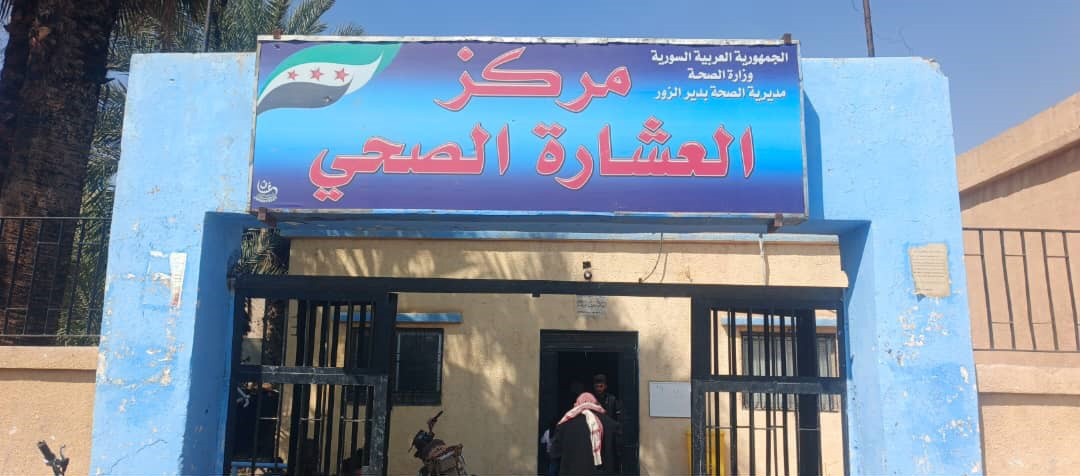 The entrance of Al-Ashara Primary Health Centre in rural Deir ez-Zor, where emergency services have been supported. Photo: WHO
30 May 2025, Syrian Arab Republic – In rural areas of Deir ez-Zor, access to timely medical care has long been a challenge. For families living in rural towns like Mahkan and Al-Ashara, reaching the nearest hospital can take hours – a delay that can turn minor injuries into life-threatening emergencies.
But with WHO’s support, that gap has begun to close.
Expanding emergency health services in Mahkan and Al-Ashara
In coordination with the Deir ez-Zor Directorate of Health and local implementing partner Syria Pulse Association, WHO supported the activation of 2 fully equipped emergency units at Mahkan and Al-Ashara primary health centres.
Each centre operated with a trained team – including a doctor, nurse, paramedic, driver and support staff – and was equipped with an ambulance, essential medicines and emergency supplies. The centres were also linked to referral hospitals in Deir ez-Zor City and Al-Ashara City, ensuring that patients in need of advanced care could be transported safely and quickly.
Stabilizing a critically ill infant in Mahkan
 Dr. Hadi Abdul Rahman Al-Sheikh examines 9-month-old Bayan Al-Darfil at Mahkan Public Health Centre in Deir ez-Zor. Photo: WHOWhen 9-month-old Bayan Al-Darfil was brought to Mahkan Primary Health Centre by her father, she was in critical condition. Bayan had been vomiting for hours and was found to have food poisoning and a rapid heart rate of 180 beats per minute.
The emergency team administered IV fluids and medication and then transported her using the project-supported ambulance to Al-Ashara National Hospital where she received further care until her condition stabilized.
Bayan’s father later said, “Thank you for the care you gave my daughter. We appreciate the medical team and the quality of services at the centre.”
Treating burn injuries and building caregiver confidence
At Al-Ashara Primary Health Centre, 3-year-old Bisan Sabouh Al-Saleh arrived with second-degree burns on her left leg after a household accident involving boiling water.
She was treated immediately. “Cleaning, dressing, pain relief and daily follow-up were provided by the emergency team,” her file notes. “Her mother was educated on how to continue care at home. The child is still under supervision and improving steadily.”
Responding to conflict-related trauma with urgent care
At Al-Ashara Public Health Centre, a 20-year-old man arrived at midnight with a gunshot wound to the abdomen. After a clinical examination, the emergency physician determined that the injury was isolated – with no vascular, neurological, or bone damage.
“The entry and exit points of the bullet were cleaned and sterilized. The wound was sutured and the patient was given antibiotics,” said Dr. Ahmed Al-Marzouk, the attending physician. “The patient’s condition improved and stabilized after treatment and he was discharged in good condition.”
Extending access through telemedicine and health education
To improve access to care in remote and underserved communities, Syria Pulse Association also operated a telemedicine and remote health education service from a static point in Deir ez-Zor city’s Al Kousour neighbourhood.
A team of general practitioners and rotating specialists, including internal medicine doctors and gynaecologists, work in 2 daily shifts, providing telemedicine consultations from 9:00 to 21:00, and 6 trained health educators deliver remote risk communication and community engagement messages, sharing vital information on primary health care, disease prevention and how to seek care.
These services helped reach families who could not afford transportation or lived too far from functioning health centres, ensuring they still received timely medical advice and follow-up support.
Saving lives and reducing pressure on families
In addition to on-site emergency care, families also benefitted from safe referrals, home-care guidance and access to remote services.
This emergency health response was made possible thanks to the Syria Humanitarian Fund (SHF) – a multi-donor funding mechanism managed by the United Nations Office for the Coordination of Humanitarian Affairs (OCHA).
For the people of Deir ez-Zor, access to emergency care is no longer out of reach. Whether it’s a burn, a bullet wound, or a sick child – these services have helped communities respond faster, recover sooner and reduce the burden on families.
WHO launches emergency cholera response as cases resurge in Syria
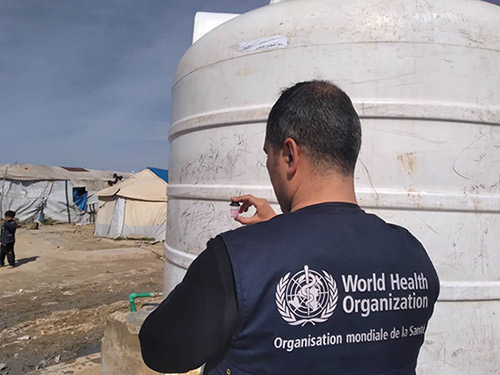 A WHO staff member collects a water sample for testing in Al-Hol camp to help ensure safe drinking water for displaced families. Photo: WHO
18 May 2025, Damascus, Syrian Arab Republic – With cholera cases resurging across parts of Syria in late 2024 and rising outbreak risks as warm weather returns to the country, the World Health Organization (WHO) has launched a 6-month emergency health and WASH response to protect more than 850 000 people at highest risk in Aleppo, Lattakia, Al-Hasakeh and Damascus.
Between August and December 2024, Syria reported 1444 suspected cholera cases and 7 associated deaths, with the highest caseloads in Lattakia, Al-Hasakeh and Aleppo and displacement sites such as Al-Hol camp. The outbreak is linked to ongoing drought, population movement and repeated disruptions to water and sanitation systems.
WHO’s response combines targeted health and water, sanitation and hygiene (WASH) interventions, focusing on early detection, case investigation, cholera diagnostics and the deployment of rapid response teams to high-risk areas. The response also includes risk communication, infection prevention and control, and sustained water quality monitoring. Water purification tablets and testing kits will be distributed to reduce the risk of transmission from unsafe sources.
“This response is designed to catch outbreaks early, isolate risks quickly and help communities protect themselves,” said Acting WHO Representative in Syria Christina Bethke. “We are strengthening surveillance through the Early Warning Alert and Response System (EWARS), expanding lab capacity to confirm cholera cases faster and supporting health workers and volunteers to respond in real time. In parallel, we’re enhancing water safety testing in camps and communities, equipping teams with purification tools and delivering key health messages to reduce exposure risks.”
The intervention, which supports national efforts to strengthen outbreak preparedness and response, together with public health recovery, is being implemented in partnership with the Ministry of Health, water authorities and local authorities. Activities include refresher training for laboratory staff, improved inter-ministerial coordination and localized action in more than 40 informal settlements and displacement sites.
This response has been made possible thanks to the generous support of the Syria Humanitarian Fund (SHF) a multi-donor mechanism managed by the United Nations Office for the Coordination of Humanitarian Affairs (OCHA) that enables rapid, flexible funding for frontline health and humanitarian partners based on local needs.
Media contact:
Halah Kabash,