

Sélectionnez votre langue
In Aleppo’s northeast, Menbij hospital delivers lifeline care to over 23000 people
 Ali carries his 8-year-old son Abdelkarim through the crowded corridor of Menbij National Hospital after the boy received urgent care for a fracture. Photo credit: WHO
17 September 2025, Aleppo, Syrian Arab Republic – When 8-year-old Abdelkarim Naasan fell while playing in his neighbourhood in Menbij, the pain in his leg left him unable to walk. His father carried him to Menbij National Hospital, the only hospital in the district. There, doctors quickly diagnosed a fracture and treated him with a cast. “The care was immediate and reassuring,” his father recalled. “We left the hospital confident that he would heal.”
For thousands of families in Menbij, a city in the north east of Aleppo Governorate, this hospital is the only place to turn for both emergencies and routine care. From trauma surgery to laboratory tests and blood transfusions, it provides essential services in an area where health care access is scarce.
 Dr Maqsoud Shankan, head of the laboratory at Menbij National Hospital examines test samples to ensure accurate diagnosis and treatment for patients. Photo credit: WHOWith funding from the European Union, through its Civil Protection and Humanitarian Aid Operations (ECHO), WHO and its partner Al-Ameen are ensuring that Menbij National Hospital remains open and equipped to serve people in need. The hospital provides medical consultations, emergency obstetric and dialysis services, as well as trauma and intensive care. In addition, WHO enhanced the hospital’s trauma capacity through the provision of mass casualty training for its staff.
In recent months, more than 23000 people – including displaced families and host communities – received care through these facilities. The increase in patient visits reflects growing trust in the health system. Specialist services, including paediatrics and internal medicine, are seeing especially high demand.
Health workers emphasize how vital this support has been. Dr Maqsoud Shankan, head of the hospital’s laboratory, explained, “Every accurate test helps doctors give the right treatment. Without these services, patients would have to travel long distances or go without care.”
 Laboratory technician Abdel Salam Khalaf collects blood from a donor at Menbij National Hospital. Photo credit: WHOAt the blood bank, 28-year-old technician Abdel Salam Khalaf manages donations and urgent transfusions. “In an emergency, we cannot afford delays. Having the right equipment and supplies here in Menbij makes the difference between life and death.”
To ensure the safety of patients and health workers, the hospital has also improved infection prevention and control. This includes practical measures such as providing staff with protective equipment, ensuring proper waste disposal, and setting up strict hand hygiene and sterilization routines. These steps reduce the risk of infections spreading within the hospital and give families greater confidence that they can seek care safely.
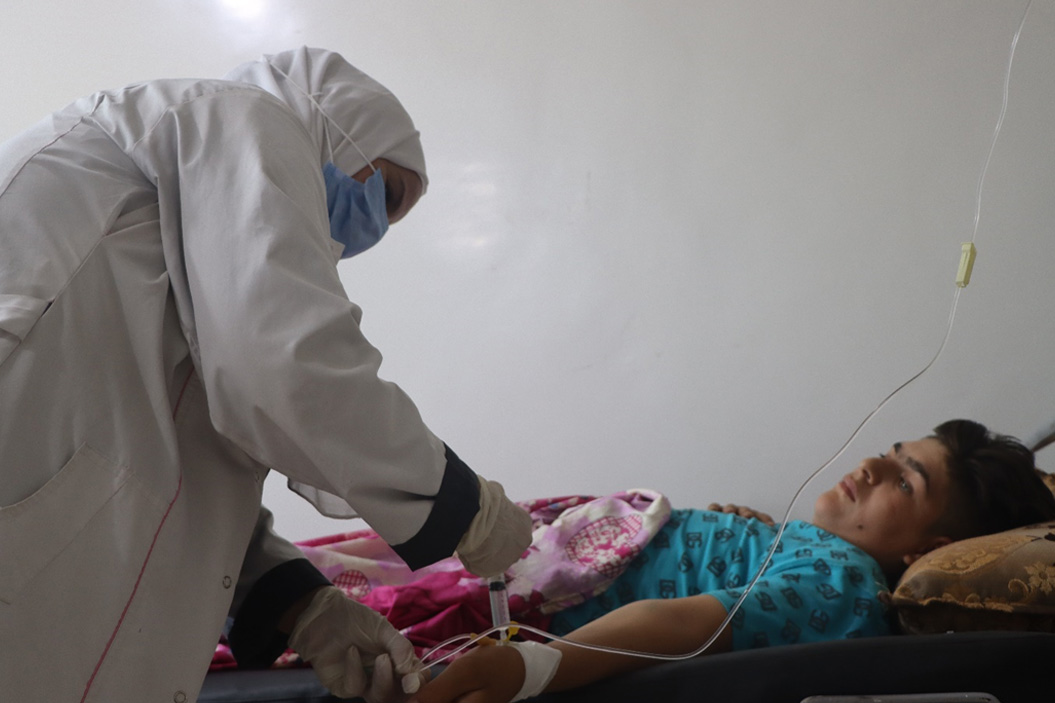 Abdelhadi Mousa receives post-operative care at Menbij National Hospital after undergoing gallbladder surgery. Photo credit: WHOFor patients like 22-year-old Abdelhadi Mousa, who underwent gallbladder surgery at Menbij National Hospital, this investment is life-changing. “I lived with pain for so long,” he said. “Now, after the operation, I can begin again.”
In a district where health facilities are few and challenges remain high, Menbij National Hospital stands as a lifeline. Continued support from the European Union ensures that these services remain available, sustaining care today while laying the foundation for stronger, safer health systems in the future.
Empowering communities, saving lives: Syria’s caring for newborns and mothers at home programme
 17 September 2025, Syrian Arab Republic – Born in the sixth month of pregnancy, in a region where access to neonatal care is limited, and weighing just 900 grams, Lena’s* survival was far from certain. But thanks to the medical and home care guidance provided by volunteers trained through a programme supported by the World Health Organization (WHO) and Syrian Ministry of Health – and the tireless commitment of her parents – Lena began to thrive.
That Lena is now a healthy 2-year-old testifies to the strength of her family and the lifesaving impact of home-based care. Supported by volunteer community health workers, who provided advice and close follow-up, her parents followed best practices: frequent breastfeeding, skin-to-skin warming, and avoiding supplements and formula. It was a collective effort, rooted in community-based care.
Lena’s family is one of many that have benefitted from the caring for newborns and mothers at home programme. Linked to the healthy village programme, the initiative involves volunteer health workers providing essential care to pregnant women and newborns.
As part of the programme, community health workers conduct home visits during the antenatal period and the first weeks after birth. They support families in adopting best practices for maternal and newborn care at home, while encouraging care seeking from specialist health professionals when needed.
 Launched in 2017, the programme reaches around 20 000 families annually in underserved rural areas, in coordination with the Ministry of Health. The programme's success is largely due to the dedication of its volunteers who receive 5 days of basic health care training.
In 2024, 19 180 home visits were made, with 58 newborns and 69 mothers referred to specialized care. The programme is currently implemented in 11 governorates, where a total of 885 volunteers cover 216 healthy villages.
Despite the successes, the programme covers just 5% of Syria’s prenatal, delivery and newborn care needs. Funding remains a significant hurdle to the programme’s sustainability and expansion. Resources are limited and access to some hard-to-reach areas across the country continues to be a challenge.
The future
The goal is to build on the programme’s successes and expand its reach. With a renewed focus on quality and training, the programme aims to engage volunteers with higher education – currently volunteers are mostly from preparatory and high school backgrounds – and enhance capacity-building opportunities, including a shift to computerized data collection.
As the caring for newborns and mothers at home programme moves forward, it is poised to make an even greater impact. It will continue to empower communities and save lives as Syria works to rebuild its health system and secure a healthy future for all its mothers and children.
* Name changed.
EU support to medical supply chains keeps hospitals and clinics running in Syria
 Majd Qolghasi, Warehouse Officer with Hand in Hand for Aid and Development, checks EU-funded medical supplies at the WHO-managed warehouse in Sarmada, Idlib. Photo credit: WHO16 September 2025, Idlib, Syrian Arab Republic – In a warehouse in Sarmada, boxes of medicines and surgical kits are stacked neatly on pallets, ready to be dispatched to health facilities across Syria. For Majd Qolghasi, Warehouse Officer with Hand in Hand for Aid and Development, the health partner managing WHO’s warehouse in Idlib, each shipment represents more than supplies – it is a lifeline for patients.
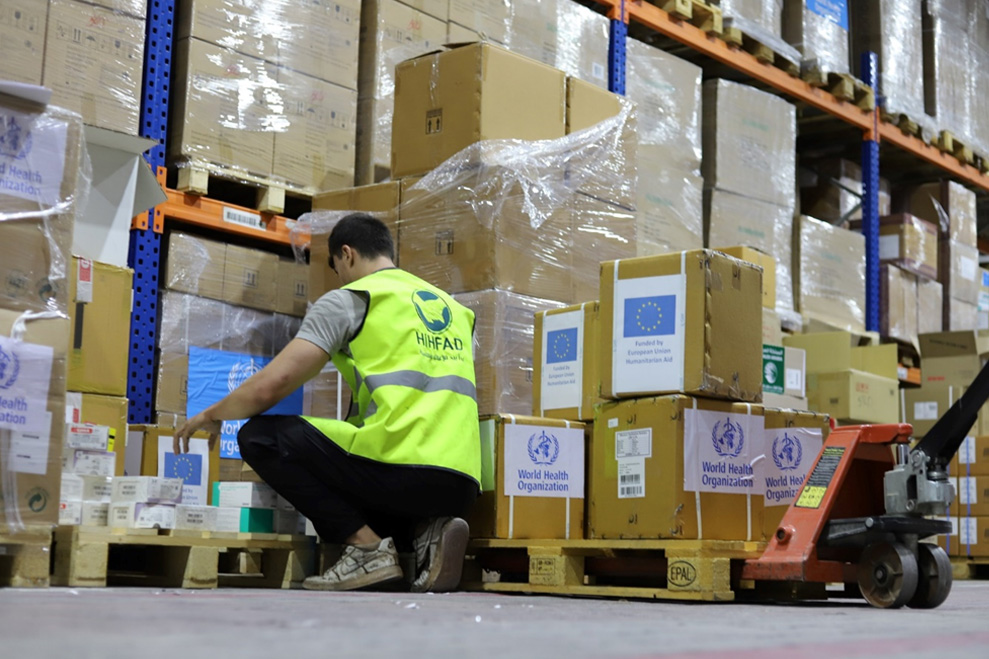 Warehouse staff organize EU-funded medical supplies at WHO’s warehouse in Sarmada, Idlib, before dispatch to health facilities. Photo credit: WHO “This shipment comes in response to the growing needs of the health sector,” says Majd. “It will significantly support hospitals and health centres by strengthening their capacity to provide medical services to patients – especially under the difficult circumstances the sector is facing, with limited resources and funding.”
The most recent consignment, delivered with support from the European Union (EU) through its Civil Protection and Humanitarian Aid Operations (ECHO), included essential medicines, medical consumables and surgical supplies. Distribution is carried out through a carefully planned system in coordination with the local Health Directorate under the leadership of the Ministry of Health, ensuring that health partners operating in Idlib and Aleppo can serve the people most in need.
Air bridge to Syria’s health facilities
This is not the first time EU support has sustained Syria’s fragile supply chain. In December 2024, more than 50 tonnes of EU-funded medicines and supplies were flown to Türkiye through the EU Humanitarian Air Bridge and transported by WHO to overstretched health facilities in Idlib and Aleppo. The delivery arrived at a pivotal moment as the country entered a transitional phase, helping facilities restock amid persistent needs.
Meeting emergencies head-on
From routine care to crisis response, timely supplies are vital to keep Syria’s health system functioning.
“These shipments help ensure the continuity of life-saving services for both chronic conditions and emergencies,” Majd explains. “Hospitals, health centres and mobile medical units are better supported, easing the pressure on facilities and enabling medical teams to provide immediate and continuous care.”
 EU-funded medical supplies are loaded for delivery from WHO’s warehouse in Idlib to hospitals and clinics. Photo credit: WHO Following the recent blasts in Idlib in July this year, WHO responded within 24 hours in coordination with the Health Directorate and partners – delivering 24 trauma kits to support emergency medical care. Each kit includes essential drugs, anaesthesia supplies, transfusion materials, dressing sets and surgical tools – enough to support more than 200 surgical procedures.
Majd recalls the impact clearly: “We had the trauma kits ready in the warehouse. When the blasts happened, the needs were identified by health authorities and partners, and we were able to send them immediately. That speed saved lives.”
This was also evident during the devastating wildfires in Lattakia earlier this summer. WHO delivered eight Trauma and Emergency Surgery Kits for burn care from its Idlib warehouse. Four kits were provided to Lattakia’s National and University Hospitals to treat people with severe burns, while another four were pre-positioned as contingency stock for future needs. Each kit contained supplies to manage 50 burn cases – helping health workers save lives when every minute counts.
Strengthening emergency response and continuity of care
Since 2011, Syria’s health system has been tested by conflict, economic crisis and multiple emergencies. EU support has been a cornerstone in strengthening resilience.
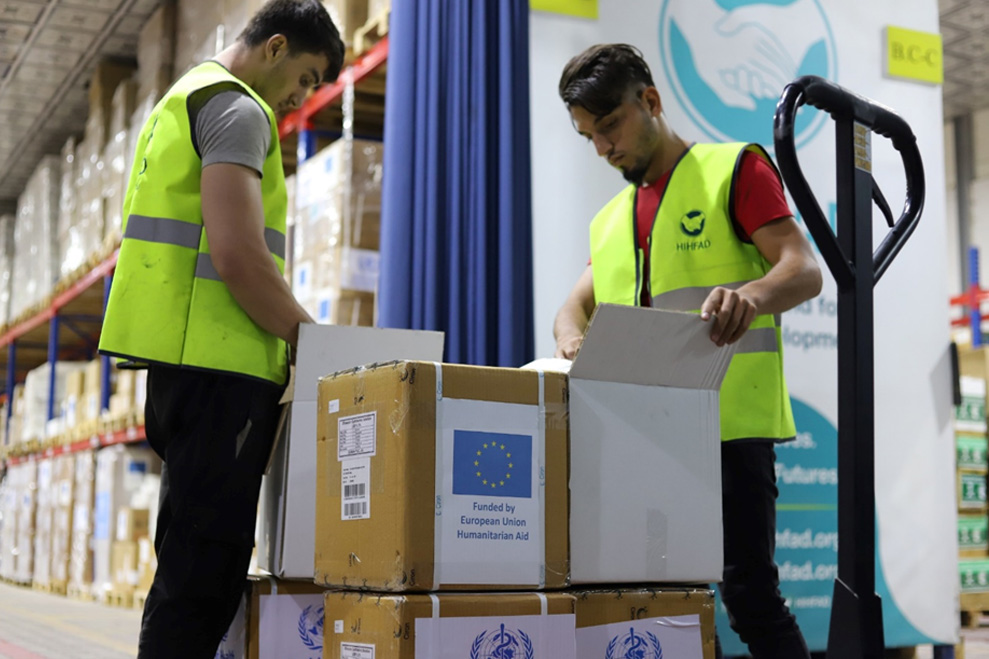 Health partner staff prepare EU-funded medical consignments at WHO’s warehouse in Sarmada ensuring medicines and supplies reach facilities on time. Photo credit: WHO Since last year, the European Union (EU), through its Civil Protection and Humanitarian Aid Operations (ECHO) has provided around €10.4 million to WHO across Syria, supporting ambulances, referral systems, essential medicines, primary health care, trauma services and more. Of this, over €4.1 million has gone towards medical procurement, ensuring essential medicines and supplies reached over 1 million people in need.
A new EU commitment of €22 million will sustain life-saving and life-sustaining health services for more than 6.5 million people into next year – keeping hospitals, clinics, referral pathways and medical supply chains running as the country begins its transition to recovery and rebuilding, while still maintaining critical humanitarian services.
“For us, every box in this warehouse means hope,” says Majd. “Thanks to the EU’s support, we can move quickly when emergencies happen and keep services running for the people who depend on them. That is what makes the difference.”
Paramedics in Aleppo keep hope alive through EU-supported referral system
 Tarek Al-Sheikh helps load a patient into the ambulance for urgent referral to hospital in northern Aleppo. Photo credit: WHO15 September 2025, Aleppo, Syrian Arab Republic – “I leave home early every morning to start my shift in the ambulance. Some days I wait for hours until a call arrives. Other days I respond immediately to emergencies – a child struggling to breathe, a mother in labour, or a patient who needs to be transferred urgently to another hospital,” says Tarek Al-Sheikh, a paramedic with the Syrian Relief and Development (SRD) team at Afrin National Hospital in Aleppo, northern Syria.
Tarek has been serving his community for more than 4 years. For him, this work is more than a job – it is a lifeline for families who otherwise would not be able to reach the care they need.
“The importance of this work is that it is purely humanitarian. Our people in the north need these services, which reach many people who otherwise would not be able to access care,” Tarek says.
Referral systems as lifelines
The referral system Tarek is part of is designed to save lives by moving patients quickly and safely across Idlib and Aleppo. Operating in areas where over 4 million people remain in need of health assistance – including 2 million living in camps – and with more returning to Syria, the need is immense. Since 2024, more than 1.2 million Syrians have returned to the country, while internal returns continue, with 1.7 million internally displaced returnees recorded since December 2024.
Against this backdrop, referral pathways help ensure that emergencies do not become tragedies. Tarek recalls one case that captures both the challenges and the impact of this work.
“We were at Bab Al Hawa Hospital, transferring a newborn from the incubator unit to Rajou Hospital in Afrin. When we arrived, we found two newborn twins, only 2 hours old, who urgently needed intubation and transfer to another hospital. The ambulance on site was not ready, and we were not fully prepared either. Despite this, with the help of the medical staff, the babies were intubated and we managed to transfer them safely to Azaz National Hospital.”
For families, the referral system also reduces the financial burden of health care. “In the past, people often had to pay extremely high costs for private transport or private hospitals. Now we can transfer patients for free to facilities where they can receive care,” says Tarek.
Building for today and tomorrow
 Paramedic Tarek provides emergency care to a patient inside an ambulance in Aleppo. Photo credit: WHOThe referral system is not only saving lives today – it is shaping the future of Syria’s health system. It supports the Ministry of Health’s goals to expand access, improve quality and strengthen preparedness. It reinforces WHO’s broader efforts to train health workers, improve coordination between facilities, and ensure patients reach specialized care without delay. Crucially, it keeps hospitals, clinics, referral pathways and medical supply chains functioning despite years of conflict and crisis.
In the last year, these services have improved significantly thanks to sustained support. Ambulances are better equipped, medical staff receive more training, and coordination has grown stronger. “We now have better training, more advanced equipment and stronger coordination. This has helped me save many more lives. It also brings stability to my own family, while serving the wider community,” says Tarek.
EU support keeping systems running
 Paramedic Tarek provides emergency care to a patient inside an ambulance in Aleppo. Photo credit: WHOThis work is made possible through funding from the European Union (EU), through its Civil Protection and Humanitarian Aid Operations (ECHO). To date, the EU has provided around €15 million to WHO across Syria, supporting ambulances, referral systems, essential medicines, primary healthcare, trauma care and rehabilitation services.
A recent commitment of an additional €22 million will sustain life-saving and life-sustaining health services for more than 6.5 million people into next year – keeping hospitals, clinics, referral pathways and medical supply chains running as the country begins its transition to recovery and rebuilding, while still maintaining critical humanitarian services.
Looking ahead
Despite the risks and difficulties of his work, Tarek remains motivated.
“This is humanitarian work. It helps the people who need it most, reduces risks and delivers healthcare quickly. The world outside Syria should know the role of paramedics and how essential these services are to saving lives here.”