

Sélectionnez votre langue
Ali “When I responded that I wanted to see what he was doing, the soldier got out of the vehicle and started pushing me and kicking me, hitting me with the back of his gun and causing me to fall to the ground.” Ali (pseudonym)
On 2 October 2022, a Palestine Red Crescent Society (PRCS) ambulance crew travelled to Beit Furik near Nablus, to provide first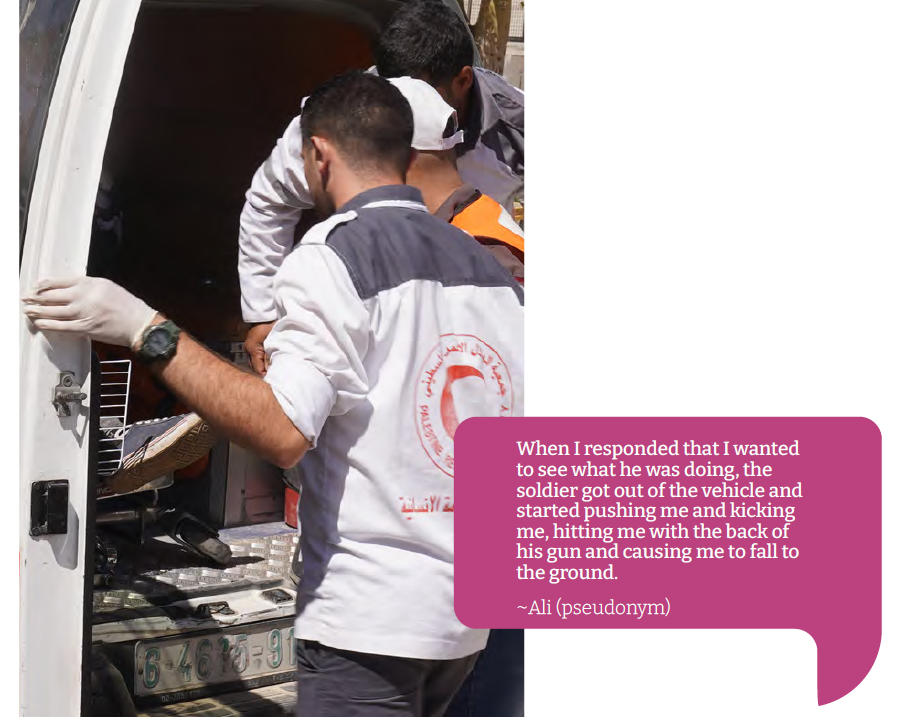 aid to persons injured during demonstrations against settlement expansion and incursions in the village, which is in the north of the West Bank.
Ali was driving the ambulance, while his colleague Omar1 sat beside him. They crossed the checkpoint leading to Beit Furik without obstruction. However, as the ambulance approached the entrance to the village the crew was confronted with a temporary (flying) checkpoint comprising Israeli soldiers and border guards.
“The soldiers aimed their guns towards us and were shouting at us, ordering us to stop,” said Ali, the driver. “I was driving very slowly, as we are used to doing in situations like this, and stopped behind one of the military jeeps. A soldier came to the window and told me to turn the engine off and give him the keys. He was banging at the window with the back of his gun. I tried to explain that we had information that there were people injured and we needed to reach them.
“After switching off the engine, the soldiers insisted on searching the vehicle. I offered to go to the back of the vehicle with the soldier to open the ambulance for him, but he refused. We are used to going with the soldiers to open the door. They usually want us to be in front of them when they search a vehicle, but this soldier insisted on going alone. Because of this, I was afraid he might try to plant a weapon or a knife on the vehicle and make an accusation against us. I wanted to see what he was doing, but another soldier stood by my door, aiming his weapon at me, and preventing me from leaving the vehicle or seeing behind.
“The ambulance vehicle automatically locked when the soldier tried to open it. He then shouted towards me ordering me to open the backdoor, which I did. I left the ambulance and went towards the backdoor. At this point the soldier shouted at me again, asking why I was there. When I responded that I wanted to see what he was doing, the soldier got out of the vehicle and started pushing me and kicking me, hitting me with the back of his gun and causing me to fall to the ground.
“Omar came out of the vehicle and tried to help me. Another soldier beside the ambulance came and started pushing Omar, while a further 3 soldiers joined and were surrounding us and pushing us away from the ambulance.”
At the point that Ali and Omar had been pushed away from the vehicle, someone in the nearby demonstration began recording what was happening in a video on their phone. The video shows the soldiers pushing, kicking and beating the paramedics before they are both made to kneel on the ground.
“When we were on the ground, someone was trying to call me. I answered the call on speaker so that the person on the line would know we were in danger. That person contacted the Palestinian Coordination Office, who arrived on site shortly afterwards. Following negotiation, we were released. Another ambulance came to take Omar to hospital for treatment, while I provided information to the officer from the Coordination Office. I then drove myself to hospital.”
As a result of the attack, Ali sustained injuries to his leg including tear of a cartilage in his knee, requiring treatment for the pain and physiotherapy. He returned to work after 40 days.
“Even after my injury, I will go back to the field. Even if it means that something can happen to me, this is our duty. We were raised this way; this is who we are. It’s not the first time I was exposed to violence from soldiers. I worked during the Second Intifada, when we were fired at with live ammunition. We had a female patient in the ambulance at the time. The violations against us have continued all these years. We are still prevented from reaching injured people, pushed around by soldiers, and shot at. Our safety depends on the mood of the soldiers.”
Hamzeh “Around five metres before reaching the guy, I was shot in the right side of my upper body. I went back around two meters and fell to the ground. I told the other paramedics that I had been shot".
27-year-old Hamzeh Abu Hajar is a volunteer paramedic with the Palestinian Medical Relief Society (PMRS).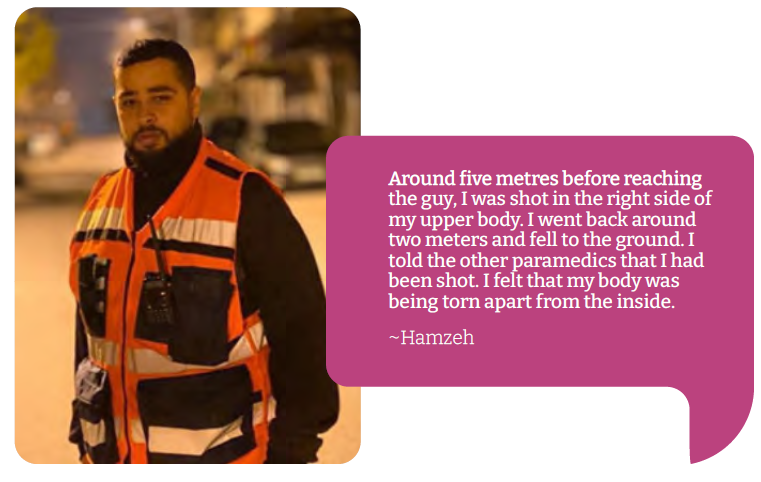
In 2022, with increasing escalations across the West Bank, Hamzeh began volunteering as a PMRS first responder.
“Every time the Israeli forces would raid Nablus Old City, I would join the field team. PMRS cars would drive us to different locations where people were injured and needed our help. I always made sure to wear my vest before leaving the house, while PMRS made sure we were all wearing vests by the time we reached a location with injured people… At first, wearing the paramedic vests made us feel protected. However, as the confrontations increased the occupation forces stopped distinguishing between paramedics, journalists, and others. We all feel or show fear in different ways. Of course, I was scared when going into the field, but it wasn’t the kind of fear that would prevent me from going to help the people who depended on us.”
At around 8am on the morning of Friday 30 December, Israeli forces raided Nablus Old City. Hamzeh was called to the field to support treating the injured.
“I heard calls to help with an injury near my location. I immediately went to respond, and there were another two paramedics behind me. Around five metres before reaching the guy, I was shot in the right side of my upper body. I went back around two meters and fell to the ground. I told the other paramedics that I had been shot. I felt that my body was being torn apart from the inside. I was on the ground for several minutes until Al Razi ambulance [a private ambulance] reached me. A sniper had been shooting between the two ambulances on site and me.”
The second ambulance had been from the Palestine Red Crescent Society, which was obstructed from reaching Hamzeh. After Al Razi ambulance reached him, they transferred him to hospital. The ambulance tried to exit via the western route to Rafidia Government Hospital but was again obstructed by Israeli forces, which compelled the team to return and take a different route.
“I remember slipping in and out of consciousness. I vaguely remember being in the ambulance. I also remember my brother, doctors, some of my PMRS friends, and many other people surrounding me in the hospital. I was put in an emergency intensive care room when I reached the hospital and ten minutes later, I was transferred to the operating room.”
Hamzeh’s surgery took 4.5 hours. He stayed in the intensive care unit for 6 days, after which he was transferred to another ward for a further two days before being discharged home. The bullet had injured Hamzeh’s right lung and diaphragm, torn part of his liver and right kidney, and broken four of his ribs. He also suffered a bladder injury. After being shot, the bullet exited from his back, resulting in a tear of his muscle and an open wound around 20 to 25 centimetres in diameter. As a result of his surgery, Hamzeh had 40 stitches in his abdomen, while his back wound remains open and will require several months to heal.
Hamzeh is undergoing a slow recovery. He moves around the house and goes for follow up visits to the hospital every Tuesday. Because of his broken ribs he faces difficulties moving and sleeping. The injury of his lungs means he gets very tired whenever he tries to move around the house.
“Before my injury I witnessed some difficult cases working in the first response teams. I helped provide first aid to people who had very severe injuries. I even had to move people who had been killed. One of the hardest experiences was when I had to move a martyr who turned out to be my friend. I had been with him just a few hours before the raid. I was so shocked to see that it was my friend. Even these experiences didn’t prevent me from going back to the field. On the contrary, it gave me a stronger push to go and to support those in need, especially knowing that they depended on our help. I felt it was my duty to help them. After I fully recover, I plan to return. My mother is worried. She keeps telling me that she doesn’t want me to go back. She says the first time I was lucky, but we don’t know what will happen next time. Still, I plan to return.”
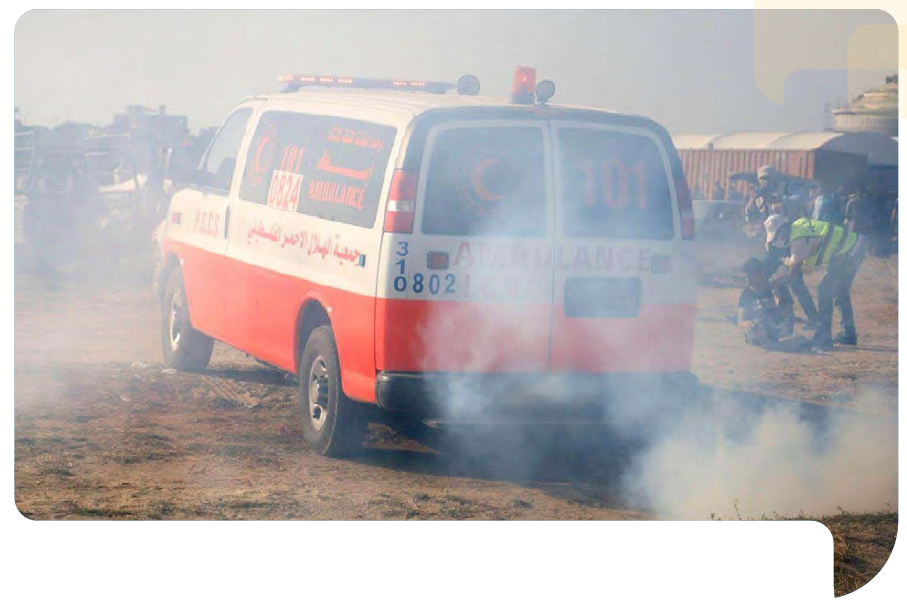
Abed “When they started shooting towards me, I felt helpless. I had the capacity to help – at least to stop his bleeding until we got him to hospital. I knew there were other injuries as well, but I couldn’t reach them…”
Abed, a 28-year-old paramedic officer working with the Palestinian Medical Relief Society, (PMRS) woke at around 5am on 3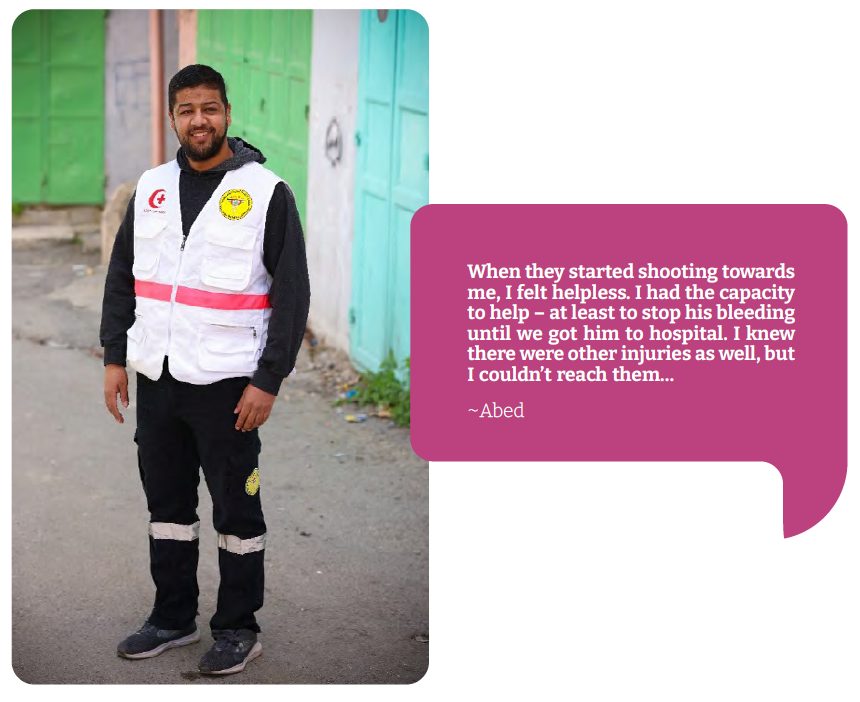 January 2023 to the sound of Israeli forces raiding Dheisheh refugee camp in Bethlehem.
“I heard loud voices near my house. I got dressed and put on my paramedic gear. As I tried to leave my house, heavy shooting toward me started. I then heard Adam Ayad shouting. He was calling for his mother. Another person, one of PMRS volunteer paramedics, was also shouting and calling me to come and help.
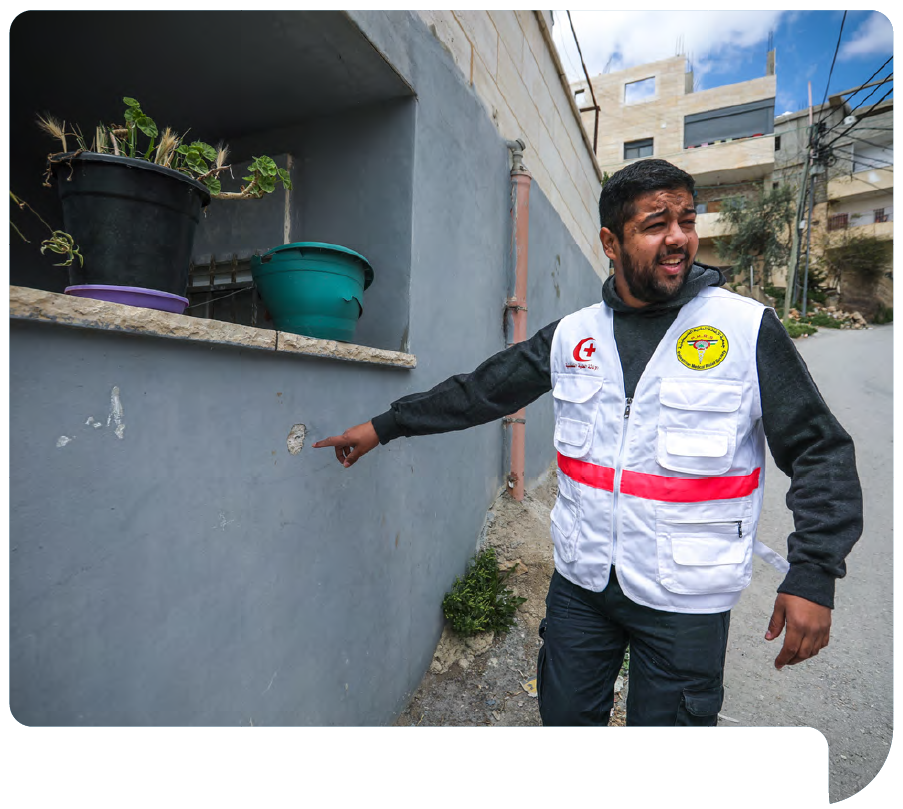
“When they started shooting towards me, I felt helpless. I had the capacity to help – at least to stop his bleeding until we got him to hospital. I knew there were other injuries as well, but I couldn’t reach them… I was afraid. Not only for my own safety, but for my family because there was shooting towards my house. One of the bullets hit my brother’s house, near the bedroom, and the bullet could have entered the window and hit him, his wife, or their children. Another bullet entered the bedroom of my uncle’s house… There was heavy shooting although there were no confrontations, the youth from the camp were afraid to come to the area because of the heavy shooting.”
16-year-old Adam Ayad had been shot while inside a car with two others, who were also injured in the incident. With heavy shooting towards the car, Adam got out of the vehicle and tried to hide under it, calling for help. A volunteer paramedic in the field unable to reach him due to the heavy shooting. After a delay several minutes, when the shooting stopped, Abed and the volunteer were able to reach the injured and provide first aid. The volunteer paramedic tended to Adam, while Abed treated the other two persons injured.
“During the incident we were calling for any car to come, we got two cars then I ended up using my own car as a third… We drove to the hospital. I had someone from my family sit in the back and help... He wasn’t trained in first aid, though, so if something were to happen, he would not have been able to help. Meanwhile I was driving so wouldn’t have been able to help.”
There are four first responders for PMRS in Dheisheh camp. Abed is the team leader. After so many fatalities in the camp, Abed arranged with PMRS for a social worker to talk with them. The volunteers blamed themselves for not being able to save people who had been injured, they were questioning the value of their work.
“At the time Sajed Mizher was killed [a paramedic killed in Dheisheh in 2019], we were 8 first responders in the camp. With the increased targeting of first responders and the high levels of violence during raids, people became more reluctant to go into the field during military operations. They are worried for their own safety, especially since there is no ambulance vehicle that can provide some kind of protection. Now we are four. The main fear of the volunteers is to have another person die in their hands. They feel alone.”
Adam Ayad was taken to Al Husein Hospital in Beit Jala, where he was later pronounced dead.
Dr Shadi “I call on international organizations to give us protection. Doctors, nurses, laboratory technicians and ambulances. We live under occupation, and we are exposed to the violence of occupation every day.”
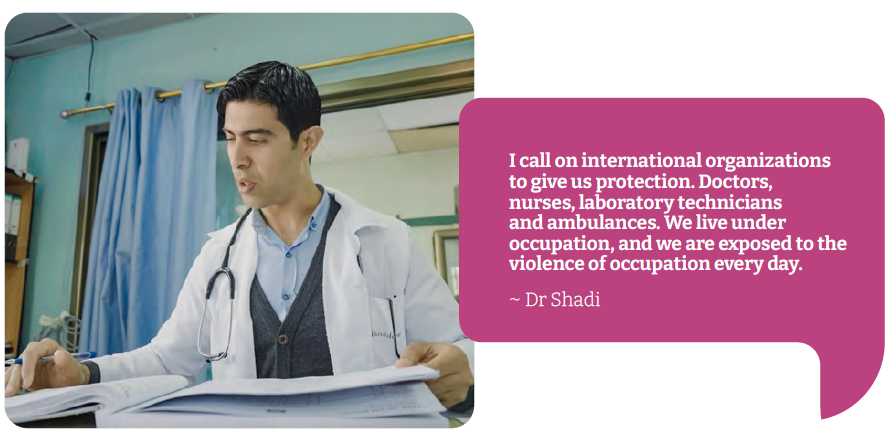 17 August 2023 – On 26 February, Israeli settlers raided Huwara village near Nablus, in the north of the West Bank. Shadi, a doctor working in emergency medicine at Huwara Emergency Medical Centre, spoke about his experience on that day.
“Our team from Huwara Emergency Medical Centre was prevented from accessing. I wasn’t on duty when it all happened. I was at home, but I was called with other colleagues to assist the team on duty. We were forced to use an ambulance to help us reach the medical centre.”
WHO documented 9 attacks on health care during the raid, obstruction to access of 7 ambulances and paramedic teams, as well as 8 doctors, with 2 incidents further involving verbal assault and intimidation of medical teams by both soldiers and settlers.
“The ambulances were not able to transfer the injured people or provide them with needed treatment. One of the conditions put on the first responders was that they would have to get out of the ambulance and go on foot to provide treatment in the field, where they were not allowed to evacuate the injured from the location.
“We contacted Rafidia Government Hospital and asked them to send staff to support our team. They sent a team, but the team reached us late because Israeli forces obstructed them at the checkpoint. The ambulance transferring the team was stuck at Huwara checkpoint for 2 hours, before they took a different route through Awarta checkpoint and reached the medical centre around 11:00 pm.”
A 19-year-old man had suffered a major head injury and needed transfer from Huwara Emergency Medical Centre to Rafidia Government Hospital in Nablus. His transfer was delayed for more than 2 hours before the crew managed to get coordination for his transfer.
“So many of our staff live in Nablus. When they come to work or leave to return home they are obstructed at checkpoints. Even ambulances – where it is known internationally that they should move freely – are obstructed. I call on international organizations to give us protection. Doctors, nurses, laboratory technicians and ambulances. We live under occupation, and we are exposed to the violence of occupation every day.”
With funding support the Swiss Agency for Development and Cooperation, the WHO occupied Palestinian territory Right to Health programme monitors and documents the barriers to the right to health and social determinants of health, including obstacles to health access and attacks on health care; capacity strengthening towards enhancing health equity and rights; and advocacy to engage public audiences, UN mechanisms, and duty bearers in efforts to enhance respect, protection, and fulfilment of the right to the highest attainable standard of health.