


Sélectionnez votre langue

23 November 2021, Cairo – After almost three years with no physical meetings together, the WHO representatives in the countries of the Region and senior managers at the Regional Office regrouped for a collaborative retreat, with “Countries at the centre” as the main theme and core objective.
“These retreats serve not only as an appropriate and opportune platform for open discussion and interaction, but also as a pivotal grounding for laying out strategic issues, challenges, and the means to find solutions and implement action points to move forward”, said Dr Ahmed Al-Mandhari, WHO Regional Director for the Eastern Mediterranean.
He explained that the development of the proposed action plans was done through a participatory and consultative process to achieve consensus among the participants, and in this regard, he called it a “body of wisdom” for WHO in the Region.
Highlighting the learning curve, experience and wisdom accumulated during the last two years, due to the pandemic and other health challenges, as well as the political contexts in the Region, Dr Al-Mandhari emphasized the need to “move as one body, one family, carrying the same values we have carried for many years,” which continue to be re-emphasized through numerous initiatives, including the process of WHO Transformation. “We need to make sure that we are always moving in the right direction,” he said.
The Regional Director highlighted the significance of the retreat for sharing beneficial ideas and as a way to regroup and readjust WHO Transformation priorities. Given the armed conflicts, economic challenges and dire humanitarian emergencies in the Region, he observed that “we need to be agile, ready to adapt, and to continue moving in the right manner.”
The agenda of the retreat comprised a versatile list of sessions, each equipped with its own set of objectives. A key topic for discussion was the need to establish a collective understanding of the challenges and shortcomings in achieving the Sustainable Development Goals, the 13th General Programme of Work (GWP13), and the regional Vision 2023, which necessitate an acceleration of progress and increased impact in order to meet WHO’s objectives. This includes: readjusting the "purpose"; a review of the multidimensional positioning, internally and externally, of WHO for greater visibility and impact; and reaffirming WHO as a respectful workplace and environment, preventing and responding to sexual exploitation, abuse and harassment (PRSEAH), ensuring a zero-tolerance approach continues to be observed on PRSEAH and approving measures for preventive action.
Another vital topic for discussion was strategic and operational planning, with a focus on the country level and on approaches to enhance the quality and coherence of WHO's delivery. This includes WHO’s strategic positioning through the Country Cooperation Strategy (CCS), Common Country Assessment (CCA), and the United Nations Sustainable Development Cooperation Framework (UNSDCF), as well as operational planning for the Programme Budget 2022-2023 and Country Support Plans (CSP).
Additionally, stress management was highlighted during the retreat as a topic of interest, as participants sought to understand and acknowledge the negative impact of stress on the productivity levels and well-being of staff, and to agree on preventive and supportive stress management measures, especially in the many hardship duty stations.
The WHO representatives in Afghanistan, Lebanon and Yemen, and others, addressed the challenges in conflict-ridden countries during the COVID-19 pandemic, sharing the obstacles that impeded their work and the strategic and operational solutions put in place to support successful delivery amidst these conditions. The participants also discussed the core emergency programme, where the main challenges highlighted included a lack of staff. As well as the various challenges noted, potential responses were also illustrated, including a staff development strategy, increased sustainable funding, and technical training, among other actions. Furthermore, participants also discussed how to better build synergies between the work on emergency preparedness, recovery and response and the work undertaken under universal health coverage and healthier populations, the other two pillars of WHO's strategic approach.
Joint statement by WHO Regional Director for Eastern and Mediterranean Region, Dr Ahmed Al-Mandhari, and UNICEF Regional Director for South Asia, George Laryea-Adjei
 A WHO-supported mobile health clinic caters to urgent health needs of newly displaced people arriving in Kabul @WHO Afghanistan
KABUL/CAIRO/KATHMANDU,22 August 2021: “As humanitarian needs in Afghanistan increase, the abilities to respond to those needs are rapidly declining. WHO and UNICEF call for immediate and unimpeded access to deliver medicines and other lifesaving supplies to millions of people in need of aid, including 300 000 people displaced in the last two months alone.
“While the main focus over the past days has been major air operations for the evacuation of internationals and vulnerable Afghans, the massive humanitarian needs facing the majority of the population should not - and cannot – be neglected. Even prior to the events of the past weeks, Afghanistan represented the world’s third largest humanitarian operation, with over 18 million people requiring assistance.
“WHO and UNICEF are committed to stay and deliver for the people of Afghanistan.
“However, with no commercial aircraft currently permitted to land in Kabul, we have no way to get supplies into the country and to those in need. Other humanitarian agencies are similarly constrained.
“WHO and UNICEF call for the immediate establishment of a humanitarian airbridge for the sustained and unimpeded delivery of aid into Afghanistan. We are also closely following up with all UN and international partners to explore options for expediting aid shipments.
“In the first few days of the recent hostilities, both WHO and UNICEF — like all other UN agencies — prioritized the safety and security of our staff. But our work continued even when the hostilities were at their worst. We remain committed to staying in Afghanistan and delivering, and we rapidly shifted gears to address the needs of millions of Afghans who remain in the country.
“Conflict, displacement, drought and the COVID-19 pandemic are all contributing to a complex and desperate situation in Afghanistan. Humanitarian agencies need to be supported and facilitated to meet the enormous and growing needs in Afghanistan, and make sure that no one dies unnecessarily due to lack of access to aid.
Notes to editors
About WHO’s humanitarian work in Afghanistan
In the past week, WHO distributed lifesaving supplies to partners and hospitals from its stocks in-country. But supplies are rapidly dwindling, and WHO currently only has enough to meet urgent needs for up to one and a half weeks. Most planes flying into the country to evacuate personnel have been arriving empty, missing crucial opportunities to bring in urgently needed health supplies and other humanitarian aid. More than 500 metric tones of WHO supplies, scheduled to be transported over three flights to Afghanistan this week and next week, remain in WHO’s logistics hub in Dubai’s International Humanitarian City. These include trauma medicines, essential medicines and medical supplies, pneumonia medicines, supplies for the management of severe acute malnutrition, and supplies for the management of chronic diseases. WHO operates through 8 offices in Afghanistan and works with local implementing partners to provide urgently needed health care for all. As the Health Cluster lead WHO also ensures that partners continue delivering a coordinated response in all corners of the country.
About UNICEF’s humanitarian work in Afghanistan
UNICEF has 13 offices in Afghanistan and a range of partners that support us in delivering lifesaving supplies to the most disadvantaged.
To support the about 10 million children, and their families, affected by the humanitarian crisis, UNICEF is currently delivering life-saving services such as ready to use therapeutic food to nourish starving children and mobile health clinics to give urgent medical care. UNICEF is also delivering water to those most affected by the drought, including in camps for internally displaced people. Despite the ongoing humanitarian crisis, UNICEF is distributing hygiene kits and continuing vaccination for babies and young children. UNICEF is also expanding its humanitarian response in the country by prepositioning supplies. In the past week, in several of the new camps for internally displaced people in Kabul, UNICEF established child-friendly spaces, nutrition hubs, and vaccination sites.
Media contacts
Samantha Mort
Chief of Communication
UNICEF Afghanistan
Tel: +93 799 98 7110
Email:
Sabrina Sidhu
UNICEF New York
Tel: +197471537
Tel: +919818717522
Email:
Inas Hamam
WHO Regional Office for the Eastern Mediterranean
Tel: +201000157385
Email:
Bisma Akbar
Communication Officer
WHO Afghanistan
Tel: +923335651531
Email:
Pravaran Mahat
Regional Communication Specialist
UNICEF ROSA
Tel: +977 9802048256
Email:
Download multimedia content here
Download testimony by UNICEF Regional Director for South Asia, George Laryea-Ad…
About UNICEF
UNICEF works in some of the world’s toughest places, to reach the world’s most disadvantaged children. Across more than 190 countries and territories, we work for every child, everywhere, to build a better world for everyone.
UNICEF’s Regional Office for South Asia (ROSA) works with UNICEF Country Offices in Afghanistan, Bangladesh, Bhutan, India, the Maldives, Nepal, Pakistan and Sri Lanka to help to save children’s lives, defend their rights, and help them fulfil their potential. For more information about UNICEF’s work for children in South Asia, visit www.unicef.org/rosa and follow UNICEF ROSA on Twitter and Facebook.
For more information about COVID-19, click here.
About WHO
The World Health Organization provides global leadership in public health within the United Nations system. Founded in 1948, WHO works with 194 Member States across six regions, to promote health, keep the world safe and serve the vulnerable. Our goal for 2019-2023 is to ensure that a billion more people have universal health coverage, to protect a billion more people from health emergencies, and provide a further billion people with better health and well-being.
For updates on COVID-19 and public health advice to protect yourself from coronavirus, visit www.who.int & follow WHO on Twitter, Facebook, Instagram, LinkedIn, TikTok, Pinterest, Snapchat, and YouTube.
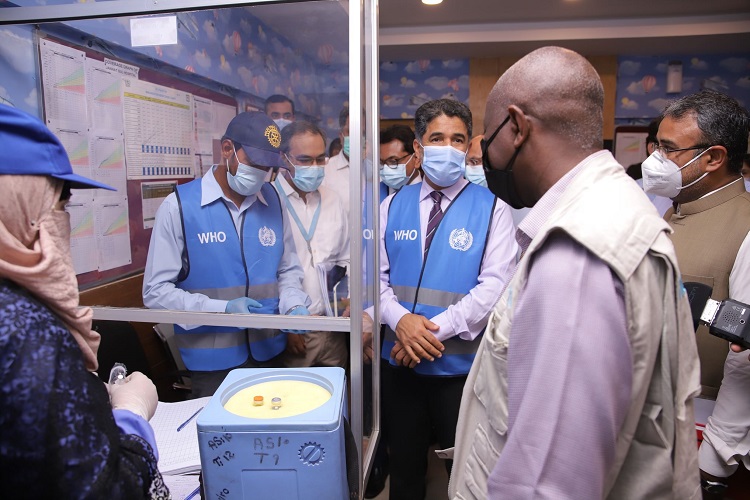
Friday 12 June, Islamabad – WHO and UNICEF have applauded the Government of Pakistan’s continued efforts to eradicate polio. The United Nations agencies commended the concerted efforts made to make sure that vaccination programmes continued even during COVID-19 surges in the country.
Both agencies urged greater solidarity and investment to sustain the momentum and reach every child with life-saving vaccines. These reflections were made by UNICEF South Asia Regional Director George Laryea-Adjei and WHO Eastern Mediterranean Regional Director Dr Ahmed Al-Mandhari as they concluded a week-long joint visit to Pakistan.
The visit coincides with the first Polio Oversight Board's visit to the country, and the launch of the Global Polio Eradication Initiative (GPEI)'s new 2022–2026 strategy.
“We know that the most important relationship in polio eradication is between the vaccinator and the child’s family. Without communication and trust, there is no vaccination. This week, I have seen a renewed focus on bolstering that relationship in the most high-risk areas of Pakistan. I appreciate the huge role played by frontline works in building that trust, and the support provided by the Government and partners to these workers. I leave Pakistan filled with hope that 'all hands are on deck' to finish the last mile in the journey to eradicate polio in the country,” said UNICEF South Asia Regional Director George Laryea-Adjei.
Commenting on this mission, WHO Regional Director Dr Ahmed Al-Mandhari said, “I have witnessed a back-to-basics approach to raise campaign quality and most importantly the need for laser focus on repeatedly missed children by provincial health ministers and chief secretaries – this is the only way we will slash the number of missed children down to zero. The GPEI leadership, including WHO and UNICEF, all have a role to play in turning the tide in Pakistan, but the real leader must be the Government of Pakistan on its emergency footing and best practices from its COVID-19 response, and this mission has showcased the diligence and accountability that Prime Minister Imran Khan and his government are applying to eradication.”
The visit highlighted the impact of COVID-19 and the changes made in Pakistan’s national polio programme. The regional directors also noted the opportunity for Pakistan to capitalize on the very few polio cases in the country and for GPEI partners to optimize support to intensified efforts by national and provincial governments to end polio.
The two regional directors met with top-level leadership, including the Chief of Army Staff Qamar Javed Bajwa, and attended the National Task Force meeting chaired by the Prime Minister Imran Khan and participated in by provincial chief ministers.
They visited Peshawar and Karachi and participated in field activities, including the ongoing polio vaccination campaign in areas that have persistently challenged the polio programme. In order to stamp out polio for good, every child living in these high-risk areas must be reached with the oral polio vaccine multiple times.
The regional directors visited routine immunization centres, where there is a growing synergy between polio campaigns and routine immunization and attended health facilities designed to help high-risk populations access health care and boost vulnerable children’s immunity.
Pakistan and Afghanistan are the only countries where wild poliovirus is endemic, and together constitute one epidemiological block. After losing traction during the COVID-19 pandemic, during which the polio programmes in each country were retooled as pandemic support, there are now promising results. The cases of wild poliovirus are down once again to just one to date in 2021 in both Afghanistan and Pakistan.
During their mission, Dr Al-Mandhari and Mr Laryea-Adjei commended the successes yet warned against complacency and urged that the hard work be continued until every last child is reached with vaccination.
