


Sélectionnez votre langue

Episode 3: Delivering Primary Healthcare in Gaza
 A health worker examines a child at a primary health care centre in Gaza.
I can't emphasize enough how hard it is to operate and provide good healthcare or even basic healthcare or any level of healthcare with such limited resources is incredibly, incredibly difficult.
After two years of conflict, only half of Gaza's primary health care centres remain functional. In this episode of the Frontline Shift, health workers from UKMed — an Emergency Medical Team working in coordination with WHO in Gaza since January 2024 — share what it has taken to keep primary health care going under relentless pressure. They discuss the immense challenges of operating with critical supply shortages, maintaining continuity of care for displaced populations, and reaching communities in areas with little to no functioning health infrastructure.
Primary health care is the entry point into the health system. Keeping it functioning is not just about treating illness, it is about restoring trust, dignity, and the foundations of a resilient health system for the people of Gaza.
Guests
Jay Matthews, Operating Department Practitioner, UK-Med
Mandy Blackman, Health team Lead for the North of Gaza, UK-Med
Transcript
Egmond Evers 00:05
Welcome back to The Frontline Shift, a podcast by WHO that looks at what it really takes to keep healthcare going in Gaza.
Luca Pigozzi 00:12
And howw, after two years of conflict, emergency medical teams supported and coordinated by WHO remain an integral part of the health system, rehabilitation and reconstruction efforts in future.
Egmond Evers 00:25
I'm Dr. Egmond Evers, Health Emergencies Team Lead for WHO in the occupied Palestinian territory.
Luca Pigozzi 00:31
And I'm Dr. Luca Piggozi, acting in charge of the WHO office in Gaza.
Egmond Evers 00:35
Over the past two years of conflict in Gaza, the health system has been under immense pressure. Hospitals have been damaged and have become non-functional. Medical supplies remain insufficient and healthcare workers are working under extremely difficult conditions.
Luca Pigozzi 00:49
In this context, primary health care centers have become more important than ever. They are often the first point of contact for people seeking care. When they are functioning well, they can treat common illnesses early, manage chronic conditions and support maternal and child care before problems become emergencies.
Egmond Evers 01:06
By providing care close to communities, primary health care centres help prevent overloading of hospitals and ensure that people can access essential services even when hospitals are not accessible.
Luca Pigozzi 01:16
In this episode, we are taking a closer look at the role of primary health care and the support from the emergency medical teams in this domain in the Gaza response. How these centers help sustain the health system and what it takes to keep them running.
Egmond Evers 01:34
This is the Frontline Shift.
With us today we have two colleagues from UKMED, Jay Matthews who is an operating department practitioner and Mandy Blackman, health team lead for the north of Gaza, speaking from Gaza. They have been working with UKMed as part of the WHO Emergency Medical Teams initiative. UKMed has been supporting the health response in Gaza since January 2024.
Welcome.
Jay Matthews 02:01
Hi, thanks for having us.
Mandy Blackmon 02:02
Hello, thank you for having us.
Luca Pigozzi 02:05
In Gaza, primary health care centers have faced many of the same challenges as hospitals, limited supplies, shortages of local health care workers, staff working around the clock, access constraints and ongoing security threats. Despite all these difficulties, health workers have continued to find ways to deliver care to their communities.
Egmond Evers 02:26
Currently, only 51% - that's 107 out of 209 primary healthcare centers that existed in mid-2023 are functioning in Gaza. Over the last two and a half years, insecurity has forced several clinics to suspend operations or relocate to continue serving displaced communities.
Luca Pigozzi 02:43
However, due to population displacement and their proximity to dangerous areas, some locations remain severely underserved.
Egmond Evers 02:53
North Gaza is a clear example. After months of siege, access restrictions and security challenges, the area was left without any functioning health services for a long period. While some clinics have since reopened, there are still no functioning hospitals in the area.
Luca Pigozzi 03:08
In the northernmost parts of this area, access to primary health care remains extremely limited. To address this gap, UK Med, together with WHO, has just established a clinic in Jabalia, the Al-Tayyeb Primary Health Care Centre, to help restore access to essential services.
Mandy, tell us why establishing this clinic is so critical right now.
Mandy Blackmon 03:31
Following our assessments up in the north, you can see that the area was very desolate. There weren't that many people living there at the time, and that was in November, but since then the population has increased. So primary health care is an integral part of the community where everybody lives and the clinics that are based within that community offer a place of proximity for people to access the services and fundamentally it prevents people either having to travel great distances, which is so difficult in this context, and prevents admissions to the other hospitals, to the larger hospitals around, so it doesn't sort of impact services.
Egmond Evers 04:06
UK Med has a lot of know-how on providing primary health care in difficult settings from Gaza and many other contexts. What can you tell us about the challenges in running primary health care in Gaza? What does it take?
Jay Matthews 04:18
So running a primary health care center in Gaza, it takes a whole variety of different support structures and efforts from a whole team. There's obviously one of the biggest problems in Gaza, uniquely, it's getting supplies in. So getting supplies to our facilities to treat people, to provide basic care for wound dressings and wound management for obstetric and gynocare, to normal injuries that have happened through the war itself, to getting pharmaceuticals like drugs, antibiotics, painkillers, really difficult to get through and get into place. And so rationing those through the community can be really difficult. So making sure the community is aware of these limitations so they know that we're doing the best we can for them through RCCE (Risk Communication and Community Engagement) outreach is really important. So that's probably the first and one of the most difficult things is managing the supplies, building materials to make new structures if you're going to deliver new services when you identify what people need as you integrate and as the dynamics of the situation change. So going from conflict into a ceasefire, what the community needs, as PHC (primary healthcare center) dramatically changes. So adjusting for that needs more logistical input, new WASH input, new materials, and security reassessments. We need to look at staff, both internationally and nationally. There's a huge amount that goes into keeping a PHC to maintain basic health needs for the people up and running.
Luca Pigozzi 05:56
Thank you, Jay. You mentioned the term RCCE. Just to elaborate for our listeners, RCCE is Risk Communication and Community Engagement, which refers to ensuring communities are well-informed about health risks and issues, and know how to protect themselves or what is being done to support them. You have worked in Gaza for some time. What are some of the most common cases you see and what does the typical caseload look like?
Jay Matthews 06:28
Yeah, so we see a lot of variety, but the main stay of cases that I see in November and December when I was managing the type one facility at Darabella was upper respiratory tract infections and a lot of gastric illnesses. They were our big two that we saw coming in. That obviously puts a lot of strain on the staff because they had to try and make progressive treatment plans to really limit the antibiotics because we had such a short supply. As an idea, I think it was something in November, December, it was something like 55, 56% of all pharmaceuticals had ruptured, so they're at 0% so we don't have them. So as an idea, We have very, very low supplies of drugs and materials for wound dressings and bandages and swabs were ruptured at like 65%, maybe 70% I think it was. So in terms of caseload, we're seeing when it was conflicts, it was about 700, 800 patients a day. And as Mandy said, as people were allowed back into the North, we saw that start to spread. So that went down to about half the patients, about 350 patients a day coming in to the primary health care centres and they were sitting for a variety of cases, mostly respiratory and gastro. We had other clinics in our facility. We had obstetric and gynecology and we had sexual and reproductive health being seen by our doctors there, also assisting with family planning. We have a lot of physiotherapy which went from only seeing a couple of patients a day, say three or four, working up to 20 as people readjusted to what facilities were available and what care was being provided. So we went from offering that twice a day to offering it six days a week. So it went up quite a lot. So in terms of caseload, we're seeing a lot of changes in the caseload, and I'm sure that if I go back in April, I'll see again another change in the caseload. But a lot of that stuff, we need a lot of support from the RCCE, so the outreach into the community, to educate people on how to manage their WASH, how to manage to mitigate against things like the flu, what symptoms will look like for certain diseases that pop up. Sometimes you'd see things like hep A start to track around the country. So we would then make sure the community understood what that looked like and made sure that we had the best resources possible to treat anybody that did have that and know where they should be going as well. So it's a big team solution to make sure that patients go to the right places within the country with minimal travel. As Mandy said, traveling in Gaza is actually incredibly difficult.
And it's not only difficult, it's really dangerous as well.
The roads are not safe.
And so I think that for the people to be moving on dangerous roads, they really need those PHCCs.
A huge, huge difference to have the primary health centers and the Type 1s in lots of
communities close to where they are to reduce all that risk to the people that are already facing so much trauma and danger.
Egmond Evers 09:37
Thanks, Jay.
Luca Pigozzi 09:38
I just want to quickly come in for our listeners and explain Type 1 and Type 2 as Jay mentioned, because I'm sure that these terms will come up again. Type 1 refers to primary healthcare clinics offering basic outpatient services, essential health consultations and preventive care serving as first point of contact with the patients. Type 2 instead refers to fully functioning field hospitals.
Egmond Evers 10:11
Over the past two years, security constraints have compromised access to healthcare. Under these circumstances, the primary healthcare centers have played a critical role in offering essential medical services to the community. Mandy, can you tell us a little bit about your experiences in this regard? Are there any examples that stand out from your work with UK Med?
Mandy Blackmon 10:29
Yeah, so with the restricted access to all healthcare services, obviously the impact for the primary healthcare service increases as it does internationally when these things happen. I think definitely the doctors and the nursing team are seeing more cases of injuries where maybe the wounds have been left for so long and that their healing has been impaired. What would have been a fairly simple wound now takes greater resources, greater lengths of time and the facilities for healing are less and with the reduced equipment that we have at our disposal, the lack of nutrition among the people of Gaza impacts upon their ability to heal, where we've got respiratory diseases especially coming through the winter where we see our peak and then as the weather changes going into the spring again, it's the medications we have to treat those patients, that can often exacerbate the disease. They can't maintain their normal levels and then we need to find the resources to treat them.
Luca Pigozzi 11:30
What were the working conditions like for health workers in primary health care centres during the peak of the conflict?
Mandy Blackmon 11:38
So working conditions obviously most of us are working at pre-fabricated buildings or tents. So obviously impacted by all the seasonal changes that are around us, like in cold environments with many of our medications and many of the equipment, just getting the fundamental equipment that we need is restricted. We don't have access to the resources that we would like in order to treat people. So a lot of the time we don't have the analgesic to give, we don't have the simple wound dressings to give. And this impacts upon the emotions of the staff as well because they're there, they want to do the jobs that they're there to do, that they're trained to do, that they're highly skilled to do and that are restricted in what it is that they can provide.
Jay Matthews 12:20
If I could add on top of that as well, like when we have patients come into the Type 1 that require further care because they can't get to a hospital, we would see that quite regularly. We had patients with severe asthma, which is like a respiratory condition and they would have to be treated in an emergency setting in a type 1, which is not what we'd normally do. But because they can't get to the place they need to go because of infrastructure collapse, because of the danger on the roads, they came to us first because we're closest to them. And we'd often see patients come in that clearly needed, as Mandy said, had worsening wounds from not being able to eat and drink normally and being malnourished. And so their wounds delay and then they get infected. They come to the type 1 because they can't get to the hospitals or the hospitals are so overwhelmed that they send people away because they just can't simply manage them as well. And so that became quite a loop system and it was really difficult to break that. We were lucky, UK Med have multiple facilities, one is just type two. And so we could often refer to ourselves if we couldn't get the patient into a national hospital or a hospital nearby and we would organise the transfer themselves but you'd often have to see your nursing staff dealing with cases that were outside of their normal remit for work in a Type 1 facility for sure and you would see a lot of people with just awful wounds coming in at different times.
Mandy Blackmon 13:55
So just to add to that as well, so yes especially in terms of chronic wounds we're seeing people maybe have been discharged from hospital earlier than they previously would have, but the impact is on the services of the hospital. It's meant that as soon as patients are well enough to leave, then they leave. So they're attending the primary healthcare services with wounds that probably haven't been seen, as Jay said, by the staff. But what the primary healthcare services can offer, even with the limited resources that we have, is that we can see those patients on a regular basis and provide them with the reassurance that they need. So we could make alternate day appointments for the patient to come in so that they can receive that wound dressing. And although the traveling to the clinic is hard for many patients, and just that reassurance, just that continuity of care that their primary health care systems can provide, and was very reassuring to the patients. You've also got parents bringing their children in, and maybe just, you know, what we would term as just common empatigo, but here, due to the lack of sanitation, you can't access the medications that can often ravage the body of the child. And so again, what we can offer at the primary health care services is that daily viewing of the child, that they can come back for extended appointments so that we can keep an eye on them and make sure that they are getting back to full health.
Egmond Evers 15:20
Thanks, Jay and Mandy. As the rehabilitation and recovery of the health sector in Gaza starts, what are the key needs and challenges for primary healthcare and what work is being done to overcome these?
Jay Matthews 15:33
Yes, so a lot of these challenges we face are things that I mentioned earlier in terms of our supplies, materials, logistics, security staff, RCCE outreach. We are looking regularly at redefining what is needed in the areas. So as we have a ceasefire in place, we have then gone back out into the community as we see less trauma coming through, and we look at what are the community's needs, what do they need next, and engage with the community. You find out they need things like dental work, you know, non-tremical disease care, like diabetes, hypertension. They need more focus on ophthalmology, eyes, and they need more care on dermatology, psychosocial support. So understanding what their needs are is really crucial in making sure you can make the right steps forward in delivering that care and then figuring out do we have the space, do we need to build more building supplies in to build tents or structures to house the new healthcare needs of the community and where are we going. A lot of the constraint is we would offer lots more services in the community, PHCCs, but often we don't have the supplies to offer more services. That is one of the biggest problems. We often look to collaborate with other charities or workers in country, so they can use our facilities to deliver certain care. I know at the moment we're working on putting together a link with some ophthalmology, and I am aware in the North they're working really hard bringing dental clinics together. I think those are things that are really needed at the moment and it's just making sure that these services that could get put in place can be continued. So making sure we have a plan in place to make sure that we can continue to run those services because we don't need them for just a week. There's been a gap in healthcare for over two years now. So the people really have a huge backlog of needs and support that they need to be given. So a lot of planning, a lot of capacity building, making sure that the team's training fully understand what needs to be given when we start offering new services, what to look out for, how those services should be managed. And I think that we really try and look at a holistic approach to making sure that services that are given to the community can be continued are managed. But the big problems are keeping staff safe, keeping our own staff safe, international and national staff, getting the supplies in. I can't emphasize enough how hard it is to operate and provide good healthcare or even basic healthcare or any level of healthcare with such limited resources is incredibly, incredibly difficult. So yeah, when we're looking at our PHC, whether we're looking at developing one in a new area, whether we're looking at changes in the healthcare needs in the service areas we're already in, we're constantly looking at evolving the PHC and we're constantly monitoring and addressing these challenges in a sort of circular approach.
Mandy Blackmon 18:56
I can add as well, so looking at all the maternal services as well that the PHCCs provide and supporting the vaccination programmes so that we're capturing people when they need us the most and providing that healthcare which then leads fundamentally to a healthier population.
Luca Pigozzi 19:13
This has been a very insightful discussion. Primary healthcare is the entry point for the patients into the health system and so critical to keep it alive through the EMT work in these circumstances. So many people are still underreached and then more access to healthcare needs to be granted. As efforts to restore Gaza health sector continue, sustained donor support remains critical, along with unimpeded access across Gaza and the large-scale flow of humanitarian aid. currently constrained by the ongoing closure of most crossings into Gaza.
Egmond Evers 19:42
Strong primary health care is one of the foundations of a resilient health system. If care starts early on close to where people live. Health services can be accessed faster, more effectively and more equitably. It's been great to hear about the work being done to ensure primary health care remains at the heart of the recovery efforts.
Luca Pigozzi 20:06
Thank you all for taking the time, especially in between demanding shifts and to share your experiences and the work you are doing.
Egmond Evers 20:13
These are your hosts Luca and Egmond signing off.
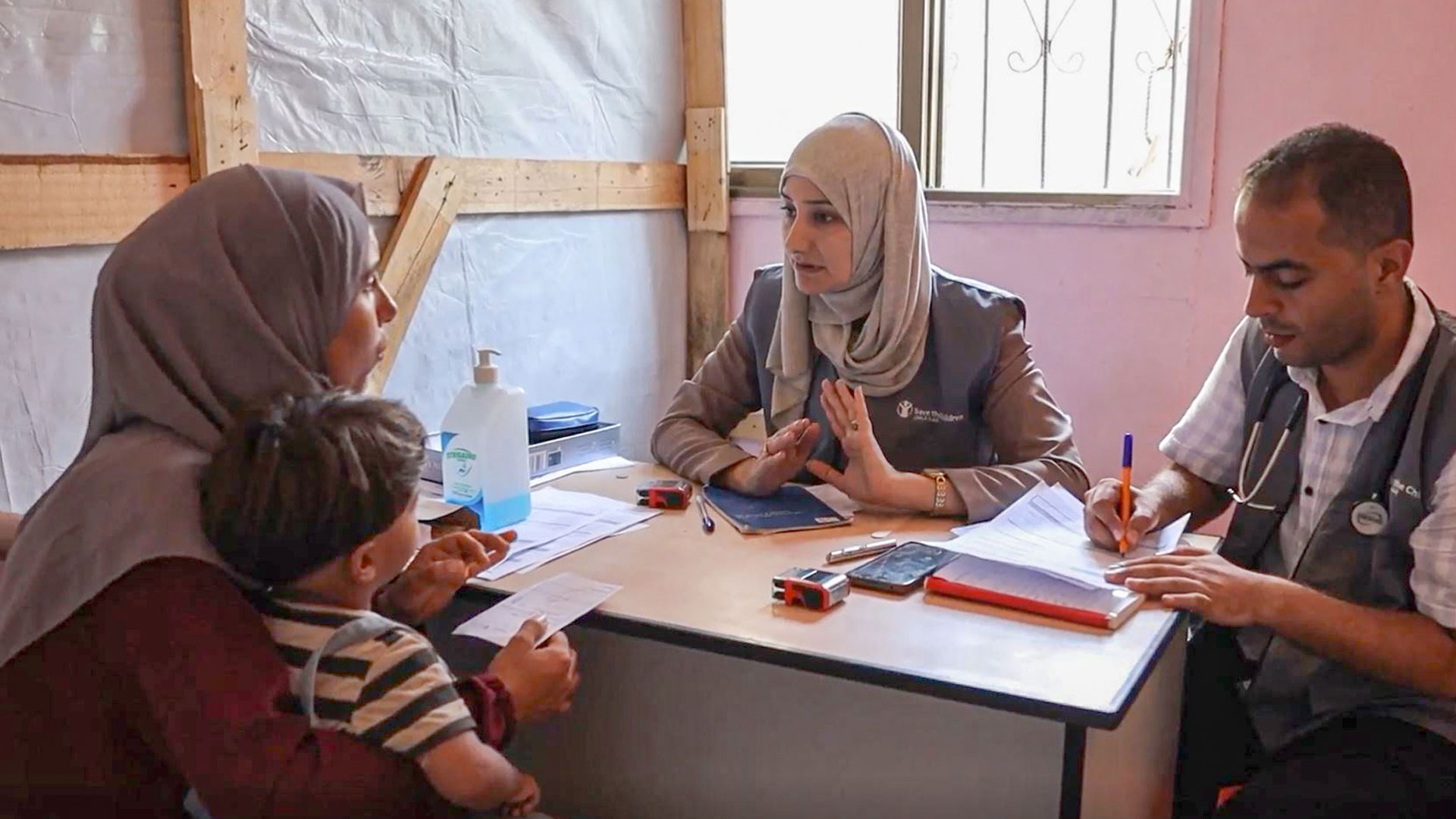 A mother and child receive consultation at primary health care centre in Gaza
Episode 2: Supporting Rehabilitation Needs
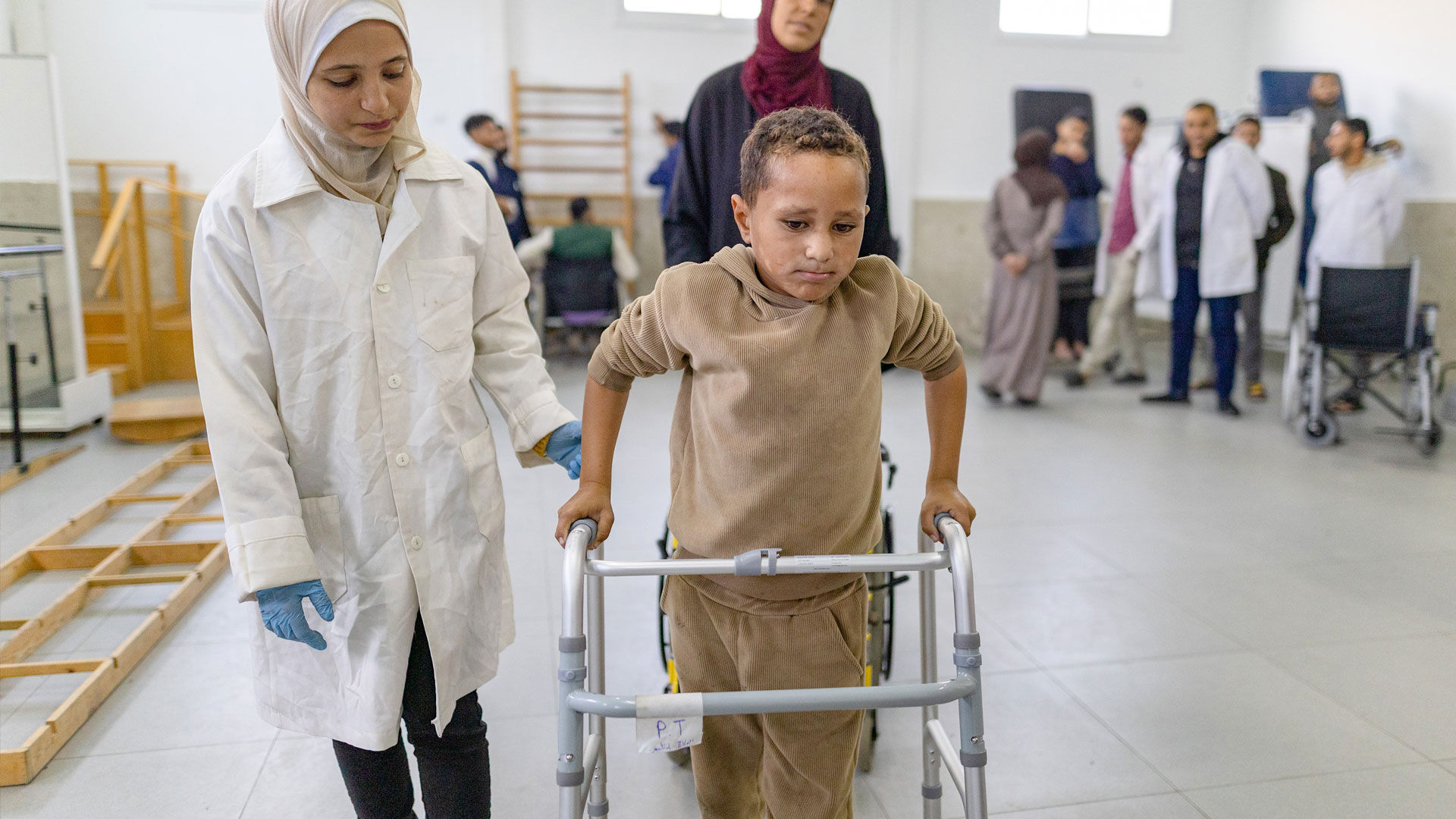 A young patient injured during the conflict in Gaza receives physical rehabilitation at Al-Amal PRCS Rehabilitation Hospital
These are injuries you might see once in a career — in Gaza, we see them every day. Without rehabilitation and assistive devices, recovery simply stops.
After two years of conflict, more than 42,000 people in Gaza are living with potentially life-changing injuries, including over 5,000 amputations and thousands of spinal cord injuries, burns, and complex limb injuries.
In this episode of Frontline Shift, health workers from NORWAC — an emergency medical team working in coordination with WHO in the Gaza Strip since February 2024 — alongside a WHO rehabilitation specialist, discuss the urgent needs, gaps, and challenges in expanding access to physical rehabilitation services. They share how the lack of functioning services and essential assistive devices is affecting patients’ recovery, independence, and quality of life.
While some progress is underway, with WHO and Emergency Medical Teams working to restore and expand rehabilitation services, strengthen referral pathways, and train and support the health workforce, the scale of needs remains immense.
With much of Gaza’s rehabilitation infrastructure damaged or non-operational, and many professionals killed or displaced, rebuilding services requires coordination, sustained investment, and reliable access to supplies.
Rehabilitation is not a luxury — it is essential to recovery, dignity, and long-term resilience.
Guests
Morten Eng, Country Director for Palestine, NORWAC
Kaja Flatoy, Emergency Nurse, NORWAC
Peter Skelton, Lead for rehabilitation in Emergencies, WHO
Transcript
Egmond Evers (00:05)
Welcome back to the Frontline Shift a podcast by WHO that looks at what it really takes to keep healthcare going in Gaza through coordination and deployment of emergency medical teams to support the health system.
Luca Pigozzi (00:18)
And now after two years of conflict emergency medical teams supported by WHO remain an integral part of the health system, rehabilitation and reconstruction efforts.
Egmond Evers (00:28)
I'm Dr. Egmond Evers, Health Emergencies Team Lead for WHO in the Occupied Palestinian Territory.
Luca Pigozzi (00:34)
And I'm Dr. Luca Pigozzi, acting in charge of the WHO office in Gaza.
Egmond Evers (00:38)
Today, we're looking at the heavy toll the conflict has taken on the people in Gaza, particularly through traumatic injuries. More than 42 000 people are now living with potentially life-changing injuries. Think of spinal injuries, amputations, complex limb injuries, burns.
That's around 25% of all people injured during the two-year conflict.
Luca Pigozzi (00:59)
This includes over 5000 people with amputations and nearly 3500 people with severe burns alongside many other serious injuries. The result is an enormous and growing need for both physical and mental rehabilitation.
Egmond Evers (01:14)
For our discussion today, we're focusing on physical rehabilitation in Gaza. We'll hear directly from our emergency medical team colleagues on the ground, what worked, what didn't, and what these experiences tell us about what's needed next.
Luca Pigozzi (01:27)
Because this response is only about emergency care. It's about sustaining services over time and rebuilding what's been damaged.
Egmond Evers (01:35)
This is the frontline shift
Egmond Evers (01:42)
With us today, we're joined by colleagues who have just wrapped up their deployments in Gaza, Morten Eng, country director for Palestine and Kaja Flatøy, emergency nurse. Both of them work with NORWAC, which has been supporting the Gaza response since January, 2024.
We also have Pete Skelton, the lead for rehabilitation in emergencies at WHO headquarters in Geneva. Thank you all for being with us.
Morten Eng (02:05)
Thank you for having us.
Kaja Flatøy (02:06)
Pleasure to be here.
Luca Pigozzi (02:07)
Pete, you have worked very closely with colleagues in Gaza supporting efforts to strengthen physical rehab. How well is the health system able to respond to the sheer scale of rehabilitation needs right now?
Peter Skelton (02:20)
Thanks, Luca, and thanks for the invitation to join today. Listen, I think that it's worth saying to begin with that Palestinian and international EMT colleagues have been doing really incredible work in Gaza under near impossible circumstances throughout this conflict.
I think the numbers of injured that we've seen are really unbelievable. And They'd be enough to overwhelm even the strongest health system, but in an area that's as small and compact as Gaza, the impact is really catastrophic.
It's equivalent to about 2% of the population that we see that have potentially life-changing injuries now. All of these people that have been injured during the conflict needed media and ongoing access to rehabilitation to be able to prevent complications and to make sure they get the best possible outcomes after being injured. But in addition to the injuries that you guys have already mentioned, there's also a whole really quite significant proportion of the population that also need access to rehab services. So are people like older people with strokes or children with cerebral palsy.
And they faced enormous challenges in not being able to access the services or the equipment that they would normally depend on during the war. Not only that, but they've also been displaced. So they're living in very, very difficult situations
At the peak of the conflict, we know that more than two thirds of the pre-existing rehabilitation services in Gaza were not operational. And that includes everything from services on the primary care level right through to the more specialised inpatient rehabilitation centres, as well as both of the prosthetic and orthotic centres in Gaza City as well.
What that means is that people simply can't access what they need, but also people that should have been able to access rehabilitation on an inpatient level by being referred into facilities were then having to be managed by mobile teams in the community in places like shelters and tents, which is obviously incredibly difficult if you have a new major injury.
The impact was beyond the destruction of the or the damage of the services as well. We have reports that over 50 rehabilitation professionals were killed during the conflict. So this also has a really major knock-on effect on the services that are able to be delivered.
But also the workforce themselves are living through the war and in them themselves are displaced and directly affected. And I think we can't underestimate the impact of that on our Palestinian colleagues in particular as they're striving to continue to try and deliver these essential services to people.
I think while things are improving following the ceasefire, there are still new injuries each day and we still have the threat of deregistration hanging over a number of really key rehabilitation providers at the moment, which is bringing new challenges.
There's still a lack of essential equipment and supplies, and there's still a really urgent need to expand services. So we're working together with EMTs and other partners to support existing services and to reopen services and expand services.
But the needs are so in enormous that we need to keep on working
Egmond Evers (05:32)
Thanks a lot, to Pete. Morten, you've been on the ground for four months. What have you seen? What stood out to you the most?
Morten Eng (05:39)
I think the first thing that comes to mind is the complexity of the injuries, especially in the young patients. M I think from the from going back to kind of this time last year when I was in Gaza, there was a and a four-year-old with a traumatic brain injury after an exposure explosive injury. And, you know, you treat these cases while they're in ICU and follow them up in the wards. And then coming back in September to Nasser, there was, again, ICU, another four-year-old and several four-year-olds coming in during my time there.
So you have these type of injuries that you think normally you'd see and only once in a while. But in Gaza, they come in time and time again, and you see the patients that you've and that you followed for a while. And just as you think you're going to manage to and to get somewhere with them and get them discharged, they end up with new case coming in with similar injuries or also of a young age. I think the time spent in Gaza, you start noticing now that a lot of the cases from earlier in the in the conflict have developed all the kind of complications that you normally try and prevent. So you have all the issues that normally the both fiscal rehabilitation and the nursing and medical care that they receive are supposed to prevent and now they've, because they've been discharged into their into their homes without the follow-up that would normally be needed to prevent these complications, they're they're having a lot more issues than you would normally see.
This goes from and from the cases with spinal cord injury, not having the necessary equipment available, the cases of traumatic brain injury that require a lot of and rehabilitation and this is not available. But also some of the kind of orthopaedic injuries and things that would normally be surgical and surgically managed early on, that now they have to wait a long time for this to be available and they're still waiting at this moment in time.
Egmond Evers (07:31)
As you've both described, the rehabilitation needs are fast. WHO and partners are working to improve the immediate availability and access to rehabilitation services while building the system as a whole.
That means strengthening rehabilitation capacity in hospitals through dedicated outpatient clinics and inpatient capacity for an additional 70 beds. It also means integrating rehabilitation in many primary healthcare centers and reaching out to people in communities. Also improving referral pathways so patients don't fall through the cracks in between.
Another key aspect will be ensuring people have access to assistive devices, as was mentioned before. And finally, strengthening health information systems to track needs and outcomes. All of these elements are, of course, interconnected.
Luca Pigozzi (08:23)
Morten, you are working hands-on across several of these areas Egmond just described. The goal is to meet urgent, short-term needs while also building longer-term capacity in the health system.
What does that look like in practice?
Morten Eng (08:38)
So at the moment, we're trying to and work closely with the national staff, both in the acute hospitals like Al-Shifa and Nasser, but also with the and but the teams working with the long-term rehabilitation units. The multidisciplinary team in these hospitals are... And working very hard to meet the demands and to and coordinate both the care patients need during their inpatient stay, but also their follow up and an ongoing treatment. And we're trying to help them implement a comprehensive multidisciplinary approaches in all aspects of the patient's care, specifically aimed towards those cases with traumatic injuries.
The international teams are always working alongside the local staff with the focus on transferring the knowledge and the ways of working that are may be sometimes different. Or A lot of the times these were things that were in place before the conflict but now have and been lost in the in the chaos of the and of the situation that's been and obviously going on for so long. This is apart with the fatigue and burnout that you see in the staff, but also with and so many hospitals having been shut down at times and then built back up again.
We have teams coming in there working on strengthening the physical therapy aspect, but also the nursing care provided in the acute stages. Trying to get the team to work as a whole to and mobilize patients, encourage them to and get their function back, prevent these complications, as I mentioned already, and to try and get the multidisciplinary team, so both the nurses, physiotherapists, doctors, to all work together on planning discharges, making sure that there's a plan in place for referrals onwards to either the rehabilitation services or the primary healthcare clinics and outreach services that are, in some places at least, available.
We are looking at the kind of initial phase of looking more on the acute side of the, both in the ICU and in the wards and acute hospitals. But we're also looking to expand our support to the tertiary rehabilitation, looking at how they're, and you know, now providing this rehabilitation for these complex injuries in the in the rehabilitation units that are being and able to start working again. And But there's obviously a real need for both capacity building. There's a lot of staff that previously and worked in this area that has either left Gaza or had been killed during the conflict. So there's a real need for encouraging the newer members of staff of kind of upscaling there and their services, improving their knowledge and management, and specifically with regards to these more complex injuries, how to and to get the whole multidisciplinary team involved early on and to work together throughout the entire and treatment.
Egmond Evers (11:27)
So, uh, Kaja, picking up on what Morten said, you've worked closely with local healthcare workers throughout the process. , what have those interactions been like? What, what can you tell us from a capacity building perspective?
Kaja Flatøy (11:40)
First of all, I have to say I'm amazed by the flexibility and the creativity within the Palestinian healthcare workers because they have to they have to flip a lot between the different wards that they work in.
And in every part of the world, these are difficult injuries. As Morten was saying, they're very complex and they need a close cooperation between the physiotherapists and the nurses and doctors to be able to rehabilitate these patients.
Back to a good quality of life. And they also require a lot of sanitary, and the sanitary situation isn't really built for that. Now in Gaza, the living conditions and the shelter from the cold and the wet environment at the moment. So there are a lot of obstacles. Also, the access for pain relief medicines and just the regular medications that people usually take to for their there and general diseases that is no longer available. So there are a lot of things and making it difficult to to treat these patients. We had a project where we did some teachings, some simulation teachings at the Al-Al-Shifa hospital, where we looked at the cooperation between the physiotherapists and the nurses to be able to work closer together help.
Change the wounds at the right time, give the pain relief medications at the right time so that the mobilization could be more effectful. So there are some ways to look at this and to work with this, but it's a very complex situation, of course.
I work closely together with the wound care team and just the pressure wounds alone is a very big problem in Gaza right now. So we looked at the possibility to try to prevent these infections.
Kind of complications from the beginning, just already from the from the ED and then from the start of the hospitalization of the of the patients. But during these conditions and the lack of staff and everything, it's very difficult to to prevent these kind of complications, which makes which makes it even more complex with the rehabilitation.
Morten Eng (13:47)
Yes, since during our and our stay, together, me and Kaja both and provided some training for and for the staff and how to identify the cases that would need and to be and mobilized, would need to be encouraged to regain their independence and function. And this is normally done as a multidisciplinary approach. And this is something that's kind of lost in the and in the time during the conflict. So we've had sessions where doing both simulation exercises, but also having discussions around how to get back to the level of care that they provided before the conflict.
And this was, for me, it was very interesting to see how and It seemed to us that they hadn't had time to reflect on how they were working now and how they could potentially get back to the ways they were working before and to identify those things that were missing for and for them to be able to do a better job.
Certainly from the point of view of and the clinical management of cases, we've had training focusing on this as well. But they do have and a workforce that has a level of experience working with complex injuries that's probably unparalleled paralleled in the in the world. And But at the same time, they are and the opportunity to discuss with someone from outside with a slightly different background than maybe a and different kind of input turned into quite good discussions around then both individual patient management, but also how to run kind of an acute hospital with the level of injuries that they saw, that the issues with the regards to equipment.
Peter Skelton (15:15)
I just want to come in then on the importance of referral pathways as well, because I think this is a really important issue. So rehabilitation care starts in acute care in the big trauma hospitals where people are referred to, but we need continuity throughout. So that means that somebody needs to know when they're leaving that acute hospital, where they're going to continue to receive their care from next. And that might be going on to a specialized inpatient unit in another facility, if that exists, throughout the conflict in Gaza, those resources were incredibly limited. What it more often needs means in this context is going out into the community. So again, being displaced, but needing access to and rehabilitation either through mobile teams that are providing services in the community or even through primary care settings.
So a lot of the work that we're doing is to make sure that we're building services throughout that continuity of care. So that people start in a timely manner at the beginning, as close as possible to when they're injured, but that they receive care that they need on an ongoing basis. So thinking around amputations, for example. It's not simply a case of providing a one-off prosthetic. You need rehabilitation immediately after the amputation to prevent complications, to get stronger. Then you need the prosthetic to be fitted. You need to learn to use it. And then that prosthetic has to be refitted and modified and parts replaced over the life of that person. So it's really an ongoing process. And a lot of the work that we do is
Looking at how we meet the immediate needs, but also making sure that the rehabilitation response is sustainable and linked to recovery as well, so that we're we're ensuring that services in Gaza are rebuilt and will remain available for people that need them for the future. And I think an important part of that is the rehabilitation task force, and so this is part of WHO's role. In very close coordination with both EMT coordination and the health cluster, is really making sure that we have a very strongly coordinated response across a whole range of different partners that are working together to put these services in place now,
Luca Pigozzi (17:38)
Thanks a lot, colleagues. And You also mentioned that ensuring patients are matched with the right assistive devices, which raises a critical point. Scaling up rehabilitation requires the facilitation of humanitarian assistance, including increased the entry of medical supplies, rehabilitation of damaged facilities, and expansion of essential services.
Egmond Evers (17:58)
Pete, access to medical supplies remains a major challenge, especially for assistive devices. What are your observations on that front?
Peter Skelton (18:07)
Thanks, Egmond. Yeah, I think it's helpful to start with what we need to deliver essential services anyway, right? So we need the staff. And in Gaza, we have an incredible workforce, but we have these huge and overwhelming numbers, and we need to increase training for that workforce and capacity of that workforce as well, and it needs international support. We need the systems, and that's where the coordination piece comes in.
We need the space, and a lot of these buildings are damaged and destroyed, and so we're working from temporary facilities. But we also need supplies, we need the equipment component and that's been a huge challenge for us in Gaza in particular. And like many, many other essential supplies and essential medical supplies, access to the basic assisted products that we need like crutches and wheelchairs has been a real challenge throughout but also access to more complex devices. So things like prosthetics and hearing aids has been a major, major constraint. Now, people might not consider these devices to be sort of essential or life-saving, but it's worth thinking that, you know, without crutches, a patient can't walk out of a hospital. So they end up being stuck in the hospital or they're stuck in bed in a tent on hard ground. They're not safe.
They will develop complications and and they'll make the whole response less efficient as well. So we really consider these basic things like crutches and wheelchairs to be essential in emergency settings and particularly in a context like Gaza.
So in collaboration with the EMT and the health cluster, as I said, we really coordinate the delivery of assisted products and the supply of assisted products to those that need them. And we've put a lot of systems in place because it's such a scarce resource to really try and prioritize those devices that we have to track distributions and ensure really that it's those that are in the greatest need get access to the products that they need but it's really an ongoing challenge to get the quantity but also the right type of equipment into gaza that is required
We've all encountered different barriers that have met, and for partners in particular, it's been really challenging and often impossible for them to get the supplies in that they need. As a result of that, we've seen some really nice things like innovation locally, so people manufacturing crutches, using local resources, people making splints, people making more specialised burns, garments that are needed after major burns injuries. All being manufactured locally by NGOs, by partners using local equipment and resources. But that's really just a kind of a sticking plaster in terms of it's it's not a solution to meeting the huge needs that we that we have. And there are some things really like prosthetics and wheelchairs, which it simply isn't safe.
Or possible to manufacture locally, we can only bring those in internationally into Gaza and we need you know unhindered access to be able to bring all of these things in.
Egmond Evers (21:07)
Thanks a lot, Pete. Kaja, from a clinical and quality of life perspective, how does the lack of assistive devices affect patients?
Kaja Flatøy (21:16)
Well, hugely, I think. Coming from Norway, where we have this equipment very available and we're very lucky in that way, it's it's very it was really hard to see how like simple tasks are made impossible because of the lack of these helping devices and equipment.
And also, as we were talking about, just the nutrition and the shelter and everything that is needed to be able to get by from day to day is of course a very important part of the of the situation down there and and what people are thinking about and worrying about. So the whole the whole complex situation and makes it difficult to get all these parts working together. But also as Pete was saying, yeah i'm i'm So amazed by all the creativity and that all the ways that they make life work and the the ways they use what they have to be able to live as best as possible and the way people help each other. So there's this kind of warmth in the environment. Palestinian environment that I was really struck by and that was moving, being a witness to. So I just hope that we can provide more of the useful equipment and and help the conditions being in a way that it's possible to come back to a quality of life. And also the medications, the access of pain relief medications and the normal medications for diabetes and and other conditions that would be very, very important effects from if they're not treated.
Morten Eng (22:56)
I think also of thinking that there's some equipment that's getting in. There was a 17-year-old with a spinal cord injury after a shrapnel injury that I treated. That you know Initially, he it took a few weeks before he had a wheelchair when normally these cases would get up and sit in a wheelchair quite early on. And But he had a large like had a big problem with the... And with the hypotension, with this but blood pressure dropping. Normally you'd use pressure garments, and abdominal binders and compression stockings to to prevent this, but this was not available. And the whole kind of early progress that he had was very limited by this. And The wheelchair he got did not have a suitable pressure relieving cushion resulting in him having a pressure sore. When I met him again a few months later, he had developed a pressure sore that's likely gonna require surgical management, which at the moment is not available in Gaza. So you have this and this initial problem of equipment not being available or not the suitable equipment being available and then the kind of compounding of issues and developing from this.
Luca Pigozzi (23:59)
While the needs remain in many, there is also hope for the future. Important work is underway in Gaza to strengthen physical rehabilitation capacity, as our colleagues were working us through.
But what needs is sustained investment in the health system to rebuild it better. This is not an overnight fix and attention must not fade.
Egmond Evers (24:20)
This has been a really insightful discussion. We hope WHO, the emergency medical teams and partners continue to be able to scale up this critical work.
Luca Pigozzi (24:29)
Thank you all for taking the time, especially in between demanding shifts, and to share your experiences and the work you are doing. It has been both insightful and definitely inspiring.
Egmond Evers (24:40)
These are your hosts Luca and Egmond signing off.
 A woman injured during the conflict in Gaza is guided by her physiotherapist during a session aimed at improving her mobility
Episode 1: Patient Evacuation During Conflict
Published: 5 January 2026
 CADUS team members transfer a patient at Kamal Adwan Hospital to southern Gaza for further medical care
April 2024
Nothing about moving patients in Gaza is predictable — every transfer is a medical, operational, and emotional challenge.
In this episode of The Frontline Shift, health workers from CADUS, an emergency medical team working in coordination with WHO in the Gaza Strip since February 2024, share experiences from the field.
The episode examines the challenges of patient transfers during conflict, including internal transfers from unsafe hospitals to facilities offering relative safety, medical evacuations via the Kerem Shalom Crossing for treatment abroad, and the emergency response to mass casualty incidents during food distribution.
Drawing on firsthand experience, CADUS team members highlight the challenges of access constraints, equipment shortages and prolonged delays, offering practical insight into what it takes to move patients safely and sustain care in an active conflict setting.
Guests
Ayvery Cox, Head of Mission, CADUS
Amar Mardini, Medical Lead, CADUS
Matthew Whiting, Critical Care Paramedic, CADUS
Transcript
Egmond Evers (00:00:00)
Welcome to the first episode of the Frontline Shift, a podcast that takes you inside the heart of one of the most challenging health responses in the world. I'm your host, Doctor Egmond Evers, health emergency team lead for WHO in the occupied Palestinian territory.
Luca Pigozzi (00:00:20)
And then Doctor Luca Pigozzi, acting in charge for the WHO office in Gaza.
Egmond Evers (00:00:27)
In this series, we're stepping into Gaza to revisit some key moments of the emergency response in this two-year conflict. We'll discuss lessons learned and hear firsthand from emergency medical teams who delivered care in impossible circumstances.
Luca Pigozzi (00:00:38)
WHO has been coordinating the emergency medical teams in Gaza since December 2023. Since then, we have identified critical gaps in care and coordinated the entry and deployment of EMTs inside Gaza. The aim is simple but urgent to provide surge capacity to health systems struggling to keep services running amid violence, staff shortages and severe supply constraints.
Egmond Evers (00:01:05)
The journey has been challenging. Surgeons have operated through power cuts, doctors and nurses have cared for patients with little medical supplies. Medical teams have moved patients to safety through battlefields.
Luca Pigozzi (00:01:16)
Two years on, EMTs have stood shoulder to shoulder with Gaza health workers and ceasefire holds. They are now an integral part of rehabilitation and reconstruction efforts.
Egmond Evers (00:01:27)
This is a story of resilience, of medicine under fire, of what it takes to keep a health system standing when everything around it is falling apart. This is the frontline shift.
With us today are our colleagues from CADUS, an emergency medical team, which has been working together with WHO in Gaza since February 2024. Speaking from Gaza, we have Avery Cox, Head of Mission for CADUS, Amar Mardini, Medical Lead, and Matthew Whiting, Critical Care Paramedic.
Luca Pigozzi (00:01:58 )
Welcome, colleagues. Before working in Gaza, CADUS has many experiences in working in conflict zones, such as Ukraine and Sudan. Avery, what has the experience been like working in Gaza?
Avery Cox (00:02:11)
I would say especially having come directly from working on medevacs in Ukraine with CADUS, it's just, a it's a much more restrictive environment. So it's restrictive on when it comes to movements, and especially resources. So getting medical supplies for our team and restocking medical supplies, when it comes to having a fleet of ambulances, maintaining them, getting spare parts or even getting new ambulances has been extremely difficult. We've been running two ambulances and we're down to one at the moment just because it's so hard to get the spare parts and to get additional ambulances in at any given time.
Luca Pigozzi (00:02:54 )
In Gaza, CADUS has been one of the most critical EMTs in the response. They have supported pre-hospital care and trauma stabilisation points as well as supporting medical transfers and patients evacuations Since February 2024.
Egmond Evers (00:03:09)
Medical transfer and medical evacuation are critical functions of EMTs in a conflict like Gaza. Since the start of the war there have been over 20,000 internal transfers, meaning transfers within Gaza from hospitals that are unsafe into relative safety, and medical evacuation of over 10,000 patients from Gaza to other countries. CADUS has supported a lot of this.
Luca Pigozzi (00:03:31)
Avery, in time you have spent in Gaza, what has been the one pivotal or defining moment of your service there?
Avery Cox (00:03:39)
There have been a lot of pivotal moments, I'd say, but the siege of Kamal Adwan is what immediately comes to mind for me. We went there several times, especially early on. A lot of these missions were denied. Even when we did get access, after a number of attempts, evacuations from Kamal Adwan were never straightforward. They were always difficult.
The first time that we went and were successful at evacuating a patient, it was a ventilated child. While we were waiting for clearance to continue to Al-Shifa, while at Kamal Adwan, we actually had to bring the patient back up to the ICU because we were running out of oxygen in the ambulance. When clearance finally came, we then got stuck at the first holding point for several hours, which meant that we then were becoming critically low on oxygen once again.
It's missions like this. Every mission in and out of Kamal Adwan was extremely challenging medically, operationally, and especially emotionally for the team. Nothing about it was predictable.
Egmond Evers (00:04:45)
This has really been an unusual crisis where medics have dealt with situations that aren't typical, even in crisis situations. We've seen healthcare coming under attack and had to move patients from health facilities under siege.
Luca Pigozzi (00:04:57)
Yeah. In 2025, three key hospitals in North Gaza (Al-Awda, Indonesian, Kamal Adwan) were besieged necessitating transfer of patients. WHO, together with CADUS, conducted several missions to support these hospitals and keep them as functional as possible.
Amar, take us back to one of these missions you've been part of and walk us through some of the extraordinary challenges you faced.
Amar Mardini (00:05:26)
Yeah, I guess the mission to Al-Awda Hospital and the Indonesian Hospital. I will always keep in mind when I get home. It was incredibly difficult to reach the hospitals. It took us several hours just to get there. The roads were blocked by debris and we had sometimes to clear the way with our hands and a shovel. And even if we did that, we got stuck with our ambulance. We had to be towed by one or another of another car. And when you finally reached the hospital, it was chaos.
Sometimes it was engineers dismantling the equipment in the hospital. We try to treat some of the staff members, which were from the hospital, which were stuck there for days and needed some treatment.
The patients, We once had a patient which had a severe brain injury, and I was thinking about how should I get this patient back to the next hospital on this roads without causing him more injuries? And even if we manage to load the patients to the ambulance? I remember one time at Al-Awda hospital, for example, we just got the patients into the ambulance. We're talking about two, three patients at the same time with some relatives in the ambulance. And then suddenly a military activity started in just in front of us, so we had to wait until we could go back. And it went on for hours. And I remember back then I was thinking, did we do something wrong? Because it was probably safer for the patients in the hospital. We were stuck there. You could see the patients in the ambulance. They got nervous, they were anxious, and we tried to emphasize that we are here in a corridor. This is an authorized mission.
On the way back, it was the same thing. We had to cross the same roads. Sometimes we had to change the route because it was just not feasible to get to the other point. And one mission, we had to be towed to the full length to the hospital with our ambulance, all while we had a patient who was not stable. We had situations where we run out of our equipment in the ambulance. We were talking about oxygen. A way which you usually would have probably taken twenty, thirty minutes took us hours. We tried to have as much oxygen in the ambulance as we could, but at one point we just ran out of oxygen and it was difficult to handle those situations.
Also, while we were at Indonesian Hospital, I remember there's one situation when we just went to Al-Awda [Hospital] and went back. Then we headed to Indonesian Hospital and there was a patient on the way. When we had to rescue him from, honestly, it looked like a desert of concrete. It was just insane to even reach him. We had to shout for him. And then finally we found him. It was a patient in a wheelchair, and there was no way we could transport him to the ambulance. So we had to carry him on the back to our ambulance.
Egmond Evers (00:08:35)
Those are really some gripping stories, Amar.
Even now with the ceasefire, the medical needs in Gaza far outweigh the available services. As we said, there have been over 10 000 people who have already been evacuated to countries like Egypt, Jordan, Qatar but also some to Europe. There are still 18 000 priority patients awaiting medical evacuation for care elsewhere.
In the past, before the war, patients would be able to receive care outside of Gaza, in the West Bank and East Jerusalem. But that route is currently closed. The Rafah border with Egypt is closed right now as well. Right now medical evacuations to other countries are the only option for care that’s not available in Gaza. CADUS to support WHO with those evacuations. Tell us a bit about that work. What moments really stick in your mind?
Amar Mardini (00:09:25)
Yeah, maybe I start with comparing it to the last ceasefire. I remember during the last ceasefire, we did six times a week evacuations to the Rafah border, and those evacuations were always stressful. We faced quick handovers of the patients at the hospitals. Usually we had to deal with alternative medications because of the scarcity of the first line medications.
And as Avery said before, the toll on our ambulance back then was heavy. The maintenance was a big problem. But most importantly, again, it was the roads. It was very difficult even, to severe injury, to transport a severe injury to the border. Sometimes I felt like the helmet I was wearing during these missions was not to protect me from bullets or something like that, but because it kept bumping in the ambulance against all the stuff we have over there. And if we look at the moment for example, we are still not back to the previous ceasefire conditions. We are due around one medevac per week at the moment.
We get the patients the night before at a field hospital, around 20 to 40 patients and with their companions, which is in total around 120 to 180. We take care of the medical needs over the night and sometimes we have nights where we work until the early morning because we have to do wound dressings and anesthesia, and sometimes we face patients with known epilepsy which haven't taken their medications for a couple of days. So we have to figure out how to get these medications before the transport. And this is all because there's still this shortage of medications around.
Recently we see a lot of PTSD cases. Last time on the last medevac, I saw a five-year-old boy, was suffering from a blast injury from several blast injuries. He lost a hand and had a wound on his left limb, and the wound dressing was done for two weeks, so we had to change it. And just to be able to touch the boy, we had to give him some sedation because otherwise we wouldn't be able to do the wound dressing. And this just showed me how much more than just the medical side. Also, now we have, we treated the medical parts, but we also kind of still, we only see the beginning of the mental issues over here.
Early in the morning, we usually then load the patients into the ambulances and buses. And I remember, for example, one time where a mother tried to hide one of their children under the bus seat because she was only allowed to take three companions with her, and she had to choose between her mother and one of the kids. And she, it took a lot of talk from the side of the WHO with her, and at the end she decided to stay. I'm sometimes I'm glad that I am not native Arabic speaking because it's hard. It's really hard for the people who could understand this conversation because I don't know what I would do.
And then again, the missions at the moment are difficult because we still face a lot of delays. We have to stop at checkpoints, we have to wait for hours. There was one medical equation where we were stuck at the border crossing for ten hours, almost ten hours, with nine ambulances of the Palestinian Red Cross Crescent and one of our ambulances. And I remember back at that time, the whole fleet was not more than 15 to 18 ambulances of the of PRCS [Palestine Red Crescent Society]. So half of the fleet were stuck for ten hours at the crossing, which meant the first responders had just half the capacity at that moment.
This is all the things we have to think about when we do these missions in this kind of conflict at the moment.
Egmond Evers (00:13:39)
You mentioned a shortage of medicines and supplies. Could you tell us about a time when you've had to improvise, when you didn't have the supplies available?
Amar Mardini (00:13:48)
I remember when we had evacuations where we knew we would not meet the needs we will face at that time. So we had to ask several partners in the field if they could supply us or help us with the supplies. At that time, just to be prepared in case we need it. And also when we reach the hospitals, many, many times we saw patients which were from the ICU, which were already taking medications, which is not first line. So we had to change the medication just and it was all in a in a very shortly manner. We had to do that just before we had to leave. So it was it was difficult. It was very difficult.
Luca Pigozzi (00:14:29)
Another major challenge of the conflict in 2025 was the severe blockade of humanitarian aid, including food – leading to violence, looting and mass casualties. With the support of WHO, CADUS positioned its ambulances near convoy entry points (Mouraj corridor) between Rafah and Khan Younis, to provide immediate rescue to the casualties. Matthew, could you give us some examples of some of the casualties you came across?
Matthew Whiting (00:15:08)
Yeah, absolutely. The Mouraj corridor was very difficult. Large numbers of children and adults seemed to be just swarming the aid trucks, trying to secure food for their families. On one occasion, we were there for maybe two, two and a half hours. In that time, with 37 patients, including fatalities. Many patients had multiple traumatic injuries. Sadly, this was prolonged and delayed transport due to the arranging for external ambulances from our partners to come and collect them and take them to hospitals.
During the time on the Mouraj, we became very quickly overwhelmed with patients and were forced to take patients outside. And obviously outside at that time, it was 30, 35 degrees with no shade for them and providing prolonged field care for these patients. A lot of them eventually managed to get onto the hospitals. They went via ambulances from the PRCS. We had some taken away on donkey carts. We had some go in taxis. It was just very lucky that there was a lot of supporting people around who would happily evacuate our patients. But as I said this, you can see why they were trying to get the aid. Because these people, the children, the adults have had nothing for months and were just desperate to feed their families.
Egmond Evers (00:16:30)
Matthew – As CADUS, you all have a wealth of experience from the past two years. For new EMT colleagues coming in, what advice would you have?
Matthew Whiting (00:16:41)
I think the main thing for new staff coming into Gaza, they have to come with an open mind. They have to come prepared to see sites that you're not going to see anywhere else in the world. See desperation that I've not seen in other conflict zones around the world. I think you need to have a good support mechanism back home, so that on your wobbly days you can phone someone. CADUS, we're very lucky, we've got a wellbeing team, and we're a close knit team, so we all rely on each other for sort of psychological emotional support. But I think the main thing in Gaza, you need to be flexible and open to change. No two days are ever the same in Gaza.
Luca Pigozzi (00:17:23)
Since the beginning of the conflict. The emergency medical teams assisted more than 3.5 millions of patients across the entire Gaza Strip, surging and supporting the health system in Gaza at all levels of care in future. The emergency medical teams will continue to be critical and support local health care workers in further developing their skills and contribute significantly to the early recovery efforts in Gaza.
Egmond Evers (00:17:57)
Thanks so much to all of you, for taking some time in between your shifts here in Gaza to share your experiences and for the great work that you’re doing. This has been insightful and inspiring.
Hopefully the ceasefire will last – if so, we will move into a new phase here in this emergency where we focus more on rebuilding the health system. We will come back to that in the coming episodes. We will be back soon to discuss that and other aspects of this emergency response.
This has been the frontline shift. These are your hosts Egmond and Luca signing off.
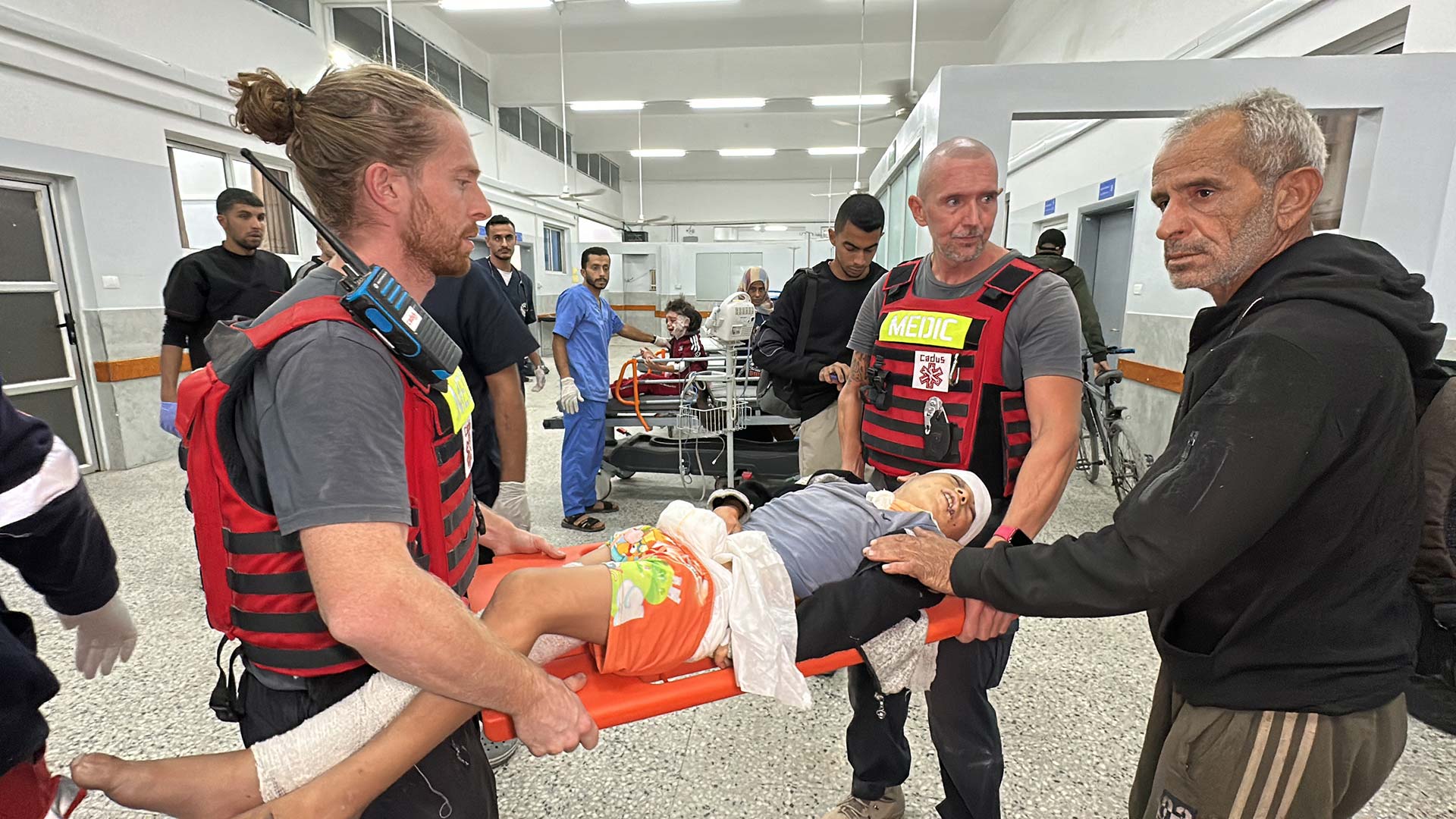 CADUS team members transfer a patient from Al-Shifa Hospital to southern Gaza for further transport for medical evacuation abroad
October 2024.
