

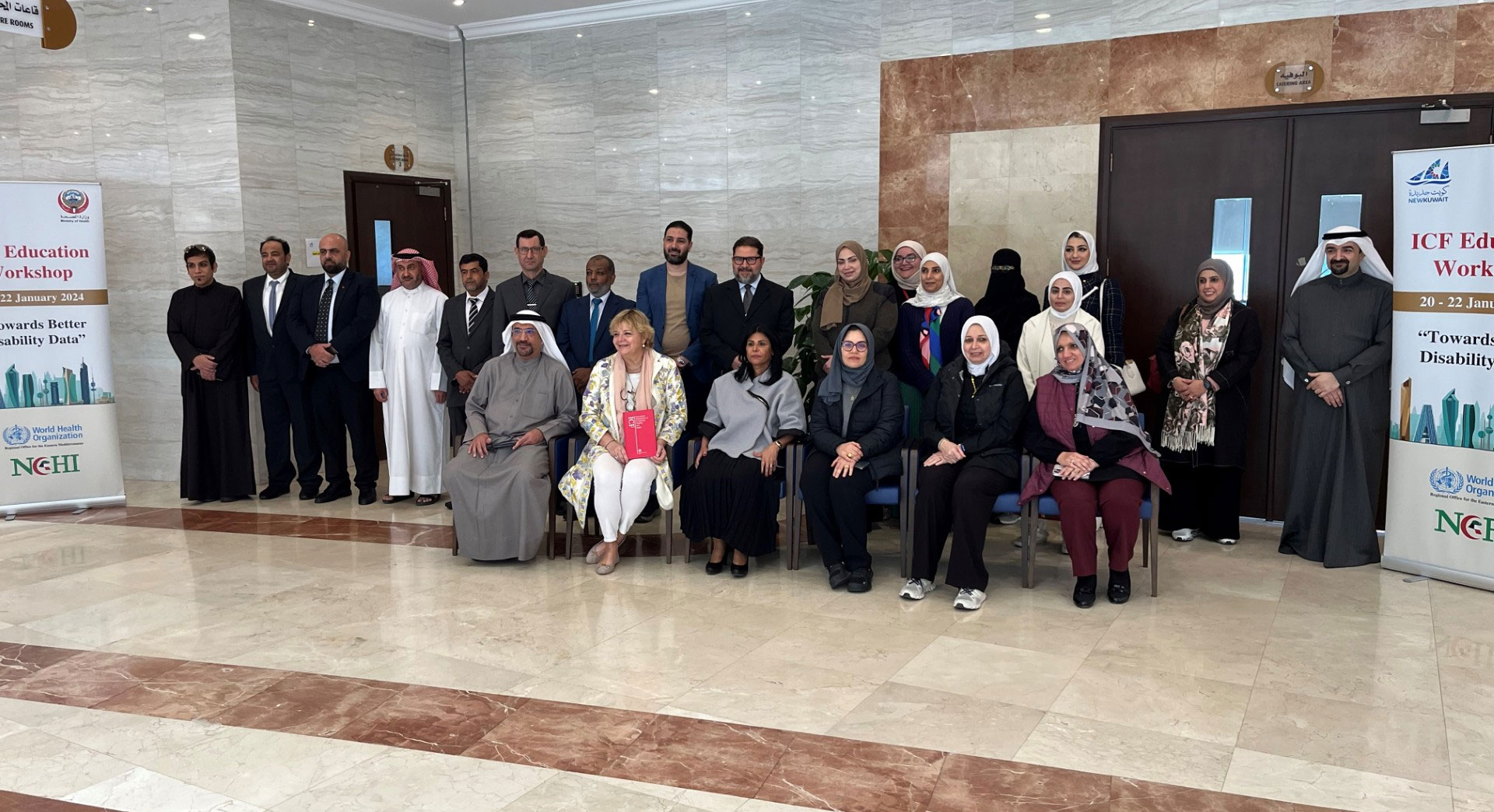
 Group photo from the Regional Capacity Building on WHO Standards of the International Classification of Functioning, Disability and Health (ICF) meeting, bringing together participants from across the region to strengthen expertise in disability data and ICF implementation. Photo credit: WHO
20 January: WHO and the Kuwait WHO Collaborating Centre for the Family of International Classifications (WHO-FIC), held a 3-day ICF capacity-building workshop on the foundations of the ICF, which covered the health, disability and environment model and WHO’s ICF assessment tools. The training was held in a hybrid format, with in-person participation from Jordan, Kuwait, Oman and Saudi Arabia and virtual participants from Egypt, Bahrain, and the Islamic Republic of Iran.
The workshop was inaugurated the WHO Representative in Kuwait, who highlighted the WHO-FIC’s role in supporting WHO’s programme of work, and the importance of the ICF in capturing functional disability levels due to chronic diseases, helping health promotion interventions. The training focused on basic definitions and history of the ICF, coding structures, mechanisms and conventions, the creation of the ICF report, goal-setting for rehabilitation and quality of care, monitoring and evaluation, and the WHO disability assessment schedule (WHODAS 2.0), addressed through discussion and practice sessions. The workshop concluded with the identification of key actions to develop methods to collect disability data through routine data sources.