


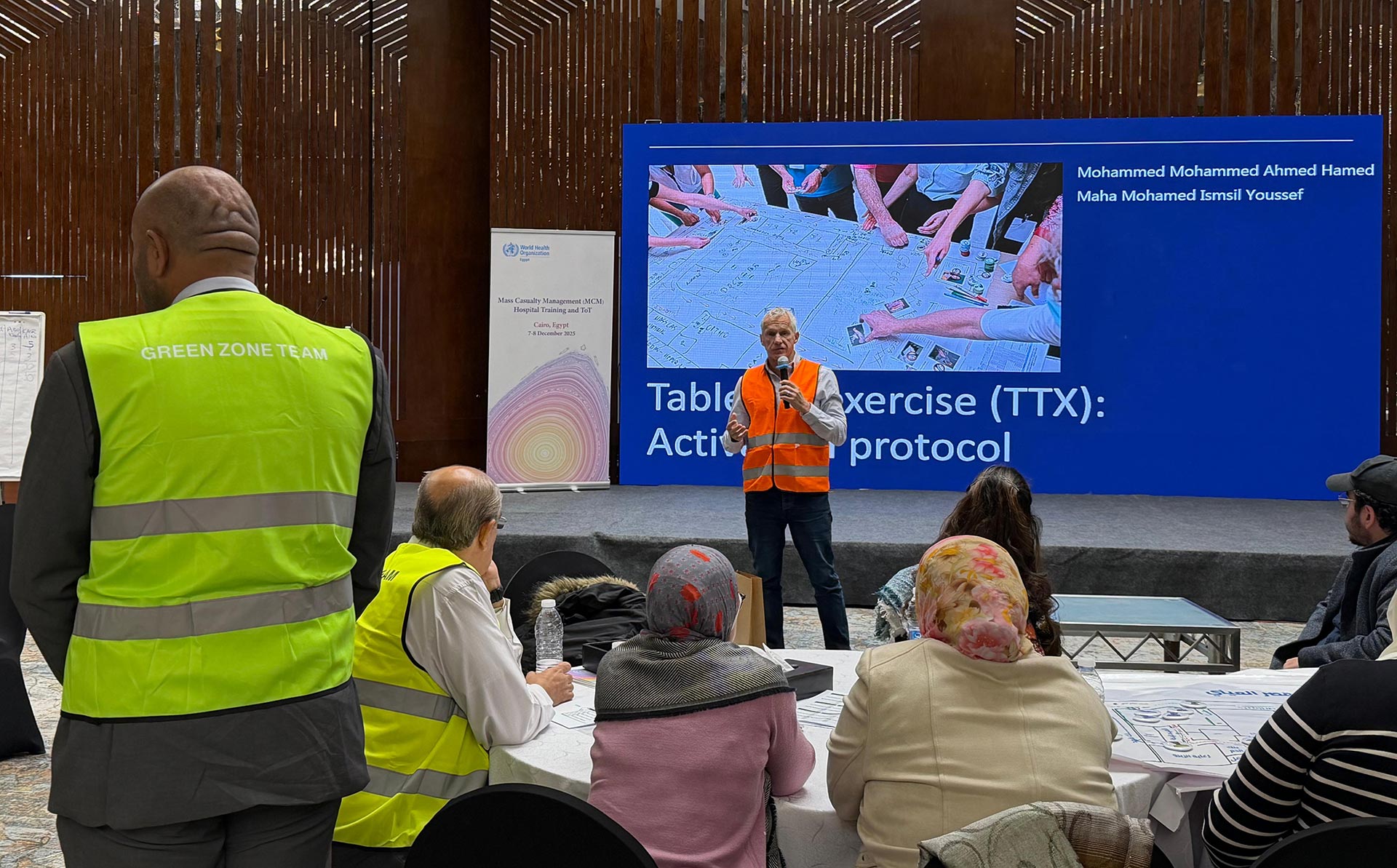
 WHO team delivering a presentation during the MCM training, Cairo/Egypt. Photo credit: WHO Academy10 December 2025, Cairo, Egypt – The World Health Organization (WHO), with funding from the Government of the United Kingdom, launched Egypt’s second national training-of-trainers (ToT) programme on mass casualty management (MCM) for hospital emergency units.
The initiative, involving WHO’s 3 levels – headquarters, the Regional Office for the Eastern Mediterranean and the Egypt Country Office – is part of WHO Egypt’s Health Emergencies Programme and aims to enhance emergency preparedness while strengthening the long-term resilience of the Egyptian health care system. The ToT certified 16 national instructors who were immediately deployed to train 60 health care professionals from 6 hospitals in Greater Cairo and Ismailia.
Mass casualty incidents (MCIs) cause a sudden surge of patients that can overwhelm hospital systems. The WHO MCM package equips emergency departments with the tools and skills needed to rapidly recognize, triage, resuscitate and route patients, helping to ensure that life-saving care is delivered efficiently and effectively, even in resource-limited settings.
The ToT programme aims to build a sustainable national pool of qualified instructors capable of scaling up MCM implementation across hospitals nationwide. The training brought together participants from the Ministry of Health and Population, Egypt Healthcare Authority, university hospitals and the Egyptian Health Council, reinforcing multisectoral collaboration.
“Our aim is to build a national cadre capable of managing mass-casualty incidents in a standardized and coordinated way. Since 2022, WHO Egypt has worked with the Ministry of Health and Population, Egypt Healthcare Authority and partners to roll out mass casualty management training. We remain committed to supporting national efforts to enhance emergency preparedness and strengthen the long-term resilience of Egypt’s health system,” said WHO Representative in Egypt Dr Nima Abid.
“The expansion of MCM training comes at a critical moment, as Egypt continues to receive large numbers of sick and injured individuals from crisis-affected neighbouring countries, including Gaza and Sudan,” he added.
The ToT follows a blended learning approach, combining digital modules delivered through the WHO Academy with in-person, hands-on sessions. The curriculum covers key principles of hospital-based planning and response, including the organization of triage and treatment zones, emergency responder roles, activation protocols and the use of action cards and checklists. Over the 2-day course, participants conducted tabletop exercises, refined their hospital MCM plans and presented analyses of real-world operational challenges.
Professor Lee Wallis, Senior Technical Officer for Emergency, Critical and Operative Care at WHO headquarters, emphasized the importance of standardized triage in mass-casualty settings: “The guiding principle in mass-casualty management is to do the most for the most. Triage is key in helping us do that. The Interagency Integrated Triage Tool provides a clear, objective framework for rapid and consistent patient sorting. Routine and mass-casualty triage share the same language, ensuring that the right patient reaches the right care at the right time.”
The programme highlighted the importance of building national training capacity to ensure long-term sustainability.
“The learning journey blends digital modules, tabletop exercises and onsite coaching. By investing in a local cadre of trainers, Egypt can sustain MCM competencies, tailor materials to local contexts, and expand the programme nationwide with ongoing support from the WHO Academy,” said Pierre Berendes, Consultant at the WHO Academy.
WHO Egypt, the Ministry of Health and Population and national partners will continue expanding MCM implementation to hospitals across the country. The newly certified instructors will support hospitals in establishing clear emergency plans, organizing treatment areas and strengthening the systems and logistics needed to sustain preparedness.
About the Mass Casualty Management Programme
The MCM Programme helps hospitals manage sudden surges of patients resulting from disasters, major accidents and public health emergencies. It provides structured guidance on triage, unidirectional patient flow, coordination roles and rapid activation protocols to strengthen hospital readiness and resilience.
