


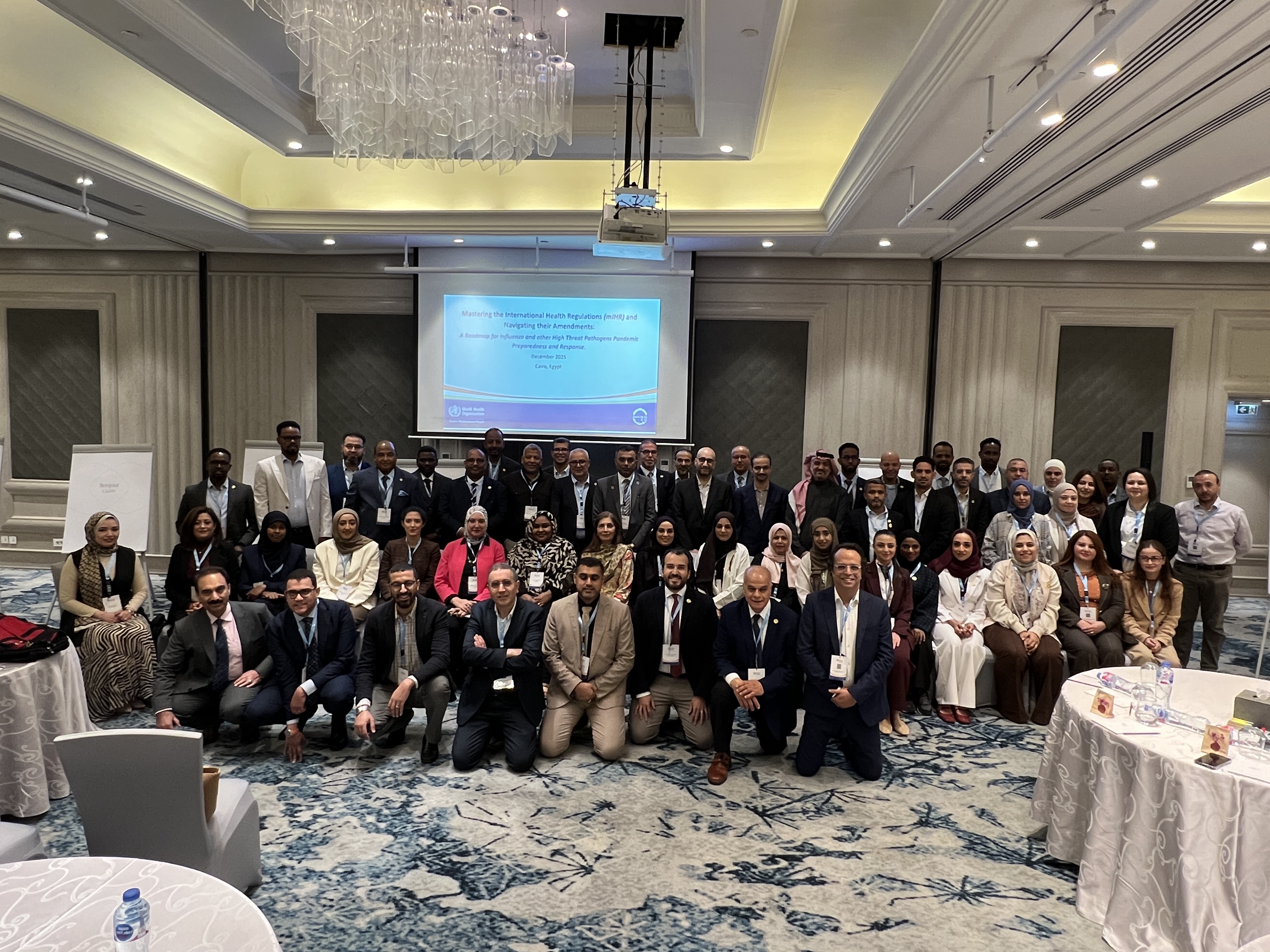
Cairo, Egypt, 30 November–4 December 2025, WHO’s Regional Office for the Eastern Mediterranean has conducted an intensive and highly interactive regional training course on mastering the International Health Regulations (IHR) and navigating their recent amendments.
The five-day training, which brought together national IHR focal points and technical counterparts from 17 countries across the WHO Eastern Mediterranean Region, was designed to go beyond a conventional learning approach to understanding the IHR (2005) and their newly-adopted amendments by providing a dynamic hands-on learning experience.
Making complex regulations accessible and actionable
Drawing on lessons learned during the COVID-19 pandemic, the World Health Assembly adopted a package of amendments to the IHR (2005) in June 2024, which entered into force on 19 September 2025. These amendments aim to strengthen preparedness, surveillance and response mechanisms and reinforce the central role of national focal points in coordinating timely action, particularly during public health emergencies of international concern.
Against this backdrop, the training was held to equip national focal points with a comprehensive legal and operational understanding of the IHR and their amendments, while building practical skills to enable them to apply these provisions in real-life contexts.
The value of learning by doing
A defining feature of the training was its innovative and highly participatory methodology. Throughout the five days of the training, each set of IHR articles was presented not as abstract legal texts, but as actual operational experiences. The participants were guided by facilitators using a carefully balanced approach that combined didactic instruction, practical group work and simulation exercises.
Ice-breaker exercises – often overlooked in technical workshops – were deliberately designed around the IHR articles and amendments. Through movement, role-play and cognitive association techniques, participants physically and mentally connected concepts to practical action. These lively sessions energized the room, fostered collaboration and reinforced learning in memorable ways.
“There was never a dull moment,” reflected several participants. “The combination of physical activity, discussion and real-life problem-solving made complex legal texts easier to remember, understand and apply.”
The diversity of participants enriched the discussions and peer learning. Group work and plenary sessions provided space for countries to exchange experiences, challenges and good practices in implementing the IHR across different contexts. Daily recap sessions ensured that key concepts were consolidated and directly linked to national realities.
By the end of the training, participants had strengthened their ability to interpret and operationalize the IHR and their amendments, gained hands-on experience through simulations and established linkages and understandings. Most importantly, they left with the conviction that a significant step had been taken towards ensuring that the countries of the Eastern Mediterranean Region are ready to implement the amended IHR confidently, collaboratively and effectively.
