


Select your language

IMCI pre-service education introduced in more medical schools, Sudan
12 March 2013 – Eight more medical schools were oriented to IMCI (integrated management of childhood illness) in Sudan in 2012, bringing to 29 the total number of medical schools in the country which have introduced IMCI.
IMCI pre-service education was formally introduced in Sudan in 2001—after a recommendation had been made the year before. A national task force on IMCI pre-service training was established to lead, coordinate, support and oversee activities in this area. The first two schools in the country to pioneer efforts to adopt IMCI in their teaching programmes were the universities of Khartoum and Gezira, both being leading medical teaching institutions in the country which graduate a large number of medical doctors every year.
Senior teaching staff from medical schools had closely collaborated with the Federal Ministry of Health in introducing IMCI in the country since its inception, establishing an excellent model of partnership which fostered support to both in-service and pre-service training initiatives.
IMCI pre-service education, including teaching and student competencies, was formally evaluated in Sudan at the University of Khartoum (2006), University of Gezira (2009) and International University of Africa (2012), in close collaboration with the WHO Regional office.
To date, 70 medical schools in eight countries in the Eastern Mediterranean Region have made efforts to introduce IMCI in their teaching programmes. The WHO Regional office has worked closely with many of these schools and has developed an IMCI pre-service education package to assist them in their teaching efforts. IMCI pre-service education is seen as playing a critical role in public child health, as it targets future cadres of doctors who will be working in the public and private sectors.
Related links
IMCI pre-service education package
Evaluation of IMCI pre-service education at the International University of Africa, Khartoum, 2012
Evaluation of IMCI pre-service education at the University of Gezira, 2009
IMCI implementation in Egypt reduces child deaths, study finds
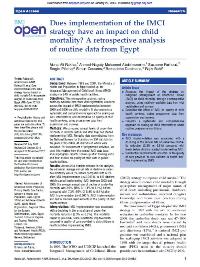 A retrospective analysis of national data from routine vital registration and surveys in Egypt, published in BMJ Open, finds plausible evidence that the implementation of the IMCI strategy (Integrated management of childhood illness) in the country doubled the rate of reduction of under-five mortality, from 3.3% before IMCI implementation to 6.3% after IMCI implementation. There was evidence that the quality of child health care services improved remarkably as a result of the introduction of IMCI in primary health care facilities.
IMCI was introduced in Egypt in 1997. The analysis suggests that the systematic step-wise approach of introducing and rapidly scaling up the strategy in districts ensured quality standards of care in implementation during expansion. Planning and implementation addressed not only enhancing health providers’ clinical and communication skills through high-quality training and follow-up but also strengthening health system supports, from planning at district level to health facility readiness, availability of medicines, monitoring and supervision. Improvements were sustained over time. High political commitment, strong management structure, WHO-coordinated support with partners and early involvement of the academia were key enabling factors.
This study is important. It confirms that IMCI is an effective strategy to improve child health, when implemented as a comprehensive strategy. The study is an evaluation of a national programme in a country with a large population scaled up under routine circumstances rather than a controlled research conducted in a limited number of areas. Also, the analysis has made use of data already available, especially from routine vital registration and programme follow-up properly documented, proposing a model which can be replicated also in other countries where such data are available.
IMCI is currently implemented in 93% of primary health care facilities in Egypt. Under-five mortality in the country dropped by 75% from 1990 to 2011, a level of decline much greater than the two thirds needed to achieve the target of the Millennium Development Goal 4 by 2015.
The WHO Regional office has been promoting IMCI as a primary child health care strategy and providing technical support to countries in the Region from planning to implementation and evaluation. IMCI is currently being implemented at health facility level in 14 countries in the Eastern Mediterranean Region and has been introduced in teaching programmes of more than 60 medical schools in 8 countries.
Related links
Progress towards MDG 4 in Egypt
Systematic approach to IMCI implementation in Egypt
Medical schools which have introduced IMCI into their teaching programmes
