


Select your language

Supervision
Supervision plays a key role in maintaining the quality of performance of health providers and the services they deliver. Supportive feedback is also highly valued by health providers and helps motivate them in their work.
Routine supervision is one of the weakest areas in many developing country settings as a result of lack of transportation means, fuel, financial resources, as well as inadequate training in supervisory skills, and approach to supervision and supervisors’ attitudes.
WHO child health-related programmes promote the concept of supervision as supportive supervision and an opportunity for strengthening services, including clinical management, to replace the deeply rooted idea of supervision as “inspection” or a purely administrative task.
The standard approach to follow-up visits after IMCI training has been used in all countries implementing IMCI in the Region to both reinforce health provider skills and improve health system support elements at the health facility. Findings of the visits are not only discussed with facility staff but also usually reported to district health officials for supportive action.
However, IMCI-trained health providers receive only few follow-up visits (one to two on average), within the first few weeks and/or months of training. Follow-up visits then leave the place to routine supervision, which should further improve or at least maintain the levels and standards of care achieved initially.
Information from reviews and data from IMCI health facility surveys suggest that much needs to be done to improve routine supervision. According to those findings, the frequency of supervision varies remarkably from place to place; only a small proportion of facilities visited receive clinical supervision and have the findings recorded in a supervisory book as a reference for the facility staff and future follow-up.
Developing checklists and training supervisors in their use is however only one of the issues. Supervision requires, as seen also for other health system elements, a more comprehensive approach.
Child health policy
Policies
Countries may have policies concerning specific aspects of child care, for example on exclusive breastfeeding promotion, immunization, control of diarrhoeal diseases and acute respiratory infections, malaria control, essential drugs, primary health care.
The term "policy" is often used to refer to ministerial statements and speeches, technical guidelines such as those contained in training materials, planning documents, decrees, directives and circulars, that influence public health activities in the health sector, at health facility and community level. The term may also be used simply to refer to established, prevailing practices in a specific domain.
However, most countries in the Region do not have written child health policies that provide a holistic view and unified approach to child health and development.
Such policies would complement and bring together in one document all the main elements and issues related to child care, including both illness and healthy growth and development.
Examples of factors limiting progress include competing health priorities, inadequate investments in health — including human resources, health services and community interventions to improve childcare in the home — and underutilized partnerships. In this environment, policies can provide clear long-term directions and commitments.
The development of a national child health policy, endorsed at the highest possible national level, would enable countries to "institutionalize" this commitment and translate it into stronger action.
The child health policy initiative
To respond to this need, the Regional Office has taken a leading role in assisting countries in developing national child health policies. It launched the Child Health Policy Initiative (CHPI) in October 2003. Five countries formally joined the initiative, namely Egypt, Morocco, Sudan, Syrian Arab Republic and Tunisia.
The initiative aims to assist interested countries in developing national child health policies, to establish a legal framework that gives clear long-term directions and support to improve the health status of children.
The policy document is recognized also as a requirement for long-term sustainability of interventions. It is expected to harmonize partners' actions and contributions, identifying priorities and laying out strategies and interventions to ensure equitable access to health care for everyone, including the most disadvantaged families.
The Child Health Policy Initiative proposes three main phases for the national child health policy development process:
- Phase 1: Situation analysis
- Phase 2: Policy document development
- Phase 3: Official adoption of the policy document
Since the foundations of a national child health policy should lie in an in-depth review of the current child care situation, the Regional Office has developed the document "Development of National Child Health Policy - Phase 1: The Situation Analysis", as part of the Child Health Policy Initiative.
The early experience of the five countries which joined the Child Health Policy Initiative in the Region has been taken into consideration during the preparation of this document.
The development of a national policy requires high-level political support within the health system to facilitate the process, including the management and coordination of all the required tasks.
The formal establishment of a task force at national level can help pursue this objective. The document developed by the Regional Office describes the terms of reference of the Task Force, its composition, including resource persons, and the possibility of setting up also a Steering Committee to advocate at the highest levels of the health system.
Community component
The community component of the Integrated Management of Childhood Illness (IMCI) strategy addresses family and community child care practices.
The family and the community where children live play a major role in child health and development.
There is a longstanding need to involve the family and community actively and plan and implement child care interventions in both the health system and the community in parallel.
The IMCI strategy was introduced in the Eastern Mediterranean Region in 1996. Initially, its main focus was on improving clinical care provided at health facilities to outpatient sick children.
Over the years, more attention has gradually been given to fully integrated child care, addressing health, growth and development of any young child, whether sick or healthy, whether taken to health facilities or cared for in the home.
The strategy has then broadened its scope in this Region and changed into the Integrated Management of Child Health, while still retaining its original acronym “IMCI”. More emphasis has also been placed on promoting good child care practices at home and in the community under the IMCI community component.
While many interventions and projects exist at community level which concern child health, there has been some delay in countries in integrating such interventions into a comprehensive primary child health care strategy that includes a well developed community approach effectively linked with the health system (i.e., the “IMCI community component”).
Furthermore, interventions often fail to reach those who need them most, including the Poor, who are among the most vulnerable people.
The Regional Office has first developed tools and supported activities to build capacity in planning for the IMCI community component in the Region.
Next, it has developed a training package on “Caring for sick children in the community” as part of a community health worker-based approach to child health care.
Child health policy
Countries may have policies concerning specific aspects of child care, for example on exclusive breastfeeding promotion, immunization, control of diarrhoeal diseases and acute respiratory infections, malaria control, essential medicines, primary health care. However, most countries in the Region do not have written child health policies that provide a holistic view and unified approach to child health and development. Such policies would complement and bring together in one document all the main elements and issues related to child care, including both illness and healthy growth and development.
Examples of factors limiting progress include competing health priorities, inadequate investments in health, including human resources, health services and community interventions to improve childcare in the home and underutilized partnerships. In this environment, policies can provide clear long-term directions and commitments.
The child health policy initiative
To respond to this need, the Regional Office launched the Child Health Policy Initiative in October 2003. Five countries formally joined the initiative: Egypt, Morocco, Sudan, Syrian Arab Republic and Tunisia.
The initiative aims to assist interested countries in developing national child health policies, to establish a legal framework that gives clear long-term directions and support to improve the health status of children.
The policy document is recognized also as a requirement for long-term sustainability of interventions. It is expected to harmonize partners' actions and contributions, identifying priorities and laying out strategies and interventions to ensure equitable access to health care for everyone, including the most disadvantaged families.
The Child Health Policy Initiative proposes three main phases for the national child health policy development process:
Phase I: Situation analysis
Phase II: Policy document development
Phase III: Official adoption of the policy document
Since the foundations of a national child health policy should lie in an in-depth review of the current child care situation, the Regional Office has developed the document "Development of National Child Health Policy - Phase 1: The Situation Analysis", as part of the Child Health Policy Initiative.
The development of a national policy requires high-level political support within the health system to facilitate the process, including the management and coordination of all the required tasks.
The formal establishment of a Task Force at national level can help pursue this objective. The document developed by the Regional Office describes the terms of reference of the Task Force, its composition, including resource persons, and the possibility of setting up also a Steering Committee to advocate at the highest levels of the health system.
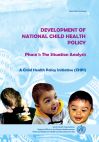
Development of National Child Health Policy - Phase I: The Situation Analysis | 2004 [pdf 1 Mb] | Arabic [pdf 471 Kb] | French [pdf 467 Kb[

Egypt child health situation analysis [pdf 500 kb]

Morocco Politique de santé de l’énfant au Maroc - Analyse de situation [pdf 877 kb]

