


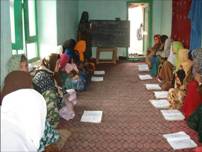
 The BDN programme empowers communities through literacy and vocational trainingThe basic development needs (BDN) programme aims to alleviate poverty and improve people's health outcomes. It was established in Afghanistan in 1996 as a community-based initiatives programme. It is based on the fundamental principle that health is central to the development process. The programme takes into account the interdependent needs of communities, both within and outside the health sector, such as primary health care, nutrition, reproductive health, basic education, provision of shelter, safe drinking-water and sanitation.
Village development committees
Trained community members constitute village development committees who identify and prioritize community needs and plan locally-based interventions. This reinforces ownership of interventions and ensures that projects respond to the real needs of communities.
Community organization and mobilization are key elements of the BDN programme. In most villages implementing the programme women’s organizations spearhead women's development activities at the community level.
Key interventions of the programme
WHO provides technical and operational support to local BDN teams and communities. Key interventions of the programme in Afghanistan include:
- establishing and upgrading health facilities
- training community health workers and volunteers on simple health-related interventions
- expanding Expanded Programme on Immunization (EPI) activities
- raising awareness on reproductive health and nutrition
- implementing community-based directly observed treatment for tuberculosis
- organizing literacy classes and women's vocational training
- establishing libraries and community-based information centres
- supporting agriculture and livestock projects, including tree plantation.
Micro-credit schemes
Provision of micro-credit schemes for income-generating projects target the poorest members of the community. The feasibility of proposals is assessed by a BDN team prior to approval. Loans are returned in installments. Micro-credit opportunities are linked to the needs of a population.
