

Sélectionnez votre langue
WHO conducts training of trainers workshop for rapid response teams in Somalia
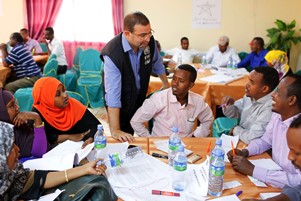 WHO epidemiologist Dr Amgad Elkholy facilitates group discussion during the training. Photo credit: Greta Isac8 November 2016 – From 30 October to 4 November 2016, WHO conducted a week-long training workshop in Hargeisa, Somalia, to enhance the capacity of Somalia’s rapid response teams for outbreak detection, response and containment in complex emergency situations.
The workshop, which was conducted upon request by Somalia’s Federal Ministry of Health, was intended to strengthen the capacity of Somalia's federal and regional teams to investigate and respond to events of public health importance. The training workshop was attended by more than 30 health professionals from various regions, including Bakool, Bari, Galmudug, Jubaland, Hiraan, Galguduud, Hir-Shabelle, Middle Shabelle, Woqooyi Galbeed, and the capital city Mogadishu.
Somalia has been experiencing recurring outbreaks of communicable diseases in the last few years, including cholera, polio, measles, dengue, chikungunya, meningitis, Rift Valley fever and others. Given the prolonged humanitarian crises in the country caused by conflict, internal displacement of populations, food insecurity, drought and floods, many parts of the country lack access to basic health services and existing health structures have been severely impacted. This has left a majority of the population vulnerable to communicable diseases.
WHO, in collaboration with health authorities and partners on the ground, has set up sentinel-based early warning systems for epidemic-prone communicable diseases, under which national and regional response teams are responsible for the investigation and conducting a rapid field response to outbreak alerts from the communities. These teams are composed of regional medical officers, regional surveillance officers, zonal coordinators and data managers.
A well-constituted and properly trained rapid response teams should be the cornerstone of the early warning system for disease surveillance and outbreak detection in dealing with public health emergencies
The scenario-based workshop was intended to provide skills and knowledge necessary to form multi-disciplinary rapid response teams who can investigate and responds to outbreaks as they occur anywhere in Somalia. As a training of trainers, this course also equips attendees to provide training to teams at lower levels.
The workshop was conducted by experts from WHO's Regional Office for the Eastern Mediterranean, based on knowledge acquired from training rapid response teams to handle the recent Ebola virus outbreak by capacity-building of teams at national and subnational levels to undertake rapid health risk assessments and timely outbreak investigation and response.
Global Outbreak Alert and Response Network (GOARN) scenario-based training on outbreak response
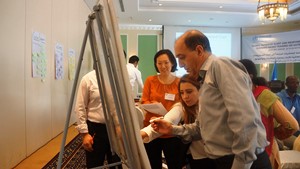 Photo credit: WHO/Banan Kharabsheh25–29 October 2016, Dead Sea, Jordan – The Global Outbreak Alert and Response Network (GOARN) is a global technical partnership, coordinated by WHO. For several years, GOARN has provided expertise and technical resources globally for field investigation of and response to public health emergencies.
During major disease outbreaks, GOARN ensures that the right technical expertise and skills are promptly deployed when national capacities are overwhelmed and an international response operation is needed.
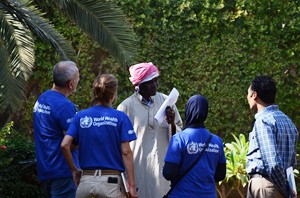 GOARN is a collaboration of existing institutions and networks, constantly alert and ready to respond. The network pools human and technical resources for rapid identification, confirmation and response to outbreaks of international importance.Photo credit: Peta-Anne ZimmermanThe GOARN outbreak response training brings together participants from GOARN partner institutions in Bangladesh, Egypt, France, Germany, Islamic Republic of Iran, Jordan, Kenya, Lebanon, Malaysia, Morocco, Pakistan, Portugal, Saudi Arabia, Senegal, Switzerland, Tunisia, United Arab Emirates and United Kingdom.
This 5-day scenario-based training aims to simulate the technical and operational challenges in field conditions, putting participants’ skills into practice, and ultimately resulting in technically proficient and experienced field teams ready for international deployment. The training is expected to contribute enhancing operational readiness of WHO and partners for international outbreak response in the Eastern Mediterranean Region.
Related link
A course on management and leadership skills in epidemics and pandemics
The pandemic and epidemic disease programme at WHO Regional Office for the Eastern Mediterranean is organizing a training course on management and leadership skills in epidemic and pandemic settings. The course jointly organized with Imperial College London through its WHO Collaborating Centre for Public Health Education and Training aims to strengthen management and leadership aspects of preparedness and response during disease epidemics and pandemic situations.
The course will be facilitated by faculty well experienced in theory and practice in disease outbreaks response. It will be held at the WHO Regional Office in Cairo, Egypt on 12–14 April 2016. Participants will be managers, directors and senior staff working at the ministries of health in the Region.
The course will be using case studies and best practices in addition to the latest knowledge of lessons learnt available in addressing management and leadership challenges in disease outbreaks. In addition, focus will be on principles and practices on decision-making, resource mobilization and planning, staff and stakeholder management and personal effectiveness as managers and leaders during epidemic and pandemic.
Related link
WHO Collaborating Centre for Public Health Education and Training
For more information
Increasing awareness of global antibiotic resistance
Be part of the first World Antibiotic Awareness Week from 16 to 22 November 2015 to increase awareness of antibiotic resistance and to encourage best practices among the general public, health workers and policy-makers to avoid the further emergence and spread of antibiotic resistance.
The World Health Organization is leading a global campaign under the theme "Antibiotics: Handle with Care" calling on individuals, governments, health and agriculture professionals to take action to address this urgent problem.
The theme of the campaign reflects the overarching message that antibiotics are a precious resource and should be preserved. They should be used to treat bacterial infections, only when prescribed by a certified health professional. Antibiotics should never be shared and the full course of treatment should be completed – not saved for the future.
Antibiotic resistance is one of the biggest threats to global health today. It is rising to dangerously high levels in all parts of the world. It is compromising our ability to treat infectious diseases and putting people everywhere at risk.
Related link