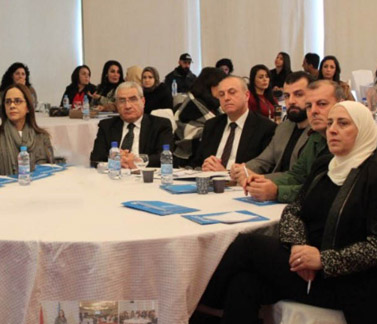
Responding to the willingness of the
Syrian Ministry of Health to establish a
centre for disease control in Syria, and
due to WHO commitments to assist in
building capacities of the center core
team in the field of epidemiology, 10
days workshop on “advanced epidemiology
course” was conducted in Damascus during
the period 22/2to2/3/2011.
Responding
to
the
willingness
of
the
Syrian
Ministry
of
Health
to
establish
a
Centre
For
Disease
Control
in
Syria,
and
in
line
with
WHO
commitments
to
Build
the
capacities
of
the
human
resources
in
the
field
of
epidemiology
,WHO
conducted
a 21
day
workshop
on
“Applied
epidemiology”
in
Aleppo
between
23/11/2010
till
16/12/2010.
Full text
Potentiality
of
local
vaccine
production
Following
the
request
of
the
Ministry
of
Health,
WHO
conducted
a
mission
to
seek
the
potentiality
and
feasibility
to
produce
vaccines
in
Syria.
Full
text
Country
consultations for global
HIV/AIDS strategy
Damascus, Syrian Arab Republic
16 September 2010
The
63rd Session of the
World Health Assembly adopted
the resolution WHA63.19,
sponsored by Brazil, which
requests the WHO
Director-General to develop a
global WHO HIV/AIDS Strategy for
2011-2015, through a broad
consultative process. A
darft Strategy was developed by
WHO in partnership with a broad
range of constituencies, the
draft Strategy
Full text
EMRO
Missions
for
Developing
a
Certificate
of
Needs
25-27
July
2010
Developing a certificate of
needs was recognized as a
priority for developing the
Syrian health system. It aims
at improving the evidence based
decision making and evidence
based planning. Mrs. Hanem
Ibrahim, HIT/ISM, from the
regional office conducted a
visit to Syria between
25-27/07/2010 to perform
Full text
Minister of Health of the Syrian
Arab Republic countersigns the
joint programme review and
planning mission document
On
16 February 2010, H.E. Dr Rida
Saeed, the Minister of Health of
the Syrian Arab Republic,
countersigned four copies of the
approved report of the joint
Government/WHO programme review
and planning mission for the
biennium 2010–2011, as well as
the detailed programme budget
and the workplans for all
national programmes. The report
and detailed workplans have been
reviewed by the WHO Regional
Office and were approved by Dr
Hussein A. Gezairy, WHO Regional
Director for the Eastern
Mediterranean, on the 3
February 2010.
The occasion was attended by Dr
Ibrahim Betelmal (WHO
Representative), Dr Hassan Haj
Hussein (Director of
International Relations,
Ministry of Health (MoH)), Dr
Talal Bakfaloni (Director of
Planning and International
Cooperation, MoH), Mr Yassin
Shukr (Technical Officer, WHO)
and Dr Nazar Elfaki (Medical
Officer, WHO).
The joint programme review and
planning mission exercise is a
consultative process between WHO
and the Member State. It aims at
ensuring that the collaborative
programmes are in line with
national health policy and will
strengthen the national capacity
for achieving health goals and
aspirations. The joint programme
review and planning mission
document reflects the country
health needs in line with
agreed-upon programme
priorities. It expresses a
mutual agreement between WHO and
the Government on the priority
areas of cooperation and the
expected results of
collaborative programmes. During
the mission, operational plans
for the various collaborative
programmes are developed listing
in detail the country-specific
expected results, the products
or services, and the activities
and activity components to be
delivered in the biennium.
H1N1
training workshop for health
professionals:
H.E. the Minister of Health, the
Regional Director, the Deputy
Minister of Higher Education,
WHO Representative and the
Project Coordinator of the
Health Sector Modernization
Project supported by the
European Union attended the
opening session of a training
workshop for health
professionals on 2009 H1N1
pandemic which was conducted in
Al Asad University Hospital in
Damascus (17-18/10/09).
The aim of the workshop was to
build the capacity of health
professionals working at
intensive care units in the
hospitals to manage cases of
Influenza A H1N1. The workshop
was organized by MOH in
collaboration with Ministry of
Higher Education, WHO, European
Union (Health Sector
Modernization Project) and Syria
American Medical Association.
The workshop was the fourth
among series of workshops
conducted in Aleppo, Lattakia
and Damascus.
In the opening remarks, the
Regional Director gave briefing
on the situation of H1N1
globally and in the Eastern
Mediterranean Region. He
stressed on the rumors and
misconceptions related to the
2009 H1N1 vaccines. He reassured
the safety of the vaccine and
its importance especially for
the high risk groups and the
health workers dealing with
cases of 2009 H1N1.
H.E. the Minister of Health
thanked WHO for the technical
support provided during the 2009
H1N1 pandemic. He also gave a
short briefing on the situation
of 2009 H1N1 pandemic in Syrian
Arab Republic and MOH measures
for reducing the impact of the
pandemic. It is worth mentioning
that these series of workshops
were facilitated by WHO one
international and three national
consultants and the training
included technical presentations
as well as practical sessions
through case studies.
To view the program and the
technical presentations please
lick on this link:
http://mecriticalcare.net/lectures.php?cat_id=19
WHO is coordinating the global
response to human cases of influenza A (H1N1) and monitoring the
corresponding threat of an influenza
pandemic. Information on this page
tracks the evolving situation and
provides access to both technical
guidelines and information useful
for the general public.