|
News |
| |
|
January 2010
Training on the Global Management System (GSM) begins in WHO Somalia as
new system rolls out in the Eastern Mediterranean Region.
WHO Somalia staff are currently undertaking a one-week GSM roll-out
training workshop in Nairobi. GSM is a new management system that brings
together separate work flows, procedures, plans and systems into one
common system across the Organization Several pre-existing systems, in
the areas of programme planning, human resources, finance, travel, and
procurement will be combined into one and health programme information
will be available in a more integrated way. All country offices, regions
and HQ will have real-time access to the same data, which is essential
in implementing health programmes.
 |
|
©WHO/Somalia |
Transparency and accessibility of
global data in one common place will enable better
resource management and decision-making for the
organization. A second group of staff members will
receive a similar training from 18 to 21 January
2010. |
|
|
December 4
WHO's statement on the
Mogadishu bombing on 3 December 2009
|
|
Visit of the Assistant Director-General for
Health Action in Crisis, to Somalia
November 22
 |
|
©WHO/Somalia/Nasir Hirsi |
Dr
Eric Laroche, WHO’s Assistant
Director-General for Health Action in Crisis and Dr Marthe Everard,
WHO Representative for Somalia visited Hargeisa, Somaliland on 22
November 2009.
On meeting a number of government
officials, the mission visited Hargeisa Group Hospital – Mental
Health Ward and spoke to patients, and health workers participating
in an ongoing mental health training course. Dr Laroche and Dr
Everard were able to see the current challenges of the hospital in
meeting the needs of people with mental health disorders in
Somaliland.
In late 2009, WHO and partners will be assessing the situation to
understand the full burden and the status of health services for
people with mental health disorders.
More
|
|
Renewing of health care services for
conflict-affected communities in Somalia
November 11-15
WHO Somalia is responding to the current conflict in South
Central Somalia including Lower and Middle Juba regions. From 11-15
November 2009, in collaboration with WFP and World vision, WHO set
up a field hospital in Bu'aale and conducted on-the-job training on
emergency surgery, basic emergency obstetric care (EmOC) and trauma
management.
 |
|
©WHO/Somalia |
To extend surgical services to conflict-affected
communities in the region, the capacity of Bu'aale mother and child
health centre (MCH) was extended with tents, equipment and essential
medical supplies to act as a field hospital providing an additional
12 beds, operating theatre, and hospital pharmacy.
Read full report
|
|
Pandemic Influenza A (H1N1) 2009 confirmed in
Somalia
November
Pandemic Influenza A (H1N1) 2009 has been confirmed in Somalia
for the first time. Two out of 10 samples tested positive for novel
H1N1 (pandemic strain) on 3 November 2009 in KEMRI referral
laboratory in Nairobi, Kenya. Somalia is the last country in the
Eastern Mediterranean Region (EMRO) to report confirmed cases of
H1N1.
The neighbouring countries Kenya and Ethiopia, which both are part
of WHO’s African Region (AFRO) have already confirmed cases of H1N1,
including from within refugee camps close to the Somali border.
Read press release
WHO updates
|
|
Improving the quality of medicines in Somalia
October
The World Health Organization
Somalia has signed a memorandum of understanding with National
Quality Control Laboratory (NQCL), Kenya. The agreement signed on
October 30 2009 with NQCL, represented by the NQCL Director, Dr.
Hezekia Chepkwony and WHO Somalia Representative, Dr Marthe Everard
seals WHO’s commitment to promoting quality consciousness of
medicines in Somalia.
 |
|
©WHO/Somalia |
The collaboration between the two organizations will assist in
strengthening the capacity of health authorities and pharmaceutical
professional associations to monitor the quality of medicines of
public health importance available in the market in Somalia. This
will be done through training of pharmaceutical health staff in both
the public and private sector including commercial importers of
medicines, in the use of Minilabs for qualitative analysis of
medicines. In cooperation with WHO Somalia, NQCL-Kenya will carry
out a comprehensive study on the extent of occurrence of counterfeit
medicines in Somalia. Other joint activities include the testing and
analysis of suspected drug samples at the laboratory and supervisory
activity.
|
|
WHO and partners support an initiative to
strengthen malaria control at community level
September
First launched in Somalia in 1988, Community-Based Initiatives
programme is a tool for bringing primary health care closer to the
community through community empowerment and inter-sectoral
collaboration. The CBI can be used to addressed a range of health
issues in a community and can be applied depending on the health
issues affected.
Considering the need to enhance community ownership in health
programmes, WHO, through its Community-Based Initiative and Roll
Back Malaria programmes in Somalia provided 3-day training on
community involvement in preventing malaria transmission through the
use of long-lasting insecticides treated nets (LLITNs) in 15 of the
BDN villages in Lower Shabelle region. The training is a part of a
wider initiative to improve coverage and use of LLITNs. Participants
will go on to advocate within their communities, providing health
education on how to prevent malaria, as well as help to implement
LLITNs distribution.
27 health volunteers from 15 BDN villages attended the training to
understand more on prevention and treatment of malaria, and conduct
household survey to register the eligible families. ON the basis of
the training. Later on second phase of the project about 11.000
LLITNs will be distributed by village representatives and health
volunteers.
This intervention will target a total population of over 33000
people comprising of about 5500 households who will receive 2 nets
per family.
This project is supported by the Patient Helping Fund/Kuwait and
Funded by Mabarah Assayer Society.
 |
|
©WHO/Somalia |
|
|
Somalia - Struggling to reach the sick
September 2009
 |
|
©WHO/Somalia/Dr Omar Saleh |
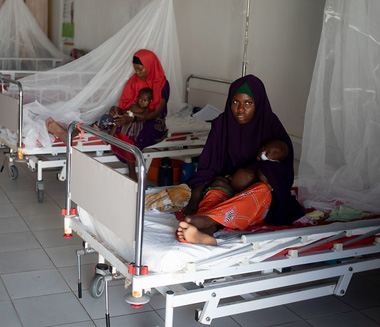
Somalia's humanitarian crisis has sunk to its lowest
point in two decades, with escalated hostilities since
May around the capital, Mogadishu, putting the lives of
millions, including women and children, at risk and
jeopardizing recent health gains.
Almost 3.6 million people nationwide need emergency
assistance, among them 1.5 million Somalis displaced by
violence and hampered by a fifth-consecutive season of
drought. In recent months, 500 000 of these displaced
have been uprooted yet again by violence around
Mogadishu, heaping further humanitarian hardship onto
these war-weary people.
Low funding of humanitarian efforts is another major
concern. Emergency health interventions such as mobile
clinics for displaced people's settlements and the early
warning and surveillance of key infectious and
communicable diseases are at great risk due to this lack
of funding.
This
photo essay highlights the humanitarian health
challenges facing Somalis in this chronically troubled
part of the world and the efforts by health providers to
try meet their needs.
|
|
|
Outbreak Response and Surveillance |
|
|
|
January 2010
Health workers in South Central Somalia trained in
disease surveillance and response
WHO and Merlin trained 57 NGO health workers from more than
38 health facilities in Bay, Bakool, Lower and Middle Jubba
regions on the early detection of epidemic-prone diseases,
case definition, reporting and case management.
 |
|
©WHO/Somalia |
The training is the first step in rolling out the Integrated
Disease Surveillance Response (IDSR) System in South Central
Somalia. It will be repeated in other regions in the coming
weeks. The system is currently fully functioning in Lower
Shabelle.
Read more |
|
 |
Publications |
|
|

Somalia 2008 Report
|
|
Technical Publications |

Somalia Standard
Treatment Guidelines and Training Manual
English
|
Storage
of Essential Medicines and other Health Commodities
Somali |
|

Reproductive Health
National Strategy & Action Plan
2010-2015
|
The Interagency Emergency Health Kit 2006 |
|
|
IN FOCUS |
WHO Somalia featured in UN
Special
WHO’s current humanitarian activities are featured in this
month’s UN Special. Please see
full article
|
|
Floods in Somalia
See latest update on flooding in Somalia
©WHO/Somalia
|
|
|
Somalia 2010 Consolidated Appeals Process
On 3 December, the 2010 Consolidated Appeals Process
for Somalia was launched. In 2010, health cluster
partners urgently require $46 million to respond to the
pressing humanitarian crisis in the country. Of this
amount, WHO requires $16 million for 7 projects (jointly
with UNICEF, UNFPA, Merlin and Save the Children UK)
which will extend emergency health services including
primary health care and emergency obstetric care,
conduct outbreak response and strengthen coordination of
the health response. In 2010, health cluster partners,
under the leadership of WHO, will be working to meet the
considerable health needs of the 3.64 million people
currently of umanitarian concern. This number accounts
for nearly ½ of the total population, representing one
of the world’s worst humanitarian crises.
Important information for health cluster partners on CAP
process
|
|
Key
donors for Emergency Preparedness and Humanitarian Action
|
|
|
WHO's role in Safe and Secure
Approach to Field Environment (SSAFE) training for Somalia
|
|
|
Events |
| |
|
1
December 2009
World
AIDS Day is being celebrated this year under the theme of “Universal
Access and Human Rights,” with affirmative slogans based on the theme, “I
am”: I am accepted, I am getting treatment, I am safe.
This year’s theme and slogans promote HIV and AIDS awareness through
translating human rights ideals into understandable, practical and
proactive terms.
Regional Director's
Message
|
|
|
Improving
the lives of people with mental health disorders in Somalia
Integrating mental health into primary health care in Somalia
10
October 2009
 |
|
© WHO/Somalia |
Conflict, amongst other contributing factors, continues to affect
the mental health of the Somali population particularly in the
worst-affected regions of South Central Somalia. Currently there is only
one major functioning mental health facility in South Central Somalia
that is the Habeb Public Mental Hospital with two branches which include
the Habeb Rehabilitation Treatment Centre and Jalalaqsi Mental Hospital.
The total bed capacity at the hospital is 232 beds. These mental health
facilities are treating people with both acute and chronic psychiatric
illness.
WHO Somalia together with partners is providing continuous support to
improve medical treatment, and capacity-building of health personnel for
mental health service delivery.
Read more
|
|
|
Health
facilities in emergencies
Save
lives. Make hospitals safe in emergencies
WORLD HEALTH DAY. 7 APRIL 2009
|
|
|
Somali youth come out in numbers to demonstrate a
collective resolve to fight against TB
24 March 2009
Million Youth March to Stop TB takes place in Somalia to
commemorate World TB Day
The national TB programme in close collaboration with
WHO Somalia, health authorities and partners spearheaded
an innovative event dubbed “I am stopping- TB Million
Youth March” on 11 March prior to commemorations of the
World TB Day.
More than 18 000 youth from Somalia took to the streets
to extend their united support to those suffering from
TB.
 |
|
©
WHO/Somalia |
Approximately
40 000 people are suffering from TB in the country. To
tackle the TB burden the national programmes will expand
TB centres in all regions.
|
|
|