WHO | Regional Office for the Eastern Mediterranean

  • Increase font size
  • Default font size
  • Decrease font size
Arabic (عربي) French (Fr)
Home Malaria control and elimination | About the programme


About the malaria control and elimination programme

Print PDF

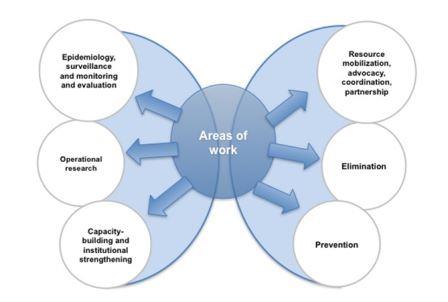
The malaria control and elimination programme provides technical support to countries of the Eastern Mediterranean Region for the control, elimination and prevention of reintroduction of malaria. The programmes works in the areas of diagnosis; treatment; prevention; epidemiology surveillance, monitoring and evaluation; capacity-building and institutional strengthening; resource mobilization, advocacy, coordination and partnership; operational research; and elimination.
Diagnosis

  • Promoting and facilitating the development of national policies and strategies and supporting assessment of the quality assurance of malaria confirmation to ensure that all suspected malaria cases are parasitologically confirmed by reliable and quality assured diagnostic tools (rapid diagnostic tests or microscopy) before receiving antimalarial medicines. 

Treatment

  • Supporting the development and adoption of national treatment policies and guidelines based on evidence.
  • Promoting and facilitating procurement and delivery of effective antimalarial medicines of good quality to all malaria patients, at all levels, including both public and private health facilities.
  • Supporting countries to develop and implement policies for containment of antimalarial resistance, and monitoring the efficacy, safety and quality of antimalarial medicines and encouraging networking among countries of the Region and neighbouring countries from other regions for information-sharing. 

Prevention

  • Supporting the development of national policies and strategies to ensure universal coverage by effective prevention measures for all the population in areas at risk of malaria within the framework of integrated vector management for vector-borne diseases.
  • Supporting the establishment of a functional entomological surveillance system, including insecticide resistance monitoring and management. 

Epidemiology, surveillance and monitoring and evaluation

  • Collecting malaria data and information from all countries and maintaining an updated electronic georeferenced regional malaria database for reporting and information-sharing at all levels of the organization with countries and other partners.
  • Providing technical support to countries to establish and implement effective malaria surveillance and monitoring and surveillance systems to measure the malaria burden and coverage of key interventions.
  • Supporting countries in the development of systems for early warning and forecasting of malaria epidemics, in collaboration with relevant agencies and departments, such as departments of meteorology and hydrology. 

Capacity-building and institutional strengthening

  • Strengthening the capacity of malaria programme managers for planning and management and monitoring and evaluation of malaria control programmes.
  • Supporting regional and national training centres/institutes in partnership with all relevant agencies as part of the health system strengthening strategy. 

Resource mobilization, advocacy, coordination, partnership

  • Supporting the development of proposals by countries to the Global Fund and other partners; cross-border coordination; and national advocacy events, seminars and conferences, in coordination with the Roll Back Malaria programme, nongovernmental organizations and other partners. 

Operational research

  • Identifying priority areas for operational research, supporting the conduct of operational research in different aspects of malaria and using results for planning and managing malaria programmes. 

Elimination

  • Supporting initiatives for the expansion of malaria-free areas.
  • Conducting feasibility assessment and providing technical support for strategy development to achieve malaria elimination at national or subnational level.
  • Implementing measures to review and validate interruption of local malaria transmission and certifying malaria elimination.
  • Supporting the development of national strategies for prevention of reintroduction of malaria in malaria-free countries.